Get Full Government Meeting Transcripts, Videos, & Alerts Forever!
Get email alerts on the Restorative Justice Implementation topic
No spam. Unsubscribe anytime.
Restorative justice credited with lowering suspensions at some Montgomery County schools; officials caution it’s one tool among many
Summary
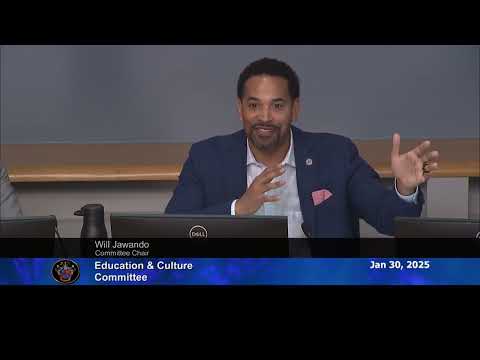
Shauna Kaye Jornby, director of student engagement and behavioral health for Montgomery County Public Schools, briefed the Education and Culture Committee on Jan. 30 about district progress implementing restorative justice (RJ) practices since the committee’s November update.
Shauna Kaye Jornby, director of student engagement and behavioral health for Montgomery County Public Schools, briefed the Education and Culture Committee on Jan. 30 about district progress implementing restorative justice (RJ) practices since the committee’s November update.
Why it matters: MCPS officials said RJ strategies — circles, reintegration practices and school‑led dialogues — have helped some schools reduce suspensions, return students to class more quickly and lower recidivism, but that RJ alone has not closed discipline disproportionality across racial and special‑education groups.
Principal April Longest of Farmland Elementary described a proactive approach at her school of more than 860 students. "Creating a strong sense of belonging and inclusion is at the heart of everything we do at Farmland," Longest said, summarizing a series of three town‑hall lessons for grades 3–5 that addressed identity, hateful and harmful words, and the application of the code of conduct with restorative practice. Longest said staff surveyed students, shared findings with parents and used scenario‑based classroom follow‑ups to teach problem solving and the speak‑up strategy.
Principal Craig Staten of Julius West Middle School told the committee his school used a restorative‑justice coordinator and expanded staff capacity to hold circles and reentry conversations after separations. Staten said the school’s suspensions peaked after the pandemic, at more than 100 in 2021, but that the number had dropped to 15 "today" for serious incidents such as fights. Staten said many incidents were resolved through dialogue and that the school saw lower recidivism among students who participated in restorative circles.
District‑level findings: MCPS staff presented systemwide RJ monitoring results and an internal evaluation framework that classifies schools as unreported, early, intermediate, mature or reactive. Staff said evaluations show movement toward more schools reaching the intermediate or mature levels but noted ongoing variability: coaches and specialists vary in experience, some schools struggle to engage parents, and a subset of schools remains reactive and requires formal action plans.
Data points shared by MCPS staff included an unduplicated suspension rate of roughly 1.4 (percent) across the district and evidence that schools with restorative specialists have shown reductions in suspensions for subjective categories such as disrespect and disruption. Staff cautioned that because RJ practices reduce suspensions across all student groups, disproportionality ratios between groups can remain similar even when absolute suspension numbers fall.
Challenges and next steps: MCPS presenters said coaches reported strong skills in community circles and relationship building, but less experience in high‑intensity formal restorative circles and reintegration practices. Officials emphasized reintegration planning for students who have been separated from school and said federal Secret Service research points to elevated risk in the days after separation, which underscores the safety imperative for reentry supports.
Legislative monitoring: MCPS staff flagged two state bills — House Bill 0192 (state designation of restorative‑practice schools) and House Bill 0488 (state reporting of restorative approaches) — that could take effect July 1, 2025. Staff said they are evaluating district data systems and staffing to meet possible new state reporting or designation requirements.
Community reaction: Community advocates, including Wylia Chase of the Black and Brown Coalition for Educational Equity and Excellence, urged stronger budgetary investment in restorative practices and asked the council to ensure resources reach students most affected by bias and discipline disparities. Chase emphasized that many community volunteers and advisory‑group members are unpaid and want the district to act on recommendations they helped develop.
The committee asked MCPS to return with more detailed school‑level data (rates rather than raw counts), standardized measures of training attendance and outcomes, and a clear account of how RJ specialists and coaches will be funded and sustained.