Get Full Government Meeting Transcripts, Videos, & Alerts Forever!
Get email alerts on the Education topic
No spam. Unsubscribe anytime.
Alaskans urge Legislature to raise and inflation‑proof Base Student Allocation, warn of school closures
Summary
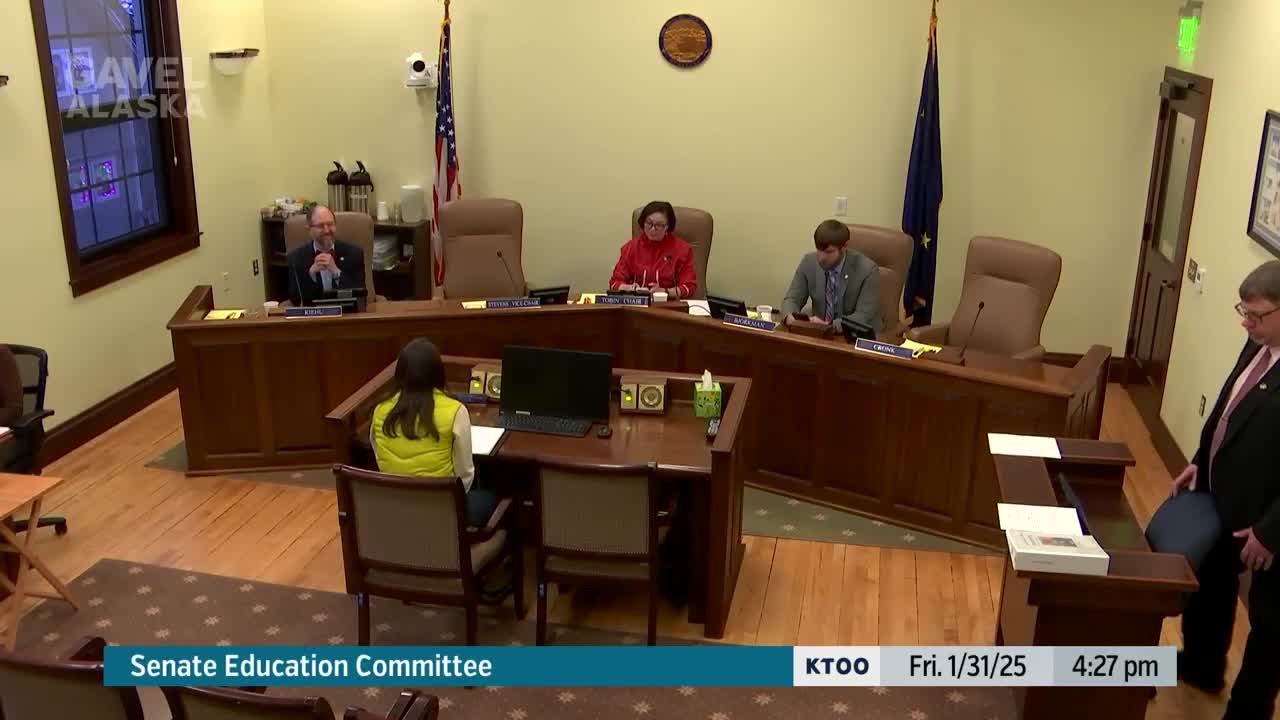
At a Jan. 31 Senate Education Committee hearing in Juneau, parents, teachers, students and school leaders from across Alaska testified in support of House Bill 69 to raise the Base Student Allocation (BSA), make it inflation‑proof and override any governor veto, citing teacher layoffs, program cuts and school closures.
Dozens of parents, educators and students told the Senate Education Committee on Jan. 31 in Juneau that Alaska must increase and inflation‑proof the Base Student Allocation so districts can avoid layoffs, program cuts and school closures.
Senator Lukey Gale Tobin, presiding officer of the Senate Education Committee, opened the public testimony portion and limited remarks to two minutes per speaker because of time constraints and weather‑related travel concerns.
The supporters sought passage of House Bill 69, which backers say would restore the BSA’s purchasing power to 2011 levels and protect funding from erosion by inflation. Lisa Egan Lagerquist, a former teacher and parent of two from Douglas, said, “I have been testifying since my 11th grader was in kindergarten. That's over 11 years. I'm tired. I'm exhausted.” She urged the Legislature to “permanently increase the BSA, make the BSA inflation proof, and commit to overriding a governor veto.”
Speakers gave local examples of the stakes. Anna Rose MacArthur, a parent from Nome, said, “The Nome Public School District will have to cut 10 teachers and 1 assistant principal,” and added that cuts would also remove travel funds and money for teacher housing. Testimony from Fairbanks described multiple school closures and deep district deficits: Tamara Cruz Rosales said Fairbanks had closed four schools and had five more “on the block,” and Jacqueline Muhlbauer said closing those schools still would leave a multi‑million‑dollar shortfall.
Several witnesses pointed to disparities in state assessment participation when discussing accountability for different school models. Nikki Eisman, a retired Fairbanks educator, cited statewide assessment participation rates from 2023–24: roughly 15% participation for correspondence students versus roughly 94% for brick‑and‑mortar students, and said that low participation makes it difficult to evaluate the effectiveness of correspondence programs.
Caroline Storm, executive director of the Coalition for Education Equity, and other witnesses framed the issue as a question of priorities. Storm noted that corrections spending has grown substantially over recent years and contrasted per‑pupil spending in prisons with public education funding. Several parents and school leaders described programs lost to cuts — band, orchestra, art, extracurricular athletics, smaller class sizes and counseling — and urged lawmakers to prioritize classroom funding.
Homer Middle School principal Megan Redmond said her school’s participation rate on the spring assessment was 97.53% and contrasted that with multiple homeschool/correspondence programs reporting single‑digit or low‑teens participation rates. She said that the statewide 95% required participation threshold makes comparison across program types difficult when participation differs so widely.
Speakers urged the Legislature not to tie one‑time funding to conditions that would favor certain school models over neighborhood schools. Sarah Lewis of Fairbanks said the governor’s proposals that prioritize “schools of choice” risk reducing options for families who want local neighborhood schools, and several speakers asked the Legislature to override any veto of a permanent BSA increase.
The committee heard repeated local budget figures and shortfalls: a $6,000,000 deficit cited for one district, an asserted $15,000,000 remaining deficit even after multiple school closures in another, and a Legislative Finance Office recommendation (as referenced by testimony) that the BSA increase needed to match inflation would be about $1,808 per student. Witnesses also described staffing shortfalls — for example, one parent said a night school program had one teacher for more than 40 students; another parent said West High had seven counselors for a very large student population — and urged higher pay to attract and keep paras, teachers and counselors.
Committee members closed public testimony after speakers representing communities from Anchorage, Fairbanks, Nome, Juneau, Homer, Ketchikan, Sitka and the Mat‑Su Borough had spoken. Senator Tobin announced that the committee will meet again Monday to hear invited and public testimony, to hear from the Alaska Council of School Administrators and the Association of Alaska School Boards, and to hold the first hearing on Senate Bill 41, which would ask the State Board of Education to develop guidelines for instruction in mental health.
No formal committee votes were recorded during this session; the meeting consisted of public testimony and an announcement of the committee's upcoming schedule.