Get Full Government Meeting Transcripts, Videos, & Alerts Forever!
Get email alerts on the Reserves Cashflow topic
No spam. Unsubscribe anytime.
Finance committee hears how Alaska uses ERA and CBRF to manage cash‑flow risks; general fund floor set at $400 million
Summary
Treasury officials described daily cash forecasting, a memorandum of understanding to coordinate temporary borrowing and the state's approach to using the Earnings Reserve Account and Constitutional Budget Reserve Fund to address timing mismatches and revenue shortfalls.
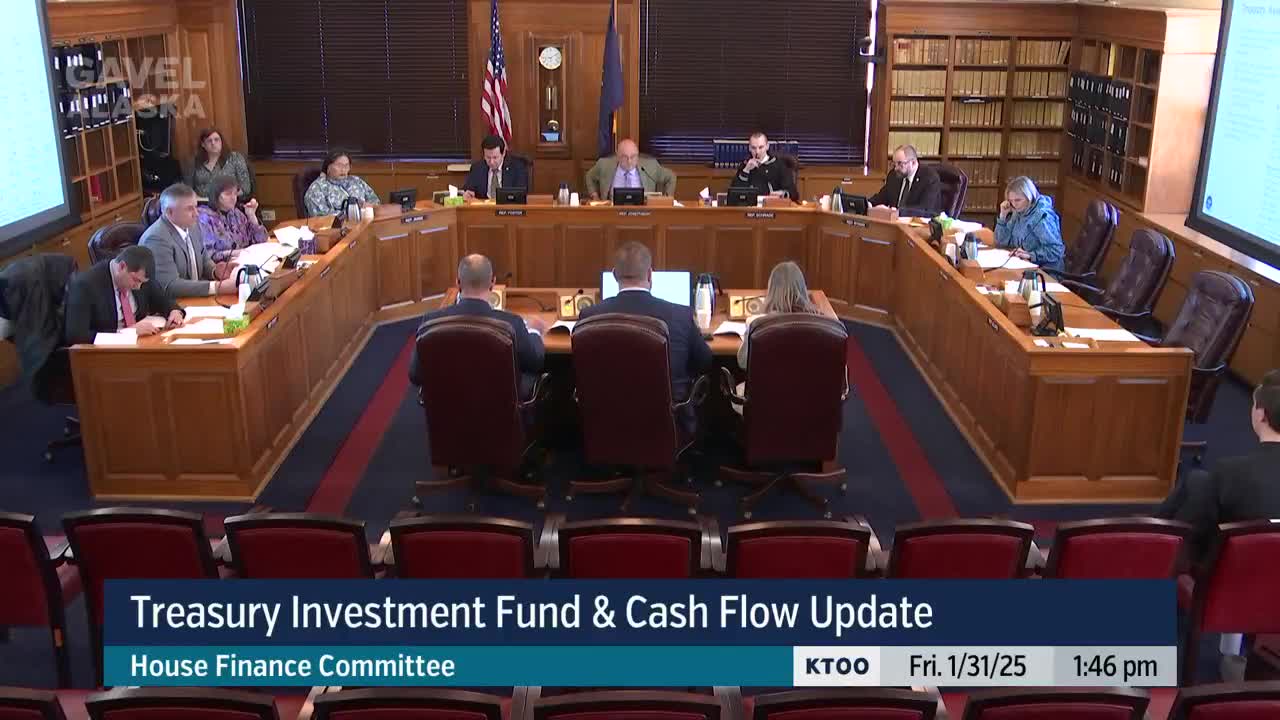
Juneau — Department of Revenue staff told the House Finance Committee on Jan. 31 that the state maintains a $400 million working floor in the general fund and uses a mix of tools — including the Earnings Reserve Account (ERA), the Constitutional Budget Reserve Fund (CBRF) and temporary borrowing under an interagency memorandum of understanding — to manage cash‑flow timing mismatches and revenue shortfalls.
Treasury Division Director Pam Leary and Commissioner Adam Crum outlined the daily cash‑flow monitoring process and the MOU between Revenue, the Office of Management and Budget, the Department of Administration and the Department of Law that governs temporary actions Treasury may take. “We pretty much do [cash projections] every day now, monitoring our our balances to see, if cash flows are not coming in that we expect or more is going out than we expect, and to execute the appropriate transfers from the ERA or CBRF,” Leary told the committee.
Why it matters: Timing mismatches—when the state pays money out before federal or other reimbursements arrive—can create short‑term liquidity pressure even when a budget is balanced on an annual basis. Committee members asked how large a disruption the state could tolerate and what assumptions Treasury uses when modeling scenarios.
Key details - General fund minimum: Treasury said it maintains a working minimum balance in the general fund of $400 million to ensure daily operations; that figure represents a standing interagency working agreement. - CBRF and SBR balances: Treasury reported a CBRF invested balance of about $2.7 billion at June 30, 2024 and an SBR (Statutory Budget Reserve) cash balance near $240 million (end of fiscal 2024 figures, with slight variation noted in December 2024 reporting). - Federal reimbursements and timing: Commissioner Adam Crum told the committee Treasury sees about $95 million per week in federal reimbursements overall; he said Medicaid accounts for roughly half of that weekly inflow (about $45–50 million per week). - Contingency planning: Treasury described stepped responses if daily forecasts show risks to the $400 million floor, including timing ERA transfers, temporary intra‑year borrowing from reserve accounts that would be repaid at fiscal year‑end, and — if revenue shortfalls extend beyond forecasts — seeking legislative appropriation of additional reserves.
Questions from lawmakers Committee members pressed Treasury on “doomsday” scenarios (how large a federal funding pause or revenue shortfall could be sustained). Crum said Treasury modeled scenarios and, in one example, operations could continue into May of the year on the available cash if only partial federal reimbursements arrived. He emphasized the MOU’s role in escalating responses and ordering bill payments when needed.
Sweep and designated funds Members raised repeated concerns about “sweep” practices (where unused balances in designated funds are moved on paper to the CBRF at fiscal year‑end). Treasury staff said many user‑funds are governed by statute, settlement or other restrictions and cannot be swept without legal or statutory changes. The committee asked for a staff follow‑up summarizing which smaller or user‑funds are protected from sweep and which are potentially sweepable.
Bottom line Treasury officials told the committee the state has daily cash‑flow monitoring, a 400‑million general fund floor and a formal MOU with other agencies to coordinate transfers and temporary borrowing. Officials recommended continued monitoring and committed to follow‑up materials to answer questions about sweepable user funds and scenario modeling.