Get Full Government Meeting Transcripts, Videos, & Alerts Forever!
Get email alerts on the Air Quality topic
No spam. Unsubscribe anytime.
Utah Division of Air Quality reports rising summertime ozone exceedances, seeks targeted reallocations and monitoring funds
Summary
Division director told the subcommittee summer ozone exceeded federal limits many days last year, outlined permitting improvements and asked legislators to support monitoring tied to the Great Salt Lake dust initiative and other priorities.
Bryce Byrd, director of the Utah Division of Air Quality, told the appropriations subcommittee that the division is tracking a troubling summertime ozone trend and asked lawmakers to consider targeted use of existing funds and a monitoring appropriation linked to Great Salt Lake dust.
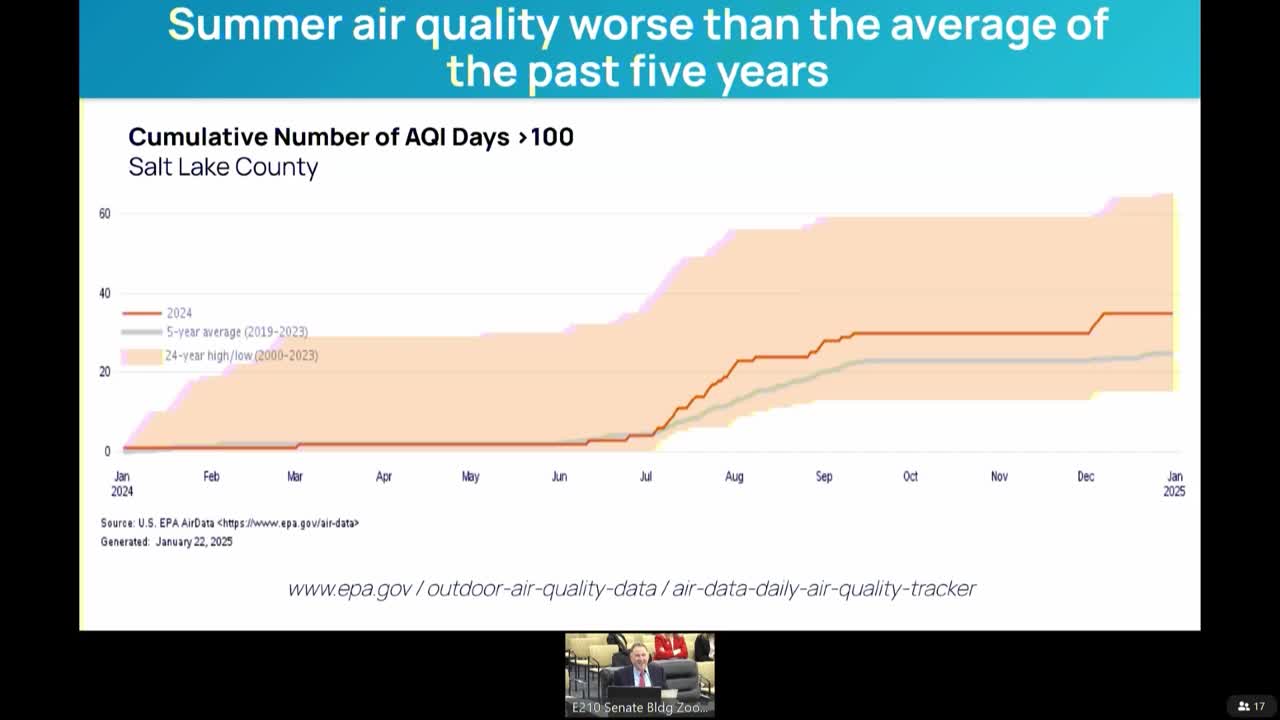
Byrd said winter particulate pollution has improved in many Utah communities but summertime ozone in metropolitan areas worsened last year. “We were approaching, 36 or so days where we exceeded the federal standard,” Byrd said, presenting a year‑by‑day exceedance graphic.
Byrd and staff emphasized that much of the ozone and fine‑particle burden in Utah comes from sources the state cannot regulate directly — international transport and long‑range transport from other U.S. regions — and that the division has submitted scientific analysis to the U.S. Environmental Protection Agency under a section 179B-style determination seeking consideration of transport contributions.
On permitting, Byrd said the division has reduced its average permit-issue time from roughly 140 days to an average of 106 days and is pursuing additional reforms — including permits-by-rule and application improvements — that could reduce timelines further if applications are complete. Byrd said a realistic low-end target, with ideal applications, would be about 45–50 days.
Budget and reallocation details: the division recommended reusing remaining funds from a 2019 wood‑stove conversion item and proposed reallocating $46,000 in a restricted alternative fuel conversion fund to higher-priority uses. The subcommittee was also asked to consider a $650,000 ongoing monitoring request — a request described in committee materials as duplicative of the governor’s budget but intended to support statewide dust and emissions monitoring tied to Great Salt Lake concerns. Byrd said the Great Salt Lake Commission and other partners support that monitoring effort.
Senators and representatives asked about wildfire smoke contributions, airport and military aircraft emissions, and the division’s ability to win EPA recognition for transport contributions; Byrd said wildfire impacts vary year to year and reiterated the division's advocacy with EPA to avoid penalizing Utah for pollution largely transported or internationally sourced.
The division also described ongoing litigation and administrative challenges with recent federal rules and said it is coordinating with the attorney general on legal responses.