Get Full Government Meeting Transcripts, Videos, & Alerts Forever!
Get email alerts on the Public Safety Communications topic
No spam. Unsubscribe anytime.
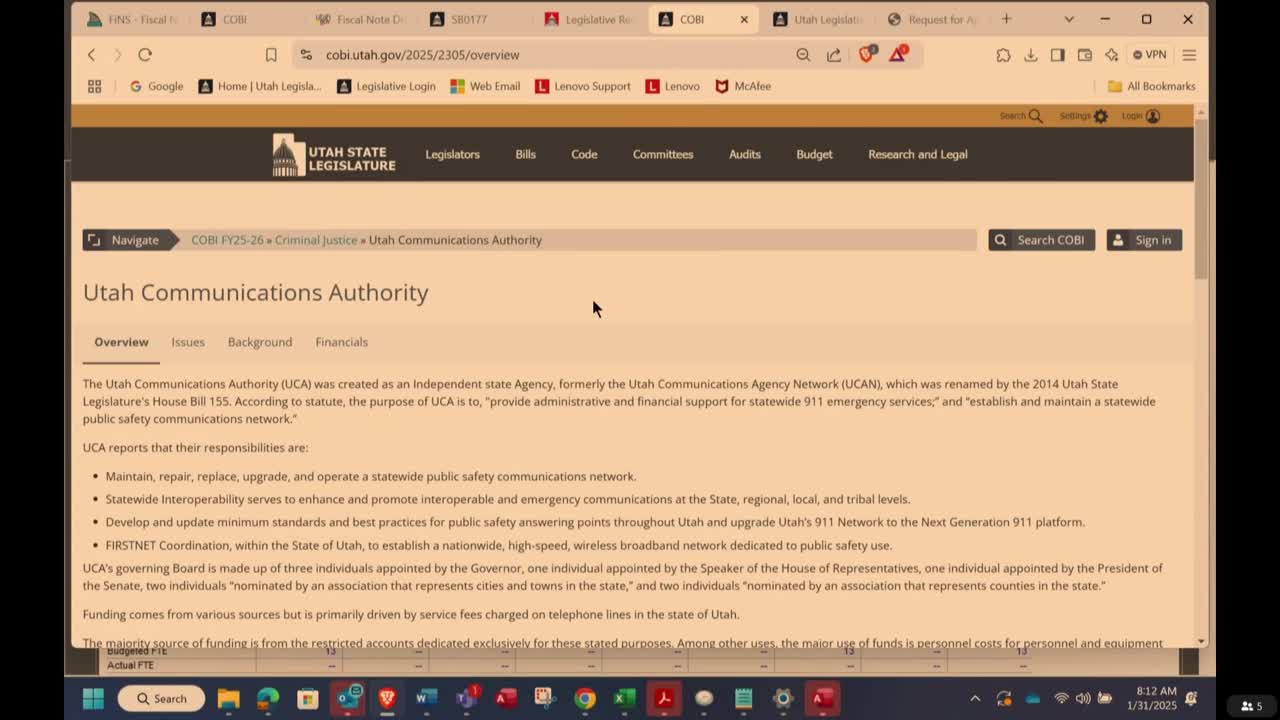
Utah Communications Authority asks for $32.1 million to sustain statewide 911 and radio systems after cutover
Summary
Utah Communications Authority told the Criminal Justice Appropriations Subcommittee it needs $10 million for next‑gen 911 and $22.1 million for the statewide radio system to continue troubleshooting, replace antennas, add sites and support training after a large radio cutover.
The Utah Communications Authority told the Criminal Justice Appropriations Subcommittee on Jan. 31 that it is seeking $10,000,000 for the Unified Emergency 911 account and $22,100,400 for the Utah Statewide Radio System account to support the statewide next‑generation 911 phone network and the new public‑safety radio system.
The authority, represented at the hearing by Director Tina Matthew and Administrative Services Division Director Chris Hughes, briefed lawmakers on post‑cutover work since the radio system began phased cutovers Aug. 30 and completed the Salt Lake County cutover Dec. 13. “We currently have 144 sites and approximately 45,000 users on the system,” Matthew said, calling the project “by far the largest public safety project in the state.”
Why it matters: the funding would support ongoing troubleshooting, firmware and antenna upgrades, new radio site construction and training for public safety answering points (PSAPs) and dispatchers to improve call‑routing and interoperability. Matthew said many field radios were on substantially older firmware, producing intermittent failures that can mimic coverage problems; getting agencies to update firmware has been a primary operational challenge.
Matthew told the committee that UCA has assisted small, rural agencies that lacked funding for compatible radios, and that stockpiles purchased with prior legislative appropriations helped fill gaps. “I believe that everyone who needs radios have radios now,” she said, noting fewer than 100 radios remain in UCA inventory.
Committee members praised the UCA team’s work during the cutover. Senator Wayne Ip[s]en (Senator Ipsen in transcript) commended Matthew for prioritizing rural and volunteer departments; Senator John Owens (Senator Owens in transcript) asked what additional steps are needed ahead of the 2034 Olympics. Matthew said the agency will continue to add sites and consider lower‑cost microsites to improve canyon and ski‑area coverage and that shifting the system to “phase 2 only” radios in the future would increase capacity.
Technical changes planned include antenna replacements beginning the week after the hearing in Utah County and Carbon County, plus sites planned or underway in San Juan, Paiute, Garfield, Emery, Sevier and Utah County. Matthew stressed that in‑building coverage is not guaranteed by the system—schools and hospitals commonly require bi‑directional amplifiers (BDAs), which state statute requires for schools, she said.
The authority also reported training for PSAP managers and dispatchers, ongoing feature reviews with the PSAP advisory committee for location‑based routing, and national certification courses in the coming months.
Ending: Matthew said the radio buildout is “a continuous project” and that UCA will ask its board for additional site funding in fiscal year 2026. The committee did not take formal action on the UCA request at the Jan. 31 hearing.