Get Full Government Meeting Transcripts, Videos, & Alerts Forever!
Get email alerts on the Economic Development Contracts topic
No spam. Unsubscribe anytime.
Madison County to renegotiate chamber liaison agreement after audit finds employees on county benefits
Summary
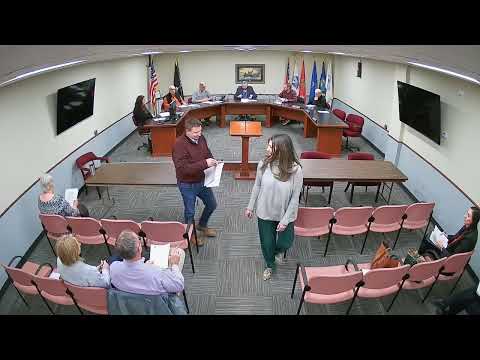
Madison County commissioners held a special-call meeting Jan. 28 to address a 2020 memorandum-of-understanding that has allowed chamber staff to receive county retirement and health insurance benefits, an arrangement the county’s auditors and outside reviewers flagged as improperly structured.
Madison County commissioners held a special-call meeting Jan. 28 to address a 2020 memorandum-of-understanding that has allowed chamber staff to receive county retirement and health insurance benefits, an arrangement the county’s auditors and outside reviewers flagged as improperly structured.
The discussion grew out of an audit conducted during separation of the county’s water authority from the Industrial Development Authority (IDA). Commissioners said the audit found county-defined benefits being applied to nongovernment employees; county staff and outside reviewers advised that the MOU as written blurred agency lines and should be rewritten as a contract for services. County officials directed the chamber to provide a clear list of services and a budget so staff and the county attorney can draft a corrected agreement. Commissioners and staff agreed to continue operating under the current funding arrangement while work proceeds, with a target transition date of June 30.
Why it matters: the arrangement affects how taxpayer dollars are used and whether chamber staff were properly eligible for employer retirement matches and county health insurance. County officials said the matter already involves roughly $30,000 in employer-match retirement funds tied to chamber staff and noted legal risk if benefits were extended to nongovernment employees in error.
Background and audit findings
County staff said the MOU dates to 2020 and was structured to provide an economic-development liaison role supported in part by the Board of Commissioners (BOC) and the IDA. Under past budgets each entity provided funding (the agreement as cited in the meeting references $15,000 from the BOC and $20,000 from the IDA), and payroll arrangements had been used to allow a chamber liaison to receive county benefits. An audit performed during the water authority separation found this arrangement was incorrect, and reviewers recommended separating the chamber from county payroll/benefits and clarifying the contract language.
County staff told commissioners that one or more chamber staff members had employer-match retirement contributions totaling about $30,000 that are currently held up with the IDA and that the Association County Commissioners of Georgia (ACCG) advised the county to avoid intertwining the chamber and the IDA in wording that would make chamber staff appear as government employees.
Options discussed
Commissioners and staff outlined two principal options: (1) make chamber workers employees of the Madison County Chamber of Commerce and have the county contract for specific economic-development services (the county would pay a lump-sum contract fee to the chamber to buy defined deliverables), or (2) restructure the agreement so the IDA (or another government entity) could legitimately employ a liaison with clearly defined duties and compliant payroll/benefits handling. Multiple participants urged a clean-slate rewrite rather than patching the old MOU.
Participants emphasized that any future contract must specify deliverables, billing frequency and whether payroll and insurance will be procured through a third-party vendor. County staff said they will provide the chamber with sample contracts the county currently uses for other service relationships (library, senior center, UGA Extension) to guide the rewrite.
Employee impact, funds and timeline
County staff said one chamber position (the president/CEO who served as liaison) remains in question for employer-match retirement funds; staff reported that some retirement match money and insurance coverage questions were resolved for other chamber employees but that the liaison position still faces unresolved employer-match and insurance issues. The meeting record indicates the county and IDA previously facilitated payroll and insurance to enable the liaison to receive benefits, but auditors found that practice inconsistent with separation of entities.
Commissioners and staff agreed to keep the existing budgeted funding streams in place while drafting a corrected agreement, targeting June 30 as a working date to complete transition tasks. County officials warned continuing the current arrangement carries legal and financial risk, and they said the county attorney and ACCG input would guide whether the temporary continuation is permissible.
Next steps
The county requested that the Madison County Chamber provide a written “needs” or work plan listing services (examples discussed included business retention, leadership development and small-business support), an up-to-date budget and the dollar amount needed to replace the benefits previously provided through county payroll. County attorneys will draft a revised contract, using the chamber’s submitted deliverables and the county’s sample contracts as templates, then circulate a draft for review and future vote by the respective boards.
Ending
Commissioners characterized the process as a correction of past drafting and oversight, not as an attempt to cancel support for the chamber. They said the goal is to ensure any continued county support is legally structured, that chamber employees receive promised compensation in a compliant manner, and that a final contract spelling specific deliverables and funding is ready for review before the June 30 transition date.