Get Full Government Meeting Transcripts, Videos, & Alerts Forever!
Get email alerts on the Property Taxes topic
No spam. Unsubscribe anytime.
Madison County meeting weighs opting out of new statewide homestead exemption
Summary
County officials and staff presented estimated fiscal effects of Georgia's new floating homestead exemption, discussed potential impacts on farmers, utilities and school funding, and scheduled additional public hearings and a final commission vote Feb. 24.
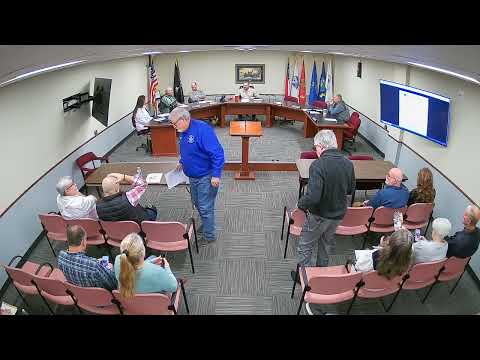
Commission Chair (name not specified) opened a public hearing Jan. 31 in Madison County on a proposed statewide "floating" homestead exemption enacted by the Georgia General Assembly and explained the meeting's purpose: to inform residents and gather input as the county decides whether to opt out of the statewide exemption that took effect Jan. 1, 2025.
The issue matters to taxpayers because the measure would freeze assessed homestead values as a base year and allow future increases only by a consumer price index adjustment (the presenters used an assumed 3 percent CPI for modeling), while local taxing authorities would still need to raise millage rates to fund budgets. "This is probably the single most important topic in the state of Georgia," the Commission Chair said during opening remarks.
Chief Appraiser Robin Baker and Deputy Appraiser Gary Kavalier gave a 90-minute presentation outlining how the exemption works, what is known and what remains uncertain, and the potential local fiscal impacts. Baker explained the state's sales-ratio audit process and why counties face penalties if their assessed-value ratio falls outside state thresholds: "When the state does the sales ratios...if we're at 40, that means our values are perfect," Baker said, noting acceptable ratios run roughly 36 to 44.
Kavalier emphasized several commonly repeated misconceptions and key points for residents: the floating homestead exemption would be additive to existing local homestead exemptions (it would not replace or remove them), the estimate box would be removed from annual assessment notices, and the state requires a millage rollback calculation in assessment notices so taxpayers can see how much taxing authorities would need to roll back rates to avoid an increase in taxes. "It doesn't take away those exemptions that are currently out there already," Kavalier said about local exemptions.
Staff and commissioners presented quantitative examples drawn from recent years: Madison County's tax collections from real property moved from about $12,466,000 in 2021 to roughly $12,604,000 in 2024 even as assessed values rose, because the board has reduced millage rates to avoid collecting more than budgeted. The appraisers modeled likely revenue losses to the county under the freeze scenario and estimated an average homestead loss per parcel of about $142 in 2022, rising in later years to the $200'$300 range per parcel depending on assumptions. They also factored in a separate change under House Bill 808, which raised the personal property exemption from $7,500 to $20,000 and will reduce personal-property tax revenue from businesses, boats and other taxable personal property.
Presenters and several commissioners warned of specific risks from opting in: reduced flexibility for local taxing authorities, potential higher millage rates for non-exempt property (including commercial property and parcels not in a homestead), and exposure to state fines and loss of state funding if the county's sales-ratio falls below the acceptable band. Staff noted uncertainty about several items the state has not finalized, including whether the CPI used will be a national or state measure and whether future amendments will limit acreage covered by the exemption (legislators were reportedly considering a 1- or 5-acre cap).
Public commenters spoke overwhelmingly in favor of opting out or wanted more time to review the bill and amendments before committing. Several residents and commissioners stressed the exemption could disproportionately benefit long-term homeowners while shifting the burden onto farmers, small businesses and new buyers, producing unequal taxable values for neighboring parcels when homes sell. One resident warned that the exemption could "lock in" elderly homeowners but make downsizing unaffordable because smaller, newer homes would be taxed at full market value when sold.
Commission members and staff repeatedly framed the opt-out option as a "safety valve" that preserves local control: if the county opts out now it can later seek to opt back in through the legislature (the presenters emphasized that opting in at the state level is effectively permanent under current statutory language, while opting out preserves local authority and the ability to pursue locally designed exemptions). Staff recommended the county opt out to allow more time to model impacts and await clarifications and any amendments from the General Assembly.
The commission did not take a final vote at the Jan. 31 meeting. Staff announced two additional public hearings: Feb. 11 at 6 p.m. and Feb. 24 at 5 p.m., with the commission expected to consider a final resolution at its Feb. 24 meeting at 6 p.m. The county asked residents to review posted materials and attend subsequent hearings before the commission votes.
Nut Graf: The debate centers on a tradeoff between statewide, uniform tax relief and local fiscal control. Proponents of the floating homestead exemption argue it would limit rapid tax increases for homeowners; opponents and county staff warn it shifts revenue pressure onto non-exempt taxpayers, risks higher millage rates for commercial and non-homestead parcels, and could expose the county to state penalties and lost funding if the state sales-ratio audit flags the county.
Background and detail: The presenters described how the new law changes several existing protections: it removes the estimated-tax box from assessment notices, limits the old multi-year sales hold tied to appeals, requires periodic reappraisals (site visits) by assessors every three years, and gives assessors new authority to contest state sales-ratio determinations. They also reviewed the mechanics of the proposed freeze: base-year valuation plus CPI adjustments each year, except for changes that increase or decrease property value (remodels, additions, demolition), which would reset taxable value for that component. Appraisers warned that the CPI assumption used for modeling (3 percent) is only an approximation and could vary substantially year to year.
Speakers and staff repeatedly urged residents to separate social-media claims from the statute's text and to use the county's posted slides and follow-up materials. Kavalier and Baker said many implementation details still depend on Department of Revenue guidance and potential legislative amendments. "There are a lot of unknowns," Baker told the room; county leaders framed the hearings as a way to gather facts and public input before the Feb. 24 vote.
Ending: The board kept the record open and scheduled the two additional hearings; no final action was recorded at the Jan. 31 meeting. County staff will publish the presentation and updated numbers on the county website and encouraged residents to contact their state legislators with concerns about unfunded mandates and statutory details that remain unclear in the law.