Get Full Government Meeting Transcripts, Videos, & Alerts Forever!
Get email alerts on the Treasury Tax Collections topic
No spam. Unsubscribe anytime.
Lake County treasurer outlines 2024 tax-collection changes, technology upgrades and enforcement plans
Summary
Patrick Sullivan, Lake County treasurer-tax collector, presented the office's 2024 accomplishments and plans for 2025 to the Lake County Board of Supervisors, reporting completed banking and software procurements, increased lockbox processing and consolidation of court-related collections into the Treasurer-Tax Collector's Office.
Patrick Sullivan, Lake County treasurer-tax collector, presented the office's 2024 accomplishments and plans for 2025 to the Lake County Board of Supervisors, reporting completed banking and software procurements, increased lockbox processing and consolidation of court-related collections into the Treasurer-Tax Collector's Office.
Sullivan said the office completed requests for qualifications for custodial banking services and short-term rental software and selected a vendor called Deckard to assist with identification and audits of short-term rental operators. "They'll help identify short term rental locations," Sullivan said, adding the tool may assist other county departments such as code enforcement and planning.
The treasurer highlighted operational changes he said will streamline collections. "We are consolidating all of that court related enforcement into our office, which will streamline it," Sullivan said, describing a merger of probation-held case records into the county's collections system. He said that consolidation required significant upgrades and remains a work in progress but is now at a "workable level." The office also established a tax intercept program with the state controller's office and the Franchise Tax Board, and implemented third-party agency collections programs for court and probation cases.
Sullivan reported property-tax processing moved substantially into lockbox operations this year, with "just over 21,000 checks processed through lockbox" and more than $25,000,000 run through the program so far for first and some second installments. The office completed a chapter 7 tax sale that targeted 1,000 properties (with some dropouts for redemptions and bankruptcies) and sold 23 properties through chapter 8 sales to the city of Clear Lake; he said additional chapter 8 sales for special districts have begun but may require extra steps or city approvals before reaching the state controller.
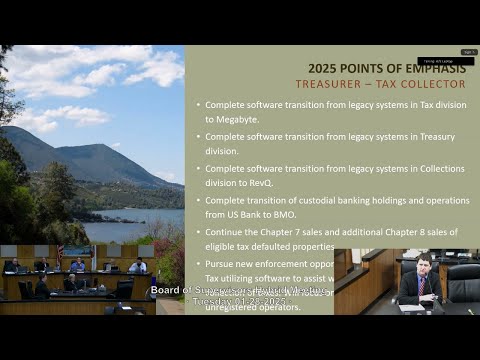
On banking and technology, Sullivan said the county will transition custodial banking holdings from U.S. Bank to BMO, the winning bidder, and continue upgrades to cybersecurity and operational banking systems. He said some legacy systems remain in use: "We retained certain legacy systems, and we did not fully transition to Megabyte, which means our office operates in a mixture of Megabyte, Access, Excel, and other systems," and that similar partial migrations affect treasury systems and RevQ, complicating operations while upgrades proceed.
Sullivan said the office started county cannabis business tax audits, using Metrc data for dispensaries and beginning work on cultivation-site audits, and has conducted staff training on Metrc. He said legislative changes will require an updated county tax ordinance for cultivation once a related task force completes work.
When Supervisor Owen asked about the cost of using third-party contractors for collections, Sullivan said the contractor fee commonly ranges "20 to 30%" depending on the age and type of debt, and that the county reserves third-party referrals for older, more difficult-to-collect accounts after in-house options have been exhausted.
Sullivan flagged a broader funding issue tied to changes in state law: reduced fines and fees at the state level have lowered available revenue while the county continues to be responsible for victim restitution payments. "We have the ability to enforce victim restitution orders, but we do so completely at our own expense," he said, calling this an increasing unfunded obligation that takes priority over fines and fees.
Looking ahead, Sullivan said the office will continue chapter 7 and 8 tax sales, pursue transient occupancy tax enforcement using the new software to address delinquent and unregistered operators, expand electronic payment and banking options, modernize the county deferred compensation plan, and use a contracted vendor to pursue unsecured property tax enforcement similarly to about a dozen other counties. He closed his remarks by noting continued monitoring of state and local court-collections impacts and the need to finalize some ordinance changes after the cultivation task force issues recommendations.
Supervisor Sabatier thanked Sullivan for starting the chapter 8 sales and said she believed the city of Lakeport had interest in some of the properties; another supervisor said she was "excited about the short term rental" enforcement work. Sullivan then closed the presentation.