Get Full Government Meeting Transcripts, Videos, & Alerts Forever!
Get email alerts on the Probation Services topic
No spam. Unsubscribe anytime.
Lake County probation chief reports staffing gains, Prop 36 implementation plan and housing project update
Summary
Chief Probation Officer Wendy Monfranc told county officials the probation department cut vacancies, launched mobile outreach for people experiencing homelessness, and received judicial approval to begin implementing Prop 36; she said the department may need additional staff because Prop 36 is currently unfunded.
Wendy Monfranc, chief probation officer for Lake County, told county officials on an agenda presentation that the probation department has significantly reduced vacancies, expanded mobile outreach and is preparing to implement changes required by Proposition 36.
Monfranc said the department promoted 10 employees and hired multiple new staff this year, and that vacancy rates have fallen from about 36% for deputy probation officers last year. “We have an amazing staff who is very concerned about public safety but also making sure that Lake County is a better place and that we know people can change and we're gonna help them do that,” Monfranc said.
The update outlined why the changes matter: increased staffing and new programs are intended to improve public safety, expand services for people experiencing homelessness and speed court processing. Monfranc told officials the department now uses tablet-based testing with human resources to shorten hiring timelines, has created a probation program technician training position to underfill deputy probation officer roles, and has designated two deputy probation officers to focus on homeless populations using a mobile services van.
Monfranc described program activity this year including three annual Resilient Reentry events at Woodland College, six community tattoo-removal events with 191 procedures performed, and two community meetings on a child abuse prevention plan developed with the Children’s Council and Child Welfare Services. She said the department supervised 1,013 people on formal supervision this year: 710 on adult probation, 88 on juvenile probation, 162 on post-release community supervision and 53 on mandatory supervision. The pretrial program had 108 participants. “Our adult report writers prepared just over a 1,000 reports this year for the courts, and we had 83 reports in juvenile court,” Monfranc said.
Monfranc said 90 adult probation violation filings and six juvenile filings were made to court this year; she noted the count of filings is not the same as unduplicated individuals. The department referred 467 people to adult programs, of whom almost 200 completed programs successfully. The office also reported attending at least 43 public outreach events.
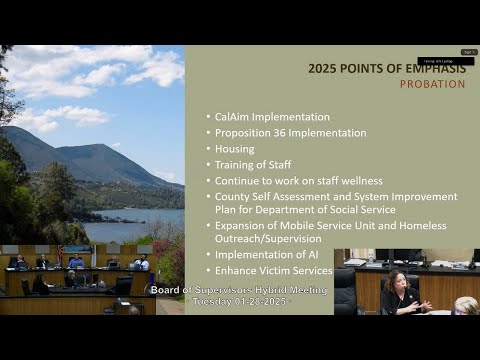
On policy changes, Monfranc said the department has been approved as a CalAIM enhanced care manager and has been working with public health on billing and implementation. She said county justice partners have developed a Proposition 36 implementation plan and that she met with judges this week to present it; “they have given us the go ahead to go forward on how to implement Prop 36 and the impact it's going to have on the county,” Monfranc said. She estimated roughly 300 individuals in 2024 would be affected across county justice partners and said Prop 36 is unfunded locally; she said that may require her to return to the board to request one or two additional staff positions to carry out mandated quarterly reporting and services.
On housing and facilities, Monfranc said the probation-led housing project has moved toward selecting a property. She told Vice Chair Rasmussen that if the selected property proceeds, groundbreaking is expected in fall 2026, with construction likely to take about a year. “When once you get the selected location for the housing, when is it expected to be actually built and people moving in?” Vice Chair Rasmussen asked. Monfranc replied the groundbreaking is expected in fall 2026 and that construction could take about a year.
Monfranc also reported the department has begun using a contracted artificial intelligence tool to summarize police reports and rap sheets to speed report writing for pre-sentence reports, with human review remaining part of the process. She said the mobile services unit had initial problems but is now operating and will be used regularly for outreach. The department said it became a Blue Zones certified location this year and continues to emphasize staff wellness and training; new deputy probation officers receive about 300 hours of training in their first year and then 60–100 hours annually.
The presentation included an invitation to a county stakeholder meeting on Feb. 19 at 9 a.m. at Robinson Rancheria, to discuss the county self-assessment and system improvement plan with Child Welfare Services and probation. Monfranc closed by thanking staff and noting ongoing outreach and service delivery efforts.
No formal board action or vote was recorded in the transcript for this presentation. The judges’ approval Monfranc described was reported by her as a go-ahead to implement the Prop 36 plan rather than as a county board vote. The department identified Prop 36 implementation as likely to require additional personnel if funding is not provided.