Get Full Government Meeting Transcripts, Videos, & Alerts Forever!
Get email alerts on the Ucce Programs topic
No spam. Unsubscribe anytime.
UC Cooperative Extension outlines local programs, research and county data plans for Lake County
Summary
University of California Cooperative Extension Director Matthew Barnes summarized 4‑H, viticulture, water resources, Master Gardener and forest‑health programs and committed to more county‑level data and quarterly updates at a Lake County Board of Supervisors meeting.
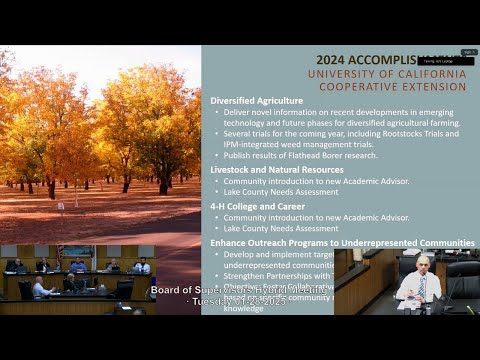
At a Lake County Board of Supervisors meeting, Matthew Barnes, director of the University of California Cooperative Extension for Lake and Sonoma counties, gave an overview of Extension programs and research plans focused on youth development, viticulture, water resources, Master Gardener outreach, diversified agriculture and forest health.
Barnes said Cooperative Extension “can be looked at as a bucket of programs,” and described work by academic advisors and local volunteers across Lake, Sonoma and Mendocino counties. He highlighted 4‑H clubs, a viticulture research program, a water resources advisor developing drought resilience plans, a Master Gardener certification class, and a newly created beneficial‑burning and land‑stewardship position aimed at improving fire resilience and strengthening tribal partnerships.
The presentation outlined program details and metrics. Gene Gollard, community education specialist, links state programs to nine local 4‑H clubs serving 139 youth; Barnes said staff aim to double 4‑H enrollment within one to two years with expanded teen programming. Chris Chen, the viticulture advisor, is in his third year and will direct more outreach and workshops in Lake County after earlier work in Sonoma and Mendocino. Dr. Laura Garza Diaz, the water resources advisor, is entering her second year and is planning a Lake County drought resilience plan after starting needs assessments. Barnes said the Master Gardener program, led by Luis Pagan, is restoring in‑person outreach after COVID interruptions and has eight signups for an upcoming certification class.
Barnes described longer‑running projects in forestry and pest research. Dr. Michael Jones’s forestry health program includes post‑fire oak regeneration studies based at the Hopland Research and Extension Center, a Ask an Oak Expert website registering about 15,000 monthly visits, and a peer‑reviewed paper on wildfire impacts on ticks. Barnes said Jones recently secured grants to expand the Forest Stewardship Education Program and that USDA Forest Service funding supports research on Mediterranean oak pests.
Barnes also noted work on diversified agriculture by advisor Klebson Conclaves, including research and workshops on pear, walnut and olive orchards, trials on drought‑resilient grapevine varieties, and ongoing research into a flathead borer found in pears. He said advisors have secured more than $2 million in external funding systemwide and listed extension outputs such as roughly 10 peer‑reviewed publications, 15 extension bulletins and several online toolkits.
Supervisors asked for clearer, county‑specific reporting. Supervisor Pfeiffer said Lake County should be separated out in future data so the board can see whether Lake is receiving an appropriate share of outreach; Barnes agreed and said he aims to provide more county‑level breakdowns. Barnes also told the board he and staff are planning quarterly updates starting in February to rotate presentations by academic advisors, and said staff can notify supervisors and the public when peer‑reviewed articles are published.
During public comment, Margo Cambara asked whether UC Cooperative Extension can support local food‑production models that would provide livable wages. Barnes responded that Cooperative Extension’s role is educational and collaborative with local farmers and that Extension could participate in further research or planning if the board or community prioritizes it.
Supervisor Sabatier said the board will bring the county’s revived Food Policy Council back to the board with bylaws and a strategic plan and asked Extension to be involved in developing approaches to diversify local food production. Barnes and staff confirmed interest in collaborating with the council and tribal partners.
Barnes closed by repeating that several advisors are doing community needs assessments and that new positions — including the beneficial‑burning and land‑stewardship role filled about 90–100 days ago by Ali Sung Jazerek — will help expand outreach, particularly with tribal communities. He noted an indigenous climate‑change internship approved for this summer that will place interns with Extension advisors in Lake County.
The presentation did not include any formal board votes or ordinance actions; supervisors requested follow‑up reporting and staff committed to periodic updates and improved county‑level metrics.