Get Full Government Meeting Transcripts, Videos, & Alerts Forever!
Get email alerts on the Governance topic
No spam. Unsubscribe anytime.
Caswell County retreat stresses boundaries between commissioners and staff, urges ‘no surprises’
Summary
At a Jan. 25 Caswell County retreat, outside facilitators and county leaders urged clearer roles and professional relations between the Board of Commissioners and staff, recommending private handling of personnel concerns, use of closed sessions for evaluations and a consistent chair role to reduce day-to-day interference in administration.
At a Jan. 25 retreat, Caswell County commissioners and outside facilitators outlined expectations for the governing board’s relationship with county staff, emphasizing professional boundaries and the need to avoid operational involvement by individual commissioners.
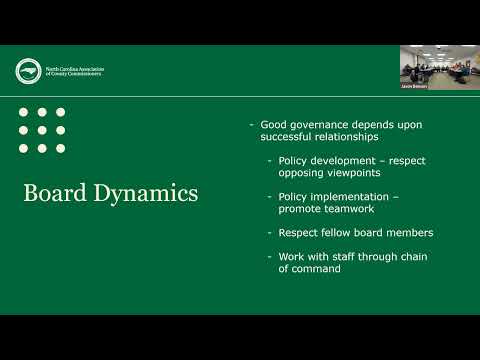
The guidance, delivered by facilitators Jonna Sharp and Amy Cannon and repeated by interim staff and commissioners, urged the board to treat the county manager as the chief executive who implements majority board decisions and to handle personnel complaints privately or in closed session rather than in open meetings. “No surprises,” Cannon said, summarizing a central principle she recommended for board-staff communications.
The guidance matters because commissioners’ interactions with staff shape service delivery, public perception and the county’s ability to recruit and retain employees. Facilitators said commissioners who bypass the manager and address department staff directly create confusion and can intimidate employees.
Sharp, introduced as a former Wake County deputy county manager, and Cannon, introduced as a former Cumberland County county manager, used a chain-of-command analogy: commissioners as team owners and the manager as the coach. They recommended that the chair clarify whether the chair serves as the board’s external spokesperson, and that conflict among commissioners be managed internally and not referred to staff.
County Manager Renee (acting county manager) and finance staff noted existing tensions around day-to-day direction. During discussion, a commissioner raised how to handle a manager who does not follow board direction; Cannon advised, “handle it in private” and suggested the chair or the board use closed session or a formal evaluation process.
Facilitators stressed that staff’s role is to present unbiased options and to implement majority board decisions, except where staff identify actions as illegal or unethical. Cannon pointed to the International City/County Management Association code of ethics as a boundary that can limit staff compliance with directions they consider unethical.
Commissioners and staff agreed on practical steps recommended by facilitators: do homework before meetings, circulate information ahead of time, keep lines of communication open, and centralize conflict resolution through the chair and manager. The retreat closed with a reminder that these norms are public-facing because meetings are televised and observed by potential economic developers, residents and employees.
The retreat produced no formal policy changes during the session; presenters recommended changes to governance practices for the board’s future consideration.