Get Full Government Meeting Transcripts, Videos, & Alerts Forever!
Get email alerts on the Neighborhood Council Elections topic
No spam. Unsubscribe anytime.
City Clerk details candidate filing, ballot model and vote-by-mail procedures for Region 4 neighborhood council elections
Summary
The Los Angeles City Clerk’s office reviewed Neighborhood Council bylaws, ballot voting models, the candidate‑filing process and an all vote‑by‑mail model for Region 4, including documentation requirements, deadlines and return options for ballots.
Michael Ekrich, an election administrator with the Los Angeles City Clerk’s Neighborhood Council Election and Funding Division, outlined how the office applies each Neighborhood Council’s bylaws to create a ballot voting model and described candidate filing and the all vote‑by‑mail model for Region 4.
Ekrich said the City Clerk’s office “was only funded to provide an all vote by mail election for neighborhood councils this year,” and walked through how bylaws' Article 3 (boundaries), Article 4 (stakeholder types), Article 5 (governing board) and Article 10 (election rules) determine who can run and who receives which ballot.
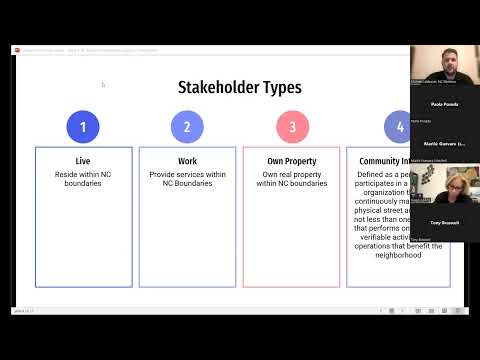
The office uses a ballot voting model—a blueprint that lists the neighborhood council name and abbreviation, ballot types and counts, board seats up for election, term lengths, voter age, stakeholder verification type and any candidate restrictions. Ekrich described the four stakeholder categories used across Neighborhood Councils: residents, people who work in the boundary, real‑property owners and “community interest” participants. He said the community interest category requires that the person “participates in a nonprofit organization that has continuously maintained a physical street address for not less than 1 year and that performs ongoing and verifiable activities and operations that benefit the neighborhood.”
For Region 4, Ekrich gave a candidate filing window of Feb. 7 through March 24, 2025, and explained the filing options: the 24/7 online Neighborhood Council portal (which no longer requires an Angelino account), or paper applications available on the City Clerk website in multiple languages. Candidates must provide identity, proof of age and proof of stakeholder status; Ekrich said a valid California driver’s license with a current address can verify both identity and residency when applicable.
He explained certification and challenges: once the office reviews an application and documentation it “will certify a candidate,” placing the candidate on the ballot; stakeholders may challenge certified candidates during the challenge window and the office will “affirm or deny” challenges. Ekrich said the office releases a certified list of candidates and contact information to the neighborhood council 60 days prior to the election for outreach.
On vote‑by‑mail, Ekrich described the voter application and mailing process: stakeholders must apply each election cycle so the office can confirm eligibility under current bylaws; once verified the office mails a packet with the ballot(s), instructions, a QR/URL to the candidate website, return options and a prepaid return envelope. Ballots may be returned by USPS (prepaid), by designated ballot boxes at library and Rec & Park sites or in person to the City Clerk’s office.
Key deadlines and dates mentioned in the presentation: candidate filing Feb. 7–March 24, 2025; vote‑by‑mail registration and related dates were cited in different places in the presentation (April 4–June 2, 2025 and elsewhere April 11 start); ballot mailing was listed to start May 6; election day June 10; deadline to receive postmarked ballots June 20; deadline to request resent ballots June 3. The transcript contains two different start dates for the vote‑by‑mail registration period (April 4 and April 11); the office should be consulted to confirm the correct start date.
Ekrich reviewed the online filing portal features (account creation, seat requirements display, address verification and document upload), the candidate profile (photo and 1,000‑character statement), and the voter portal (self‑affirmation vs. documentation pathways). He noted that paper filings and paper voter applications remain available and that authorized‑agent collection of paper voter applications is permitted.
Ekrich also described an enhanced notification flow for applicants: automatic emails when an application is submitted, when eligibility is verified and when the office receives a mailed ballot back so stakeholders have tracking visibility.
Ending: Ekrich closed by identifying the region’s election administrators as local contacts for questions and said the office will send regular updates during the filing and vote‑by‑mail periods.