Get Full Government Meeting Transcripts, Videos, & Alerts Forever!
Get email alerts on the Education Goals Guardrails topic
No spam. Unsubscribe anytime.
Seattle school board adopts new district goals and guardrails after public hearing; amendments change benchmarks and wording
Summary
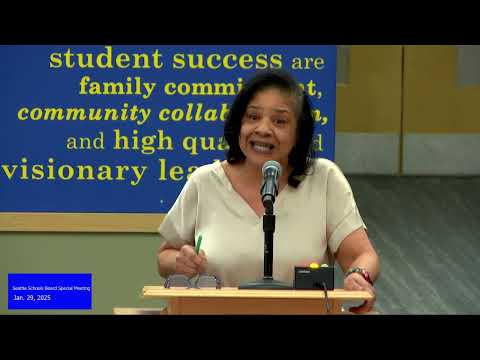
On Jan. 29, 2025, the Seattle School District No. 1 Board of Directors approved new district goals (Policy 0020) and guardrails (Policy 0025) and amended Policy 1010 after a public hearing. The board adopted three amendments to the package and defeated one; the final vote was 5–2.
The Seattle School District No. 1 Board of Directors on Jan. 29, 2025, voted 5–2 to adopt new district goals (Board Policy 0020) and guardrails (Board Policy 0025) and to amend Board Policy 1010 (oversight and progress monitoring), following a public hearing and debate over five proposed amendments.
The vote finalizes a package the board said will guide district accountability, budgeting and five‑year planning. Director Rankin sponsored several amendments that the board considered in sequence; three amendments (Nos. 2, 3 and 5) were adopted, Amendment 1 failed, and the board approved the action as amended.
Board members and staff framed the items as foundational steps to link goals to budgeting and progress monitoring. Vice President Briggs moved the final motion to adopt the policies as amended; Director Mizrahi seconded. The motion passed 5–2 (Briggs—mover; Mizrahi—second; recorded votes: 5 yes, 2 no). The board then recessed into executive session to review the performance of a public employee under state law (RCW 42.30.110(1)(g)).
Public testimony at the hearing focused on several themes the board said were relevant to the goals and guardrails: protection for marginalized students amid recent federal directives; requests for stronger disability‑centered language and intersectional approaches in accountability; concerns that proposed targets were too low; and calls for more robust, ongoing community engagement.
Gerard Montejo Thompson, identified in testimony as vice president of the Seattle Education Association, urged unity and protection for students in the face of “hate and bigotry,” saying, “We are scared. We are confused, and that is by design by those that have taken power.” Misha Vecchio, who identified themself as president of the Seattle Education Association, described recent executive orders as “anti science” and said they risk erasing trans, intersex and nonbinary students from school systems: “This policy ... has overwhelmed and confused those working with our students.”
Janice White, president of the nonprofit All Youth Belong, testified that “the word disability is not mentioned in any of the goals and guardrails,” and urged the board to use an intersectional disability justice framework in district planning. Sabrina Burr, co‑president of the Seattle Council of PTSA, characterized the stakes as existential for some students: “These are lives, and what we are saying is we're willing to fail some students.”
Board discussion focused on measurable targets, baselines and whether proposed percentages would drive resource changes. Director Rankin proposed raising the 2nd‑grade literacy target from a drafted 10 percentage points to 15 percentage points by June 2030; that Amendment 1 failed (vote: 2 yes, 3 no, 2 abstain). Amendment 2, which revises the graduation goal to tie graduation outcomes to the student’s High School and Beyond plan and to count dual credit, work‑based learning or college application activities (baseline TBD pending spring data), passed (6 yes, 1 abstain). Amendment 3 added a middle‑school math goal — a 10 percentage‑point increase in the percentage of 6th graders prepared to succeed in grade‑level coursework by June 2030 — and passed (5 yes, 2 abstain). Amendment 5 changed guardrail language to clarify that “the superintendent will not allow a student’s school assignment, family income, race or ethnicity, need or identity determine access to high standards, rigorous programming, high quality teaching, and supports”; Amendment 5 passed unanimously.
District staff described the baselines the board can expect. Assistant Superintendent Anderson (staff) reported a spring 2024 baseline for the 2nd‑grade literacy indicator of 56.5% projected proficient or above. Staff said 6th‑grade SBA proficiency is roughly in the mid‑50s. The district provided illustrative figures for post‑secondary and graduation components: approximately 73% of the class of 2024 graduated without state waivers, and about 80% is a working figure cited for students completing at least one dual credit course and district FAFSA completion rates (Seattle Promise was cited as a contributing factor). Staff said some proposed measures (for example, application counts or work‑based learning participation) require new or aggregated data and that baselines will be reported once state and district data systems complete transitions.
Board members asked staff to provide clearer baseline numbers and to develop interim measures tied to these goals. Staff said they will work to produce those baselines by this spring and will propose interim progress measures and reporting that reflect the adopted goals and amended language.
What the board adopted: the board approved Board Policy 0020 (Goals for the District) and Board Policy 0025 (Guardrails for the District) as amended, plus an amendment to Board Policy 1010 (Oversight and Progress Monitoring). Adopted amendments that will modify the final policy language are those numbered 2 (graduation goal language, baseline TBD), 3 (6th‑grade math goal: +10 percentage points by 2030, baseline TBD), and 5 (guardrail wording clarifying access). Amendment 1 (raising a 2nd‑grade literacy goal to +15 points) failed. The board recorded the vote to approve the package as amended: 5 yes, 2 no.
The meeting record shows that the board will use the adopted goals and guardrails to guide subsequent budgeting, accountability and monitoring conversations. Several public commenters and board members urged that the board and district continue robust, ongoing community engagement and explicitly center disability, multilingual learners and historically underserved groups as staff operationalize the goals.
Following the vote, the board entered an executive session to review the performance of a public employee under RCW 42.30.110(1)(g); no further public actions were taken in open session after that executive session.