Get Full Government Meeting Transcripts, Videos, & Alerts Forever!
Get email alerts on the Comprehensive Plan topic
No spam. Unsubscribe anytime.
Council holds public hearing on 2044 comprehensive plan update; planning commission recommended approval
Summary
City staff presented the draft 2044 comprehensive plan update, which the planning commission recommended 4–1 with amendments. Major changes respond to state housing laws, update growth targets (to about 61,500 people by 2044), and propose land‑use map adjustments in downtown, South Hill and corridors. Council set first and second reading windows.
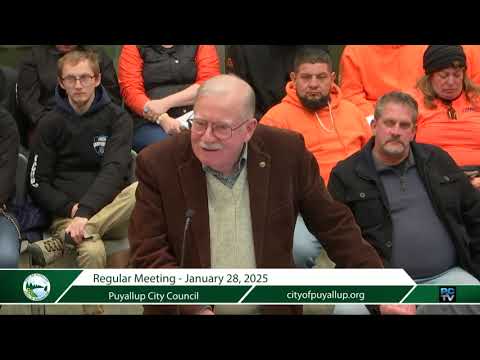
Puyallup held a public hearing Jan. 28 on its draft 2044 comprehensive plan update, which staff prepared to comply with state Growth Management Act requirements and new housing legislation. The planning commission previously held hearings and on Dec. 18 recommended the draft with a 4–1 vote and 15 amendments; staff included further minor technical amendments requested by state and regional reviewers.
Why it matters: The periodic update sets the city’s goals, future land‑use map and policy framework for the next 20 years. It determines where growth will be directed, how the city will accommodate higher housing targets and how infrastructure priorities will be sequenced.
Key elements and changes: Kendall Walz, senior planner, summarized updates across required and optional plan elements. The draft increases emphasis on housing choices, middle housing and ADUs to meet new state mandates; updates growth targets for the 20‑year planning period (city staff cited a 2044 population target of about 61,500, implying roughly 7,500 new housing units and close to 15,000 new jobs); and reorganizes and simplifies the land‑use and transportation elements. The transportation update shifts toward multimodal level‑of‑service standards, considers grid connectivity and prioritizes state‑of‑good‑repair investments. The parks element was realigned with the city’s 2020 Parks, Recreation and Open Space plan.
Housing mandates and code work: The plan reflects recent state bills noted during the hearing — including House Bill 1220 (housing affordability, disparate impacts and emergency housing), HB 1337 (ADU provisions) and HB 1110 (middle housing). The draft adds analysis required by state guidance: land‑capacity calculations for housing priced at different income tiers (moderate, low and extremely low), a new section on displacement risk and proposed code amendments to accommodate emergency housing where appropriate. Walz said remaining code work (such as updating the city’s critical‑areas ordinance and clear‑and‑objective design standards for downtown) will follow the plan’s adoption.
Map changes and special requests: Staff proposed future‑land‑use refinements to support density in regional growth centers (downtown and South Hill), convert some auto‑oriented commercial corridors to mixed‑use commercial and create limited neighborhood commercial nodes. Two privately requested map changes were noted: a small adjustment in the South Hill Business and Technology Center and a Washington State Fair request to expand the fair designation on adjacent parcels. Staff and fair representatives told the council they will coordinate a concurrent zoning‑and‑code package to address fair‑specific parking and use rules before any zoning change becomes effective.
Public comment and concerns: Speakers supported housing increases and downtown activation; others raised concerns about parking, neighborhood commercial nodes and insertion of politically sensitive language in the plan’s foundations element. The planning commission had previously noted both support for the draft’s technical work and reservations about some state‑mandated content.
Process and next steps: City staff said the comprehensive plan and supporting checklists were submitted to the Puget Sound Regional Council and Department of Commerce on Dec. 20, 2024, and additional technical comments may result. Staff recommended the council consider the planning commission’s 15 amendments plus six minor staff‑recommended edits generated after agency review. Walz told the council the city expects to bring the ordinance for first reading at the end of February and second reading at the end of March, with further opportunity for amendments and final adoption after council deliberation.
Ending note: The update rebalances policy language, land‑use designations and regulatory follow‑up to meet state requirements while preserving council‑directed choices on downtown form, public amenities and subarea visions. Staff flagged that additional agency comments could lead to further limited edits ahead of formal ordinance readings.