Get Full Government Meeting Transcripts, Videos, & Alerts Forever!
Get email alerts on the Utilities Streetlights topic
No spam. Unsubscribe anytime.
Ohio Edison rep explains storm restoration priorities, streetlight reporting to Struthers council
Summary
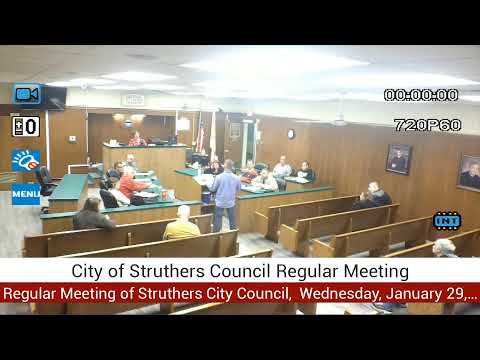
Troy Rhodes, external affairs director for Ohio Edison/FirstEnergy, told the Struthers City Council on Jan. 29, 2025, that electric restoration after major storms is triaged by public-safety priorities and circuit size and urged residents to track outage ticket numbers when reporting hazards.
Troy Rhodes, external affairs director for Ohio Edison/FirstEnergy, told the Struthers City Council on Jan. 29, 2025, that electric restoration after major storms is triaged by public-safety priorities and circuit size and that residents should track outage ticket numbers when reporting hazards.
Rhodes said restoration crews prioritize life-safety locations such as hospitals, 911 centers, fire and police facilities and polling locations on election days, then address the largest circuits first because they serve the most customers. "Priorities are first hospitals, like safety, then public safety, fire, police, departments, 911 cells," Rhodes said.
The council heard several operational details that bear on how quickly lights and service are restored. Rhodes said the city has roughly 780 street lights; the count he gave breaks down as about 740–745 traditional municipal street lights, roughly 25 energy-only "Struthers" post lights that the city provides power for but must maintain, and additional private outdoor-area lights. He told the council that 146 street lights were reported out in 2024 and that Ohio Edison has a three- to five-day window to respond to reported streetlight outages once a work request is logged.
Rhodes described the company's "global ETR" (estimated time of restoration) practice: when a large storm generates many simultaneous reports, the global ETR identifies when the last outage reported during a given window is expected to be restored. "That doesn't mean that's when everybody will be restored," he said, adding that the company works with county emergency management agencies to provide more localized updates.
Council members and residents raised several recurring concerns: how to identify and report the correct pole or light, who owns poles when replacements leave an empty or leaning pole behind, and how long utilities other than Ohio Edison take to transfer their lines to a newly installed pole. Rhodes said the company uses a system called SPANS to notify other utilities after a pole replacement and that the sequencing of work (electric, then cable, then phone, then fiber) can leave old poles standing until all parties complete transfers.
Rhodes also addressed vegetation and pole-safety issues. He said Ohio Edison trims only around its top wires and that other companies (cable, fiber) do not always have the same trimming obligations. He advised residents to report limbs on lines so the company can evaluate whether the wires in question are electric or belong to another utility.
Rhodes encouraged a stronger local reporting process and recommended that the city post a direct link to Ohio Edison's outage and streetlight reporting form on the municipal street department page; a council member noted the link already exists but could be made more visible.
Resident Kevin Walsh told the council about specific leaning and empty poles on State Street and asked who would be responsible if a damaged pole became a public-hazard. Rhodes said responsibility depends on pole ownership and explained the process the company uses to identify and coordinate removals with other utilities.
Why it matters: Streetlight outages and damaged poles affect public safety, pedestrian and traffic visibility, and emergency response. Rhodes gave the council practical steps (get an outage ticket number, call every two hours for updates on a barricaded line) and described regulatory and operational constraints that affect how quickly repairs and pole removals occur.
Rhodes offered to provide the city with the 2024 report of reported-vs.-repaired dates and contact information for other utilities. He also advised city staff and residents to include nearby addresses or mark a pole when reporting so crews can identify the correct unit during daylight repairs.
The presentation concluded with an offer by Rhodes to follow up directly with Safety Service Director Bob (name as in meeting) and others on specific problem poles and to provide the requested data for 2024.