Get Full Government Meeting Transcripts, Videos, & Alerts Forever!
Get email alerts on the Early Childhood Care topic
No spam. Unsubscribe anytime.
State officials outline rollout, spending and remaining requests from House Bill 1540 to expand early childhood care
Summary
Health and Human Services officials told the Appropriations — Human Resources Division committee that programs funded by House Bill 1540 have added licensed capacity, launched new facility and inclusion grants and expanded quality-improvement supports, and requested additional funding to sustain and grow those initiatives.
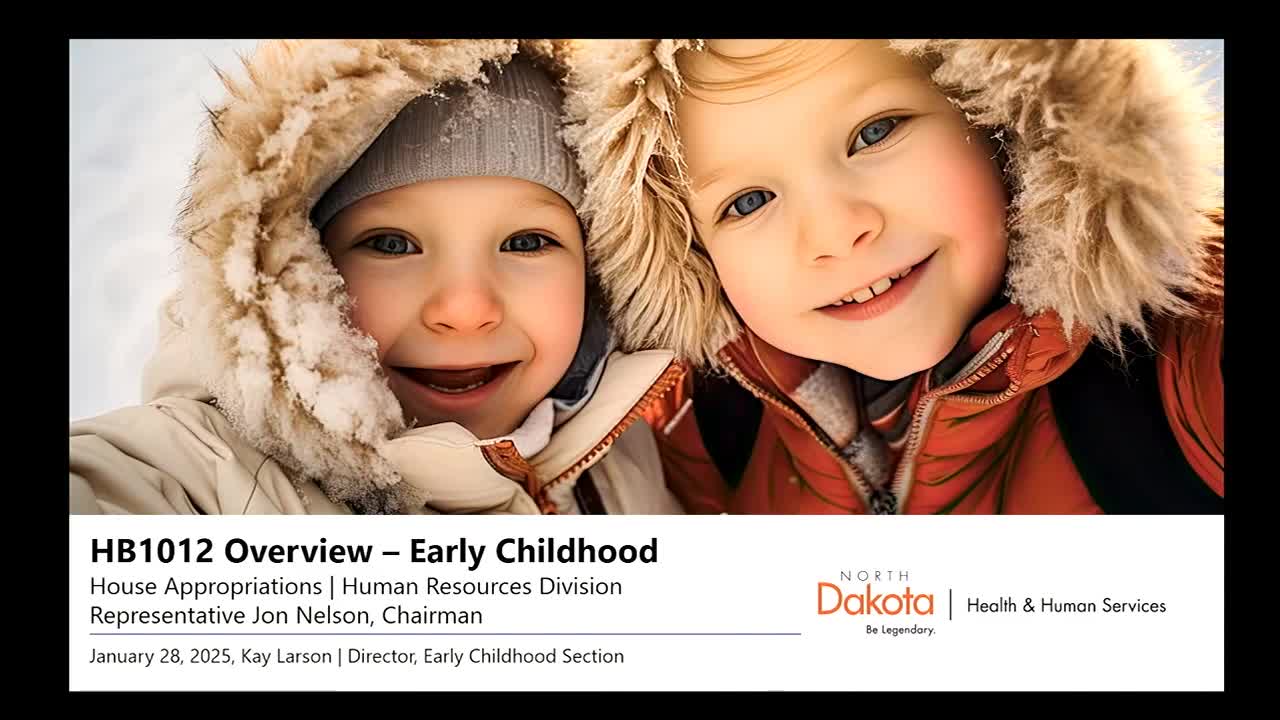
Kaye Larson, Early Childhood Section director for the North Dakota Department of Health and Human Services, briefed the Appropriations — Human Resources Division committee on implementation of House Bill 1540 and related early childhood work, saying the department has used legislative and federal funds to add licensed child care capacity, deliver facility improvements and expand quality supports.
“By this grant round we have 720 newly available child care spots and 468 of those spots are in programs that are located in underserved areas,” Larson told the committee during the department’s presentation. She said the department tracks underserved counties by a threshold of “3 or more children for every licensed child care slot.”
The department said its early childhood portfolio combines state general funds, federal Preschool Development Grant (PDG) and other federal funds and contracts with several statewide vendors. Larsson described a mixed-delivery system that deploys licensing specialists, contracted coaches and assessment vendors, and programs such as Waterford Upstart and Best in Class to target readiness for children ages 0–5.
Why it matters: legislators pressed for details on how the department defined grant eligibility, how dollars were targeted and how progress will be measured. Committee members repeatedly asked for trend lines, age breakdowns of licensed capacity and documentation of grant demand before the panel considers additional appropriations.
Key details and current results presented by HHS: - Licensed programs and capacity: the department reported 1,183 licensed and self-declared child care programs with a licensed capacity of 38,957 slots statewide (providers in every county except one). Larson said the department will provide more granular age breakdowns by infant, toddler and older children as an estimate because North Dakota licenses programs rather than individual child ages. - Grants from HB1540: the child care initiative included a single $7 million line for grants and shared services; HHS said it allocated that amount across startup/expansion grants, facility improvement grants and other shared-service supports. Larson said about $1 million was set aside for startup/expansion and nearly $2 million has been distributed for facility improvement grants to date. - Facility grants: the department described awards for repairs, flooring, kitchen/heating upgrades and natural playscapes and said there are roughly 133 applications still under review from the initial April solicitation. Committee members asked whether grants required a local match; HHS said ceilings vary by provider type and there is no universal match requirement, though some projects include partial provider contributions. - Quality rating and improvement (Bright & Early North Dakota/QRS): 931 providers are participating in the state QRS. HHS reported a net increase of about 3,800 “quality” spaces across steps 2–4 of the rating system and said participation in QRS has grown by 25% in the current biennium. - Best in Class and Waterford Upstart: HHS said 57 Best in Class programs are in the current cohort and 1,066 families participated in Waterford Upstart this year; the department reported nearly 6,000 children have used Waterford Upstart since initial funding. Larson said Best in Class targets slots for children at or below 60% of state median income or children with disabilities. - Inclusion and coaching supports: HHS credited expanded inclusion specialist capacity (contracts with Aspire ND) with a 209% increase in inclusion support instances and said the department is asking to retain an additional inclusion coaching role whose funding expires in 2025. - Employer-led Working Parents Childcare Relief: HHS reported 49 employers and 395 parents participating in the employer-match program that the state matches; the department said employers headquartered outside North Dakota can participate if they opt in for their North Dakota employees and that the policy was clarified after early implementation questions. - Nontraditional hours pilot: HHS described pilot programs that expanded evening and overnight care (some operations until 11:00–11:30 p.m., one 24/7 site) and said these pilots required logistical license increases to serve second-shift families.
Requested next steps and decision-package amounts presented to the committee: - Best in Class expansion: a request for $6,000,000 (the governor’s budget places $18,000,000 base and additional SIF/one-time amounts in the executive recommendation; HHS said the governor designated part of the request as one-time SIF funding). HHS described the request as intended to expand service to roughly 1,500 children in year one and 1,800 in year two depending on classroom sizes. - Teaching Strategies (assessment portfolios): $100,000 to purchase additional portfolios for classroom assessment and child progress tracking. - Inclusion support services: $172,500 to preserve an additional inclusion specialist role supported by expiring funding. - Infrastructure for quality improvement: $3,000,000 to maintain the infrastructure that supports QRS participation, coaching and technical assistance. - Child care provider grants, resources and shared services: $5,000,000 request to continue facility, startup/expansion and shared service supports (HB1540 originally appropriated $7,000,000 for these items and HHS said demand exhausted prior allocations).
Committee members asked HHS to provide follow-up information on: the number of providers that applied and their requested amounts for startup/expansion grants; a trend line of total licensed capacity and workforce registry growth; a breakdown of licensed slots by infant/toddler/3–5 age groups (estimated because the state licenses programs not ages); geographical distribution for QRS and Best in Class participation; and employer participation details for the working-parents match program. HHS said it would provide trend data, maps and the requested application detail at a subsequent meeting.
Quotes from administration staff and committee members appear in the record. Larson closed with an appeal to continued investment: “Continued investment in child care makes a difference,” she said, summarizing the department’s view that licensing, coaching, facilities and employer-match supports act together to increase safe, high-quality options for families.
What was not decided: the committee did not take formal votes on any HB1540-related appropriations during the hearing. HHS’s requests listed above are pending committee and executive budget review.
The department said additional materials and appendices — including quarterly trend lines, maps of provider participation and a full list of participating employers in the working-parents match — will be made available to the committee for follow up.