Get Full Government Meeting Transcripts, Videos, & Alerts Forever!
Get email alerts on the Chins Navigators topic
No spam. Unsubscribe anytime.
Lawmakers, schools and law enforcement press HHS on CHINS navigators and chronic absenteeism
Summary
Committee members and HHS officials discussed the Children in Need of Services (CHINS) program, its navigator model, and concerns from schools and law enforcement that the current staffing model lacks enforcement power and needs more capacity.
BISMARCK — Lawmakers, school officials and law enforcement representatives have raised concerns about the capacity and authority of CHINS (Children in Need of Services) navigators after responsibility for many CHINS referrals moved from juvenile courts to human‑service zones.
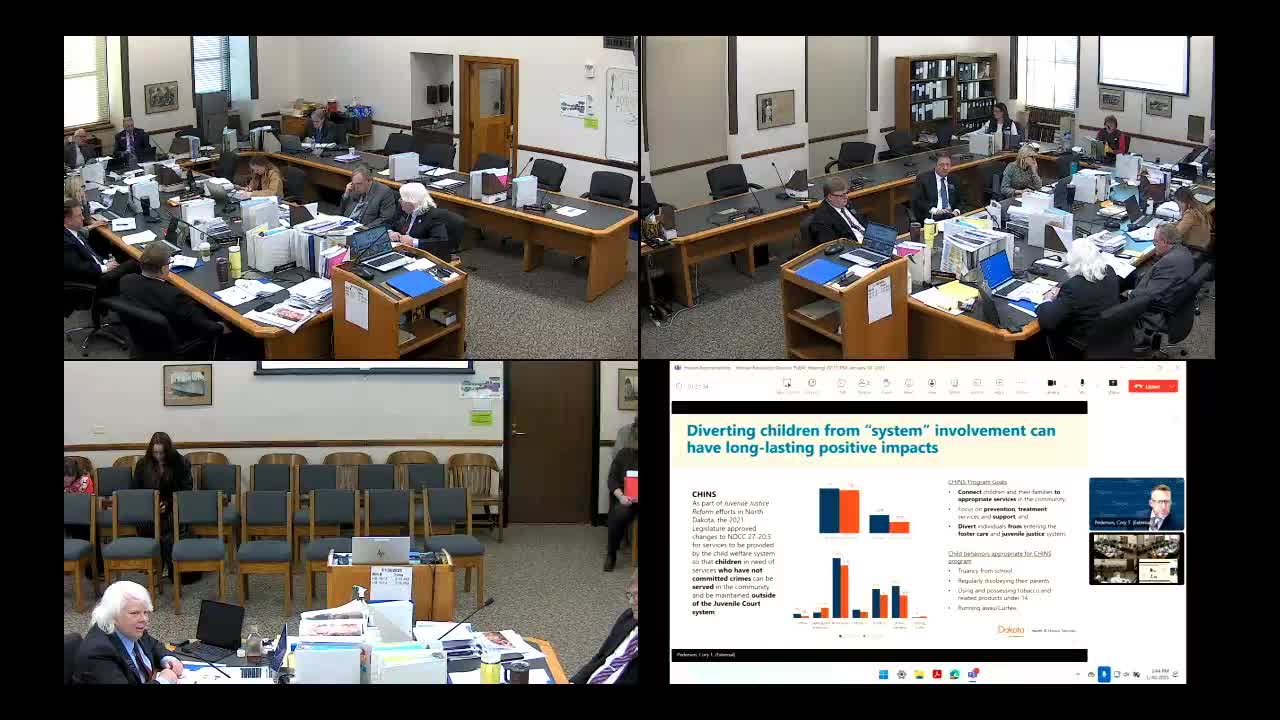
Corey Peterson of HHS described how the CHINS team operates: an eight‑person statewide team — one supervisor and navigators hired out of a host zone — that receives referrals from schools, parents and police and “navigates” families to services rather than providing court‑ordered case management. Peterson said CHINS staff are intended to divert youth from juvenile court and deeper system involvement.
Concerns from lawmakers and local leaders
- Limited capacity: Several members, including Representative Murphy and Representative Scott, said local meetings with school officials showed CHINS workers are spread thin and sometimes only hand families a pamphlet rather than provide active assistance.
- Role and authority: Legislators asked whether CHINS workers should have more enforcement or case‑management authority. HHS said the program is designed as a voluntary navigator model and that there is no court enforcement mechanism built into CHINS referrals; if families decline help there is no immediate court action unless subsequent referrals change the response.
- Geographic coverage and staffing: HHS staff acknowledged the current team size is small relative to the need in some communities. Peterson and the CHINS supervisor said decisions about adding navigators depend on whether the legislature wants the workers to provide case management or maintain a navigator role; the budget for CHINS navigators comes from zone budgets.
Pending legislation and next steps
Peterson told the committee House Bill 1328 would expand schools’ ability to refer to CHINS, a change that could increase CHINS workload. Multiple legislators suggested regional meetings to map service gaps and expectations among schools, law enforcement and zones; HHS said regional convenings are already being discussed.
Quote
Representative Murphy summarized concerns from local schools: “The CHINS people give the parents a pamphlet and say you should go do some of this stuff, and that's about the level of the intervention,” he said in committee remarks after hearing from attendees.
Ending
HHS said it will continue to convene regional stakeholders, evaluate whether additional navigators or a different model (case management vs. navigation) is required, and provide the committee with more data on CHINS referrals and capacity if requested.