Get Full Government Meeting Transcripts, Videos, & Alerts Forever!
Get email alerts on the Safety Framework Audit topic
No spam. Unsubscribe anytime.
Audit prompted safety framework changes; HHS reports improved face‑to‑face response rates
Summary
HHS told the House committee an audit found the state was not consistently meeting face‑to‑face response timeframes for child protection reports; the department described policy categories and said recent data show a measurable improvement in on‑site contacts.
BISMARCK — Department of Health and Human Services officials told the House Appropriations Human Services Division on Thursday that a state audit found the child‑protection system had not always met required face‑to‑face response timeframes, and that a safety framework implemented in 2020 has since improved performance.
Kirsten Hansen, administrator for child protection and prevention services, and Corey Peterson, director of Children and Family Services, described how the department categorizes reports and responds under policy. Peterson said the audit focused on whether the field complied with timeframes for face‑to‑face contact with alleged child victims.
What the audit found and how HHS responded
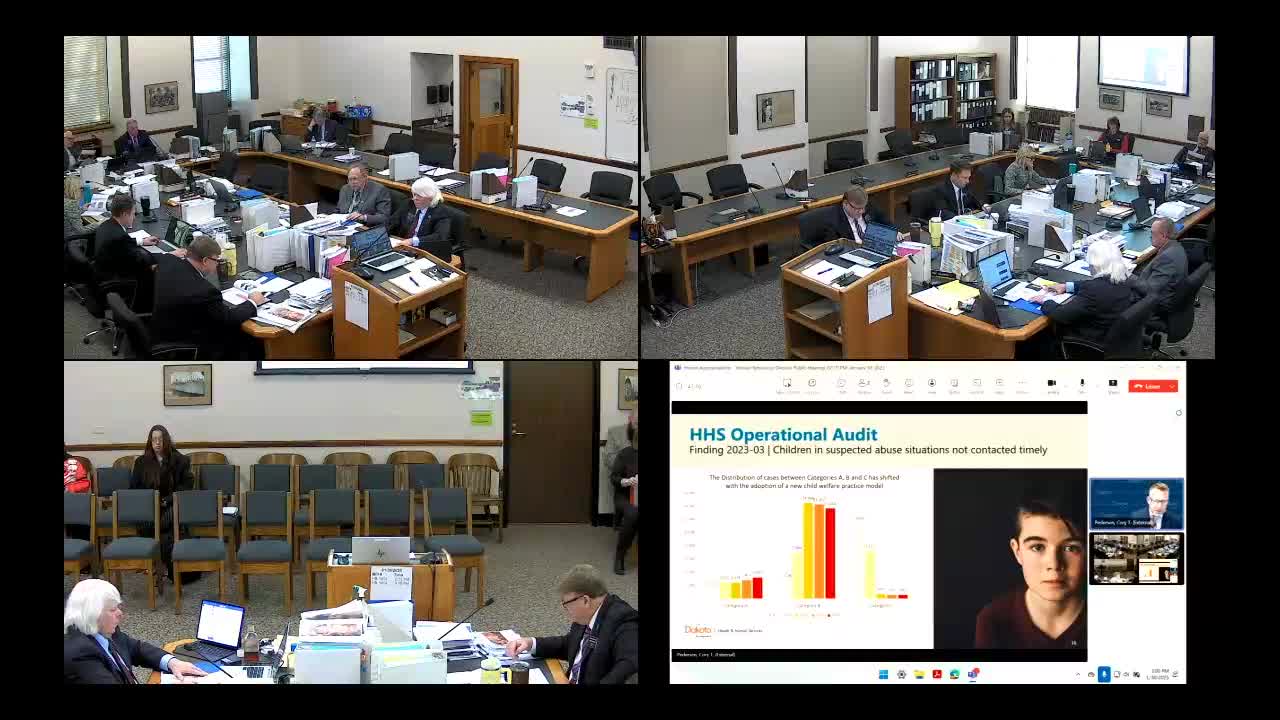
- Response categories: HHS staff explained the three policy categories: Category A (24‑hour response) for major injuries and severe allegations; Category B (72‑hour response) for moderate concerns such as minor injuries; and Category C (14‑day response) for lower‑risk matters such as alleged educational neglect or inadequate clothing in some cases. Peterson said many cases formerly coded as Category C have moved into Category B under the safety framework.
- Audit exceptions: Officials emphasized the policy contains specific exceptions that can delay contact, including active law‑enforcement investigations or difficulty locating a family (no answer at door, child not at school), and coordination with children’s advocacy centers.
- Measured improvement: Peterson told lawmakers that between 2020 and 2024 the number of in‑person assessments rose 24 percent and that zones have improved timeliness. He said larger urban zones (Fargo/Cass, Grand Forks, Minot and Bismarck) account for a disproportionate share of volume and that when those zones slip the statewide average declines.
- Ongoing federal review: Peterson said the state is currently in a federal audit with the Children’s Bureau and that the department expects to report on performance near the end of March 2025; if necessary HHS will submit a program improvement plan.
Why it matters: Timely face‑to‑face assessments are a federal and state performance measure that affect child safety reviews and can trigger federal oversight if the state fails to meet standards.
Quote
- Peterson: “We have increased the number of cases that we're seeing face to face by 24%,” and he added that “the number 1 thing… their number 1 reason for this work is to keep kids safe.”
Ending
HHS told the committee it has layered quality‑assurance reviews, an executive continuous quality improvement team and zone‑level reporting to monitor timeliness and compliance; lawmakers requested continued updates and more granular data by zone.