Get Full Government Meeting Transcripts, Videos, & Alerts Forever!
Get email alerts on the City Government Notice topic
No spam. Unsubscribe anytime.
Charter, ordinance changes on electronic notice tabled for revision after solicitor review
Summary
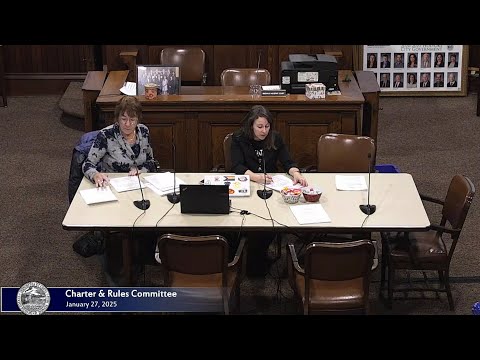
The Holyoke City Council Charter & Rules Committee on Jan. 27 discussed an order to update the Holyoke City Charter and municipal code to accept electronic transmission as sufficient public notice for special meetings and to specify alternate delivery for members who do not use electronic communications.
The Holyoke City Council Charter & Rules Committee on Jan. 27 discussed an order to update the city charter and ordinances to accept electronic transmission as sufficient notice for special meetings and to clarify alternate delivery methods for council members who do not use electronic communications.
Committee Chair Meg McGrath Smith said the orders (from Councilors Givner and Talman, filed Oct. 3, 2023) would change “special meetings of city council” language to permit electronic delivery in place of earlier, mail-focused wording. She asked Solicitor Bissonnette for advice on drafting language that will remain usable as technology changes.
Solicitor Bissonnette recommended substituting a broad “electronic communication” term for specific references to email so the charter would not be rendered anachronistic as technology evolves. He also proposed keeping alternatives for members who do not use electronic methods — for example, allowing an individual to elect hand delivery or first-class mail, or another locally defined alternate delivery method.
Councilors debated practical consequences. Councilor Bacon argued for keeping a rarely used backup option such as hand delivery to respond to short-notice special meetings, noting first-class mail can take several days and may not meet a 48-hour notice standard. Councilor Carmen Ocasio and other councilors said mailed agendas sometimes arrive after meetings, and that needs operational attention. Chair McGrath Smith and councilors expressed a preference to place finer implementation details into ordinance language so the charter amendment could remain general while the council could adjust delivery specifics by local ordinance.
City Council Assistant Jeffrey explained current practice: agendas are mailed for those who request them but mailing schedules depend on when chairs finalize agendas; he said three members currently receive mailed packets. Jeffrey and Bissonnette noted the open meeting requirements impose a 48-hour notice standard for special meetings and that any alternate method must still comport with the state open meeting law.
After discussion, the committee voted to table the orders for further revision. The committee asked Solicitor Bissonnette to redraft the charter language to use a broad “electronic communications” term, to develop companion ordinance language (section 2-58) specifying alternate delivery methods, and to meet with the maker and the city clerk for operational input. The motion to table passed unanimously.
What happens next: the solicitor will revise the language and the committee will reconvene the item with proposed ordinance language and clerical input before forwarding any charter change to the mayor and state as required.
Quote: “I would like to... devise a way for members who are not electronically inclined... to have their agenda and notices delivered hand delivered, or... mailed,” Solicitor Bissonnette said during the discussion.
Ending: The committee did not advance a charter amendment at this meeting; it instructed staff and the solicitor to return with revised language that places delivery specifics in ordinance and keeps the charter amendment broad so it endures future technological change.