Get Full Government Meeting Transcripts, Videos, & Alerts Forever!
Get email alerts on the Public Lands And Parks topic
No spam. Unsubscribe anytime.
Boulder County commissioners delay decision to dissolve Gunbarrel Public Improvement District after large turnout
Summary
After hours of testimony from residents, the Boulder County Board of County Commissioners voted Jan. 16 to table action on dissolving the Gunbarrel Public Improvement District and transferring six open‑space parcels to County Parks and Open Space for at least 180 days so staff can pursue more analysis and outreach.
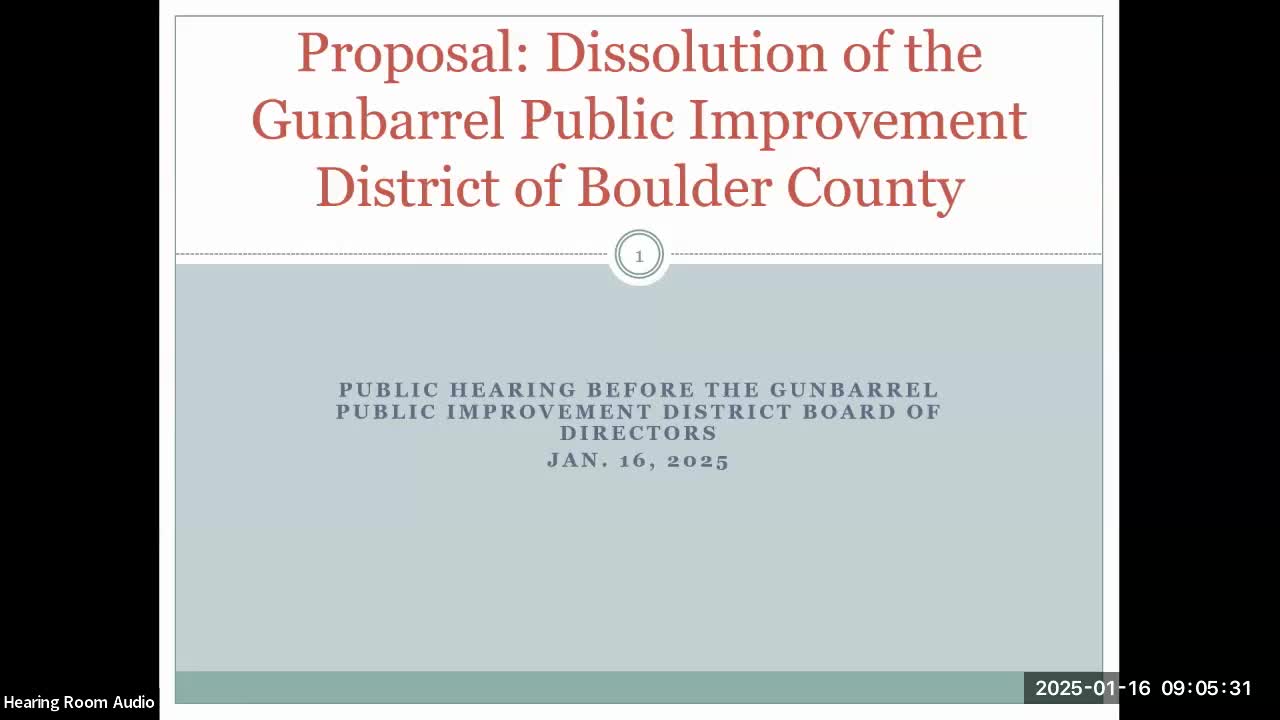
The Boulder County Board of County Commissioners on Jan. 16, 2025 voted to table indefinitely — with a minimum delay of 180 days — a proposal to dissolve the Gunbarrel Public Improvement District and to transfer six open‑space parcels to Boulder County Parks and Open Space.
The proposal on the table would have dissolved the GPID under Colorado Revised Statutes and conveyed six parcels that the district had purchased or jointly purchased in the 1990s to the county for continued open‑space management. Commissioners instead directed staff to return with additional legal analysis, options to preserve the properties’ open‑space status and more community outreach.
Why this matters: The GPID holds several parcels acquired in the 1990s that residents and speakers at the hearing estimated together at roughly 250 acres and, by several resident statements, a market value on the order of tens of millions of dollars. Speakers at the hearing said residents approved taxes and bonds in the 1990s to buy and protect open space and argued the county should not transfer ownership without fuller notice to district electors or clearer protections tied to those parcels.
Olivia Lucas, Senior Assistant County Attorney, told the commissioners the GPID was formed in 1993 with two stated purposes: acquisition/management of open space and street grading/paving. Bonds and an elector‑approved mill levy financed the purchases and the district’s road work; the district’s paving and road activity largely ended by 1996 and the district has been inactive since about 2007, Lucas said. She said the creation last year of a Homestead subdivision PID with paving authority inside the larger GPID raised a statutory concern: Colorado law discourages overlapping PIDs with the same purpose, so staff proposed dissolution to remove ambiguity and allow subdivision paving PIDs to proceed without the risk of overlapping taxing authority.
County staff summarized the GPID’s land purchases: Heatherwood Notch, Jaffee and James Construction parcels are reportedly owned in full by the GPID; Cohen, Johnson Trust and Churchill parcels were acquired jointly with Boulder County and have been managed by Boulder County Parks and Open Space as open space since their purchase. Janice Wissman, real estate division manager for Boulder County Parks and Open Space, told the board that county funds used for the county’s purchases came from the county open‑space sales tax.
Ramona Farreno, Boulder County chief financial officer, provided the district’s historical accounting: audited statements show active spending in the 1990s, an equity balance near $649,032 in 1998, large county contributions to two jointly purchased parcels (about $680,000 on Cohen and $785,000 on Johnson Trust) and a final transfer of about $17,655 from the district accounting fund into the county general fund in 2009 after the county closed the district accounting fund. Farreno said the $17,655 transfer was recorded in the county’s audited financial statements and that the district accounting fund no longer appears in the county’s published statements after 2009.
Members of the public — many of them Gunbarrel residents — urged the board not to dissolve the GPID and not to transfer the parcels. They raised three recurring concerns: (1) inadequate notice of the hearing (a newspaper notice Dec. 29 and a mailing residents say they received the second week of January), (2) an asserted outstanding county matching commitment and an unmet promise of a public park, and (3) the risk that parcels conveyed to county open space could later be disposed of or transferred in ways residents find unacceptable.
Donna George, who identified herself as a Gunbarrel resident, said residents want the district to remain active and accused the county of inadequate notice and of preparing a quitclaim deed to transfer valuable property to Parks and Open Space for $500. “Do the right thing and preserve the GPID so we can start working together,” she told commissioners. Several other residents described receiving mailed hearing notice only days before the meeting and urged a longer delay to allow broader community review and to explore alternatives.
Several speakers proposed alternatives to full dissolution: removing “paving” from the GPID’s enabling resolution so it could remain an open‑space entity; carving Homestead out of the GPID by petition of property owners; or convening the GPID advisory committee and restarting regular advisory meetings to address outstanding matters. County staff noted that carving out an area requires petitions and costs and that staff’s initial legal analysis suggested dissolution and property transfer would be the most administratively straightforward way to remove overlap.
Lucas told the board she could not yet confirm whether deed or title language would permanently bar disposition of the three parcels purchased solely with GPID funds and said she would return with further legal analysis. Janice Wissman explained that parcels purchased with county open‑space sales tax are subject to the sales‑tax ballot language: if the county ever sought to dispose of those particular county‑funded interests, the county would follow the formal disposition process (public notice, advisory committee review and a hearing before the Board of County Commissioners, with a 60‑day waiting period to allow for petitions). Lucas said there is no outstanding indebtedness on the GPID and that, under CRS 30‑25‑27, the board may dissolve a PID if it determines dissolution is in “the best interest of all concerned” and there are no outstanding obligations.
What the board did: Commissioner Stoltzman moved — and a colleague seconded — to table the two related actions (the transfer of GPID properties to Parks and Open Space and the dissolution of the GPID) indefinitely but not fewer than 180 days to allow staff to prepare additional analysis and outreach. The motion passed with all three commissioners voting in favor.
Next steps and outstanding questions: County attorneys said they would return with a fuller legal analysis of alternatives, including (1) whether deed or title restrictions (or other legal instruments) can provide permanent protection against future disposition; (2) what the specific legal exposure is from overlapping PIDs and whether removing paving as an enumerated GPID purpose would be sufficient; and (3) a clearer accounting of historical county commitments that residents say remain unpaid. Residents asked for re‑establishment of the GPID advisory committee and more time for neighborhood‑level discussions about maintenance, park development and potential new revenue if the community wanted enhanced services.
Residents who requested delay asked for at least 180 days; the board granted at least that minimum. Commissioners and county staff said they would use the break to gather the requested legal and fiscal details and to design additional outreach so the district electors and other stakeholders can review options before the board considers any transfer or dissolution.
Votes at a glance: The board did not approve dissolution or a transfer today. Two separate motions to table (transfer of property; dissolution of the district) were made, seconded and approved unanimously (three votes in favor).