Get Full Government Meeting Transcripts, Videos, & Alerts Forever!
Get email alerts on the State Auditor topic
No spam. Unsubscribe anytime.
Bill to update state auditor authorities advances after debate on subpoena power and audit fees
Summary
Senate Bill 2251, proposed changes to state auditor law, drew committee debate over adding subpoena authority for audits of non-government entities and removing agency billing for audits; supporters said changes increase oversight and efficiency, opponents asked for guardrails and clarifications.
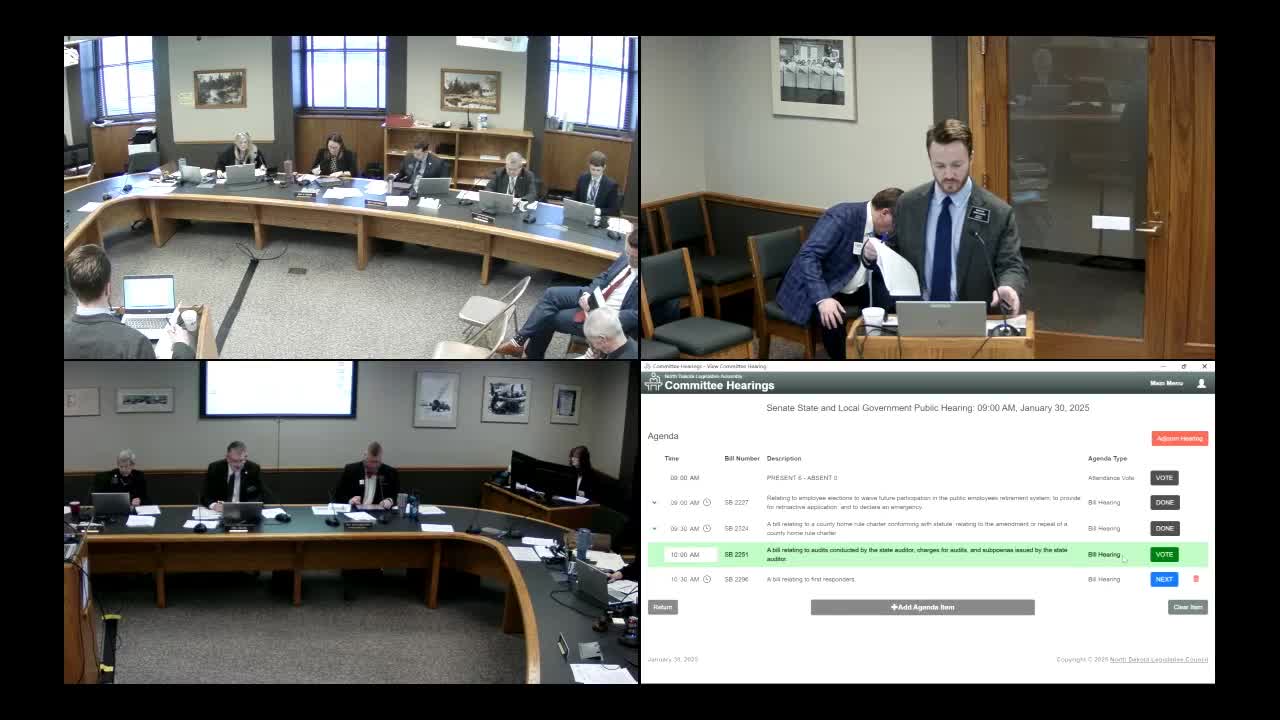
A package of changes to state auditing law drew extended testimony and questions at the State and Local Government Committee Monday as lawmakers weighed whether to give the state auditor broader subpoena authority and to change how audit costs are billed.
Senator Sean Cleary, sponsor of Senate Bill 2251, told the committee the bill makes five main changes: it would eliminate the auditor's authority to bill state agencies for special-fund audits; codify current practice to allow federal Single Audit costs to be paid from federal program funds; reduce retainage paid to auditors for local-government audits from 20% to 5% (a number committee members said could be adjusted); grant subpoena authority to the state auditor to compel records from non-government entities that receive public funds; and raise the threshold for required audits for occupational and professional boards from $200,000 to $2,000,000.
Dan Cox, director of audit services for the State Auditor's Office, said the billing change would extend the same benefit the university system already received to all state agencies and that the federal single-audit provision simply formalizes an existing practice. He said federal single-audit billing collected about $1.25 million last biennium and that state-agency audit billing had fallen to about $340,000 in the 2023-25 biennium as exemptions were added.
The proposal to reduce local-government retainage was presented as a response to requests from private-sector auditors who said a 20 percent holdback can create cash-flow problems while auditors await final approval of reports. Cox said the 5 percent figure was chosen as a practical compromise, but the office is open to alternate percentages if the committee prefers.
The most contested provision was a targeted subpoena authority for the auditor's office to obtain records from non-government entities that use public funds. Auditor Josh Galyon said the change would align North Dakota with about 37 other states and could have aided past audits, citing a prior pharmacy benefits management audit in which private entities declined to provide records. "We were never able to proceed," he said.
Committee members raised privacy and scope questions. Senator Lee said she was "a little anxious" about the subpoena power and emphasized that statutory penalties for refusing to cooperate (such as removal from office for public officials) would not apply to private entities; the sponsor and auditors said subpoenas would be used sparingly and that legal counsel (the attorney general's office) would be involved when necessary.
Several stakeholders, including the North Dakota Soybean Growers Association and the insurance commissioner, testified in support of removing the agency-audit billing requirement, saying it reduces an administrative loop that returns funds to the general fund. A filmmaker and members of the 911 community testified in related hearings that subpoena authority could be useful in specific cases involving grant or contract oversight.
No final committee vote on the bill was recorded in the transcript. Committee members asked auditors to provide more drafting detail, and the assistant attorney general said language could be added to require filing of amended home rule charters in a different bill; the auditor's office and sponsor left the committee with instructions to work with counsel on precise subpoena scope and retainage amount.
The debate highlighted tensions between transparency and privacy when audits touch private contractors and the trade-offs between audit oversight and the administrative cost of mandated audits for small entities.