Get Full Government Meeting Transcripts, Videos, & Alerts Forever!
Get email alerts on the Public Employees Retirement topic
No spam. Unsubscribe anytime.
Panel backs amendment to let retired state workers keep pensions while appointed to unclassified posts
Summary
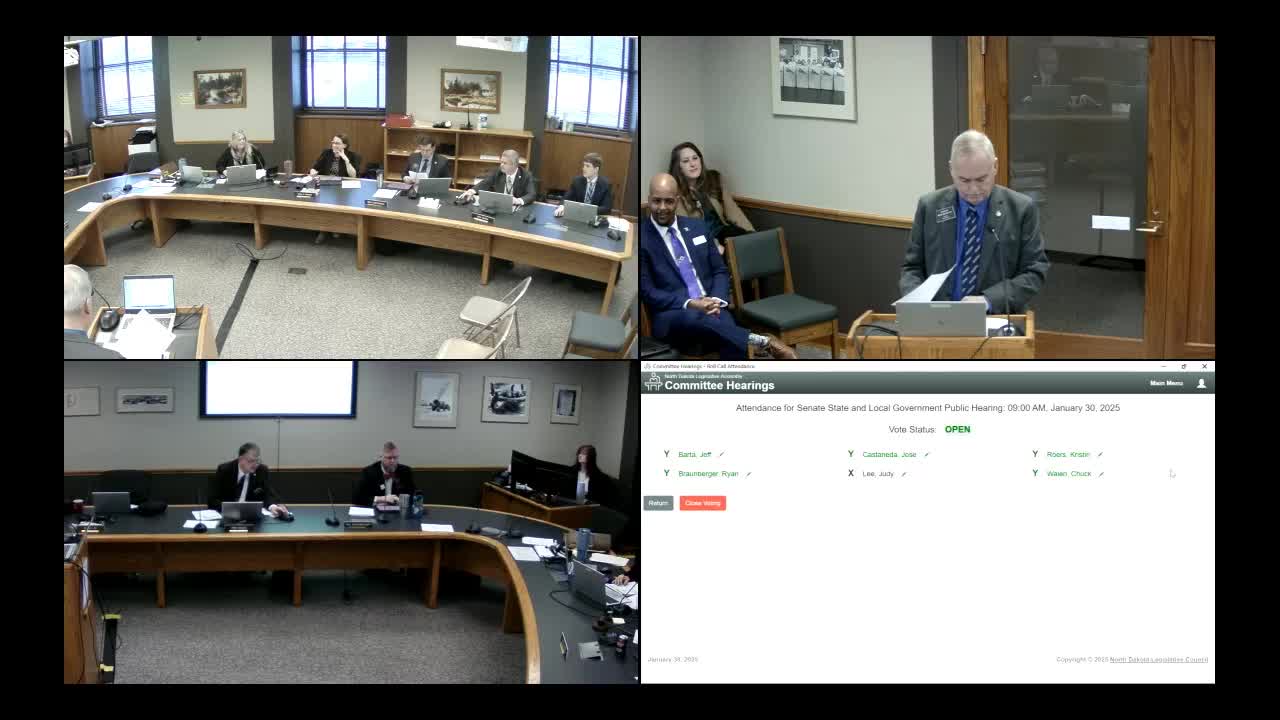
The Senate State and Local Government Committee voted 6-0 to adopt an amendment to Senate Bill 2227 to allow certain retirees to continue receiving Public Employees Retirement System benefits while serving in unclassified appointments, after clarifying federal tax and plan-qualification concerns.
The Senate State and Local Government Committee on Monday voted to adopt an amendment to Senate Bill 2227 that would allow certain retired state employees to continue receiving retirement benefits while accepting appointment to unclassified positions without rejoining the Public Employees Retirement System (PERS).
Senator Brad Beckettall, sponsor of the bill, told the committee the measure was requested by Governor Armstrong to permit the administration to hire retired North Dakota employees without forcing them to suspend retirement pay or resume PERS contributions. "Some of his senior cabinet officials under the current PERS system statutes would be unable to accept employment without compromising their current retirement pay situation," Beckettall said.
Rebecca Fricki, executive director of the North Dakota Public Employees Retirement System, testified in opposition to the bill as introduced, saying the original language created a plan-qualification problem with federal tax rules. Fricki said the issue was that, as drafted, retirees returning to work for the same employer would be given an irrevocable election to participate or waive participation, which could create an impermissible cash-or-deferred arrangement under Internal Revenue Service rules. "Giving a retiree of the plan who has returned to eligible employment with the same employer the opportunity to either join or waive gives them a choice ... and that creates an impermissible cash or deferred arrangement with the IRS," Fricki said.
Beckettall and PERS staff said an amendment (identified in committee papers as the provisions responding to their federal tax advisor Ice Miller) would remove the elective choice and instead make the affected retirees ineligible to participate in the retirement plan while serving in the specified unclassified appointments. Fricki said that change would resolve the IRS concern and leave the PERS board neutral on the bill.
Chris Joseph, general counsel for the governor, told the committee the bill would "allow the governor and other elected officials on the executive branch to hire the most experienced people in their fields and bring them back to service." Committee members questioned implementation details, including how many employees could be affected; Fricki said the population is expected to be narrow.
The committee unanimously adopted the amendment (referred to in committee testimony) on a motion by Senator Wallen, seconded by Senator Barta, and later voted 6-0 to give the bill a "do pass as amended" recommendation (motion by Senator Castaneda; second by Senator Lee). Senator Wallen volunteered to carry the bill.
The committee record shows the amendment was intended to remove the retiree's choice to participate, thereby addressing the IRS plan-qualification concerns while allowing retirees appointed to certain unclassified positions to continue receiving retirement benefits without making PERS contributions.
No actuarial estimate requiring a fiscal referral was reported; PERS noted it had commissioned actuarial and tax analyses and would testify further if the bill advances.
Committee action moves SB 2227 to the next step with the amendment in place; further legislative consideration will determine whether the change becomes law.