Get email alerts on the Apprenticeship Grants topic
No spam. Unsubscribe anytime.
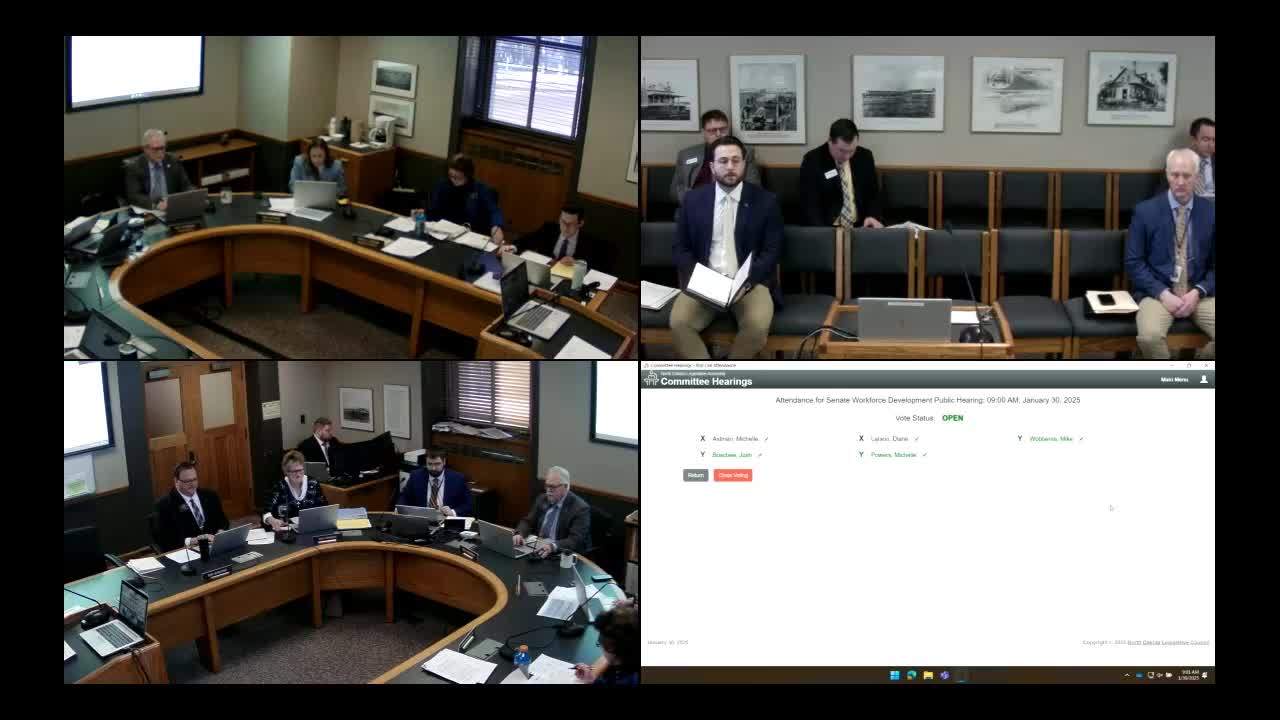
Senate committee hears bill to create statewide apprenticeship grant program
Summary
The Senate Workforce Development Committee heard testimony on Senate Bill 2239, which would create a grant program to help apprentices pay upfront costs. Supporters said the program addresses gaps left by an expanded North Dakota scholarship and urged alignment with a separate bill to house apprenticeship services in Job Service North Dakota.
Sen. Josh Beauchez, District 44, introduced Senate Bill 2239 to the Senate Workforce Development Committee, saying the bill "would create a grant program to support apprenticeships throughout the state." The bill is intended to help people afford start‑up costs for registered apprenticeships and to expand apprenticeship opportunities beyond traditional trades into healthcare, technology, manufacturing and public service.
The nut graf: Supporters told the committee the proposal closes a gap created when the Legislature expanded the North Dakota Scholarship last session to cover apprenticeships but left GPA eligibility rules that exclude many apprenticeship candidates. The bill would provide a separate grant program for apprentices who do not qualify for the scholarship or who face upfront costs such as tools and work boots.
Testimony in support came from state officials and workforce partners. Zachary Greenberg, interim commissioner of the North Dakota Department of Labor and Human Rights, recommended the apprenticeship office be housed within Job Service North Dakota, saying that would create "consistency in program administration" and "maximize employer engagement." Phil Davis, workforce services director at Job Service North Dakota, told the panel Job Service tracks employers and apprentices in the RAPIDS system and said North Dakota currently lists 103 employers and 1,765 apprentices in that federal registry.
Katie Ralston Howe, workforce director for the Department of Commerce and executive director of the North Dakota Workforce Development Council, said apprentices often face upfront costs and that the proposed grant would remove a barrier to entry. Wade Sik, state director for the Department of Career and Technical Education, said SB 2239 focuses on apprentices’ needs at the time they enter programs, not on past academic records.
Several witnesses noted a related House bill, HB 1036, which would create a Division of Apprenticeship; panelists urged the committee to align SB 2239 with HB 1036 so the grant program and any apprenticeship office operate in the same agency. Witnesses said that if Job Service were assigned the apprenticeship office, the administrative costs for the grant could be absorbed if HB 1036 included funding for three full‑time equivalent staff.
Committee questions covered GPA eligibility, industries targeted by the grant, coordination with employer‑provided supports, and typical apprenticeship duration and costs. Davis said, based on RAPIDS data, apprenticeships in the state range from roughly six months to four years; one witness who completed an apprenticeship estimated initial participant expenses at about $2,000, though witnesses said a precise average cost was "not specified." Several witnesses recommended rules to prevent duplicate payments when employers or other scholarship programs already cover specific costs.
The committee closed the hearing on SB 2239 after receiving supportive testimony from business groups including the Greater North Dakota Chamber and the National Federation of Independent Business, and from stakeholders who recommended making sure the program administration aligns with where the apprenticeship office is ultimately placed.
AI generated
The text on this page is AI generated. Summaries, highlights, analysis, and video transcripts are all produced from the original source material.
AI can make mistakes, so if you spot one, and we will fix it for everyone.
Note: the source content is unaltered by us. Any content source we link to, be it a video, an audio recording, or a document, is presented exactly as its publisher released it. That publisher is usually a government body, sometimes an individual official or another organisation.