Get Full Government Meeting Transcripts, Videos, & Alerts Forever!
Get email alerts on the Waterfowl Habitat Stamp topic
No spam. Unsubscribe anytime.
Senate committee backs work on $10 waterfowl stamp to fund habitat and youth programs
Summary
Senate Bill 2216 would create a $10 waterfowl registration stamp or license for resident and nonresident hunters to fund waterfowl habitat restoration and youth hunting programs. Game and Fish and hunting groups supported the bill and the committee agreed to work on an amendment to clarify administration and matching funds.
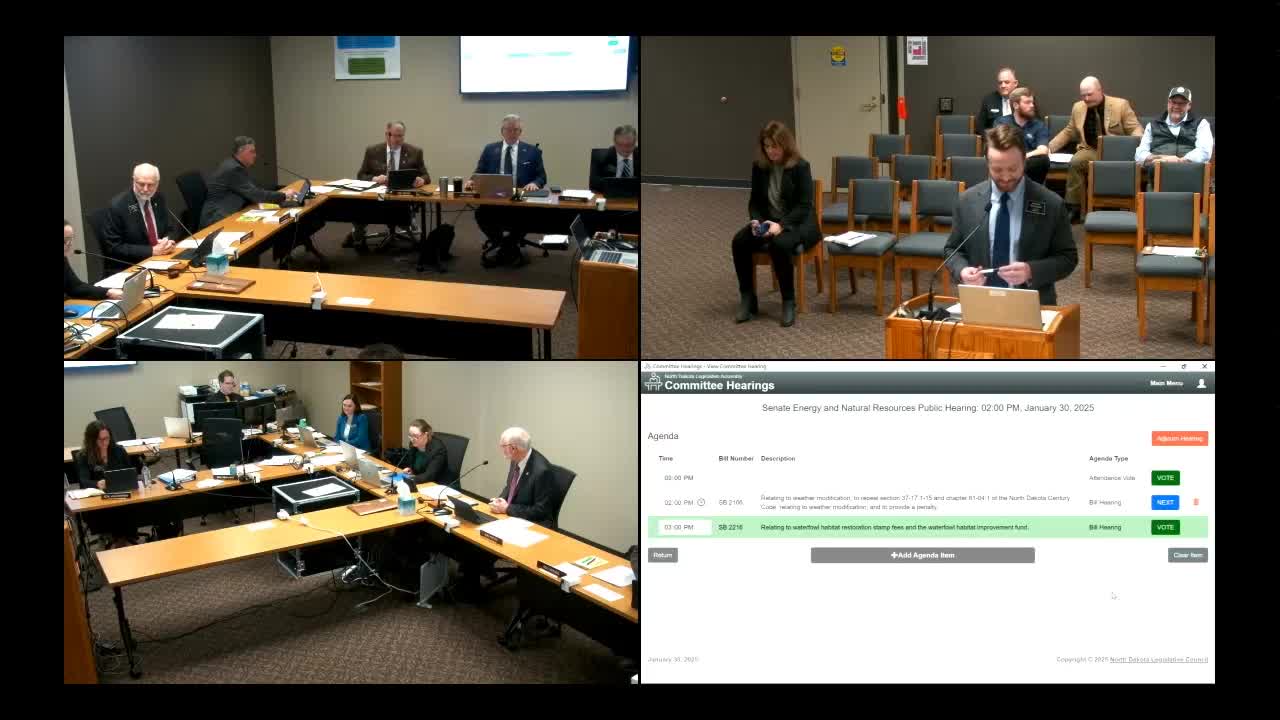
Senator Sean Clary introduced Senate Bill 2216 to the Senate Energy and Natural Resources Committee, asking lawmakers to create a dedicated waterfowl habitat improvement fund financed by a $10 waterfowl registration stamp or license for residents and nonresidents.
"Since proposing the bill, I did bring with me an amendment that I brought you a physical copy of," Senator Clary told the committee, describing the measure as intended to "supply funding for the waterfowl habitat improvement fund" and to support habitat restoration and youth hunting programs.
Supporters told the committee the stamp would give the North Dakota Game and Fish Department better data on resident waterfowl hunters and provide a dedicated, modest revenue stream for habitat work and youth outreach. Jack Parris, a board member of the North Dakota Waterfowl and Agriculture Association and a lifelong hunter, said a specific license would "give the Game and Fish an accurate number of these resident waterfowl hunters" and help target habitat and youth programs.
Casey Anderson, wildlife division chief for North Dakota Game and Fish, said the department estimates about 16,000 active resident waterfowl hunters and about 74,000 small‑game license holders; a targeted waterfowl license would improve harvest and participation estimates and reduce the need for broader surveys. "A specific waterfowl license will allow the department to accurately determine hunter activity and harvest," Anderson said, and the department supports the amendment and a do‑pass recommendation if the amendment is adopted.
Conservation groups including Ducks Unlimited and the North Dakota Wildlife Federation supported the bill as a user‑funded conservation mechanism. Ryan Taylor, director of public policy for Ducks Unlimited, described how state duck stamps in other jurisdictions are used to fund on‑the‑ground habitat work, often through grants or partnerships with private landowners, and said those dollars can be leveraged with matching funds from federal programs and nonprofit partners.
Several witnesses urged language clarifications. Warren Swenson and others asked the committee to treat the charge as a license rather than a physical stamp to ease implementation, and to specify that the fee applies to hunters who actually hunt waterfowl rather than anyone who might "intend" to hunt. Senator Clary and Game and Fish agreed to work on language that would clarify administration of the fund and explore matching options.
Some speakers, including resident hunters, expressed a desire for any fee changes to advantage state residents and to ensure the state pursues matching funds and partnerships so stamp dollars go further. There was no formal committee vote; committee members directed Senator Clary to work with Game and Fish on an amendment to clarify dispersal, administration and potential matching requirements.
The committee recessed after concluding testimony; no committee vote on the amended bill was recorded at the hearing.