Get Full Government Meeting Transcripts, Videos, & Alerts Forever!
Get email alerts on the Weather Modification topic
No spam. Unsubscribe anytime.
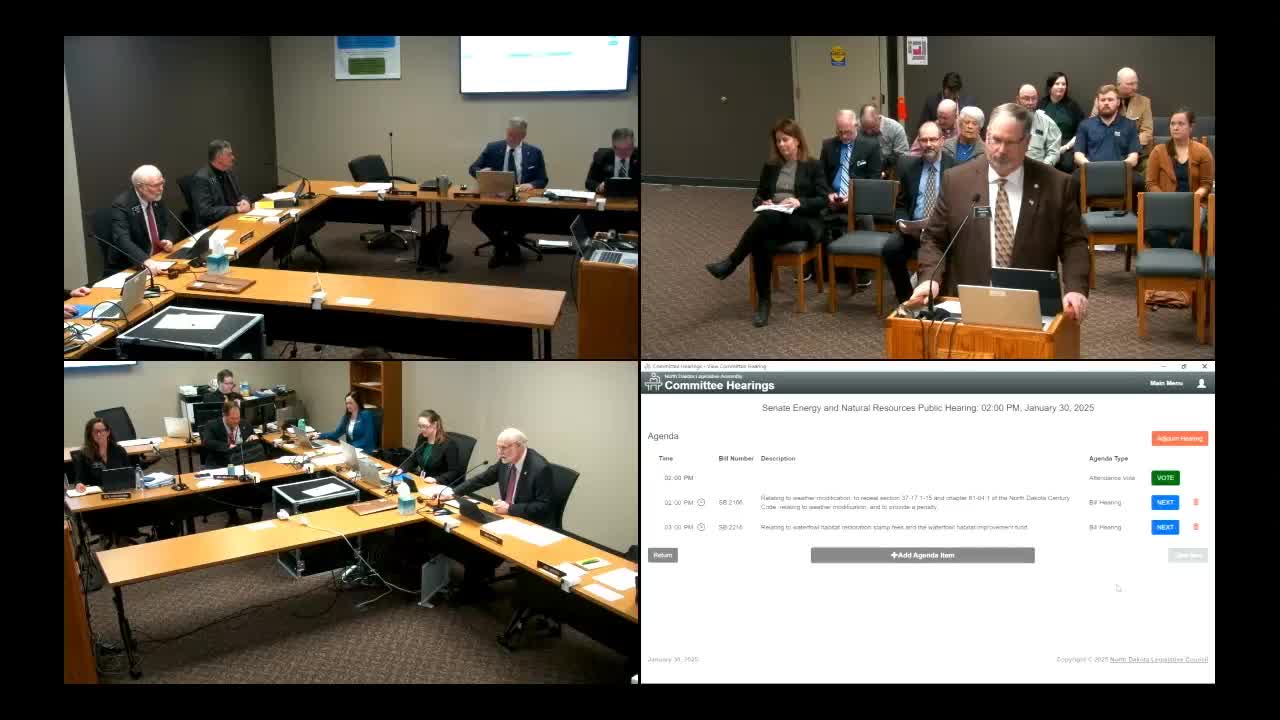
Senate committee hears push to end North Dakota weather‑modification programs
Summary
Lawmakers heard competing testimony for and against Senate Bill 2106, which would prohibit county participation in cloud seeding. Supporters cited county votes and alleged lack of demonstrated benefit; program representatives and state staff cited independent studies, training and economic analyses that they said show benefits.
Senator Todd Beard, sponsor of Senate Bill 2106, asked the Senate Energy and Natural Resources Committee on the bill to end weather modification programs that counties operate in North Dakota.
Beard said the measure would restore a direct public voice on whether cloud seeding should occur in a county. "Watching these citizens fight for the right to vote on this issue and having to spend $1,000 of dollars in personal funds to fight the weather modification machine should make you question what does local..." Beard told the committee.
The bill drew extended testimony at the committee hearing from farmers and residents who said counties have repeatedly voted to abandon cloud seeding and that the program has not shown measurable benefit. "I think it is a good thing to make this a misdemeanor and make it illegal," Roger Nasham, a Ward County farmer who led a successful petition drive, told the committee. Nasham corrected earlier figures given by the sponsor and said Ward County voted to abolish the program by about 85 percent; he said Williams County voted about 75 percent and Mountrail County about 70 percent.
Supporters argued the program imposes costs and carries environmental uncertainty. "No county has seen an increase in precipitation in the 40 years in the program," Amy Dennis, a resident whose county voted to end cloud seeding, told lawmakers. Several speakers mentioned silver iodide, a commonly used seeding agent, and questioned long‑term environmental or health effects.
Representatives of the weather‑modification industry, the State Atmospheric Resource Board and the Department of Water Resources urged the committee not to ban the program. Darren Langroud, division director for the Atmospheric Resource Division at the Department of Water Resources, told the committee that multiple independent studies have found increases in precipitation of roughly 3–14 percent in target counties and a statistically significant 45 percent reduction in crop hail losses in seeded areas compared with upwind control areas. Langroud said economic analyses have estimated annual direct agricultural benefits of $28 million to $48 million in the project area and benefit‑to‑cost ratios in the range of 31:1 to 53:1 depending on assumptions.
Leonor Dollinger, who supervised research for the Atmospheric Resource Board for 27 years, said the state program supports aviation and university training opportunities and cited published studies showing lower hail losses and modest precipitation increases in target areas. Jody Fisher, vice president of flight operations at Weather Modification International, told the committee that North Dakota is a global training center for cloud‑seeding operations and stressed the safety record and minimal environmental deposition of silver iodide.
County officials and local farmers who opposed the bill said counties should keep local control. Pine Abrahamson, a Bowman County commissioner, said Bowman voters approved continuation of its program by about 70 percent in 2016 and that the county benefits economically and from the local flight‑training relationship with the University of North Dakota.
The committee heard both technical and anecdotal claims: witnesses demanding an outright statewide ban pointed to county votes, petition drives and personal observations of seeded storms dissipating, while proponents of the program cited peer‑reviewed studies, economic analyses and training or research benefits.
The committee closed the hearing without taking a committee vote. Senator Beard asked for a "do pass" recommendation; supporters of the program asked the committee to "do not pass" and to leave decisions to counties.
The committee recessed and moved on to its next agenda item. No committee decision on Senate Bill 2106 was recorded at the hearing.