Get Full Government Meeting Transcripts, Videos, & Alerts Forever!
Get email alerts on the Reclamation Topsoil Oil Gas topic
No spam. Unsubscribe anytime.
Hearing on bill to require pre-construction soil reservation for oil and gas sites draws debate over costs and enforcement
Summary
Senate Bill 2313 would require documentation and reservation of suitable plant growth material (topsoil and subsoil) for well pads and other oil and gas sites; landowner advocates urged statutory minimums and monitoring, while the Oil and Gas Division said rules already address topsoil and warned of staffing and workload impacts.
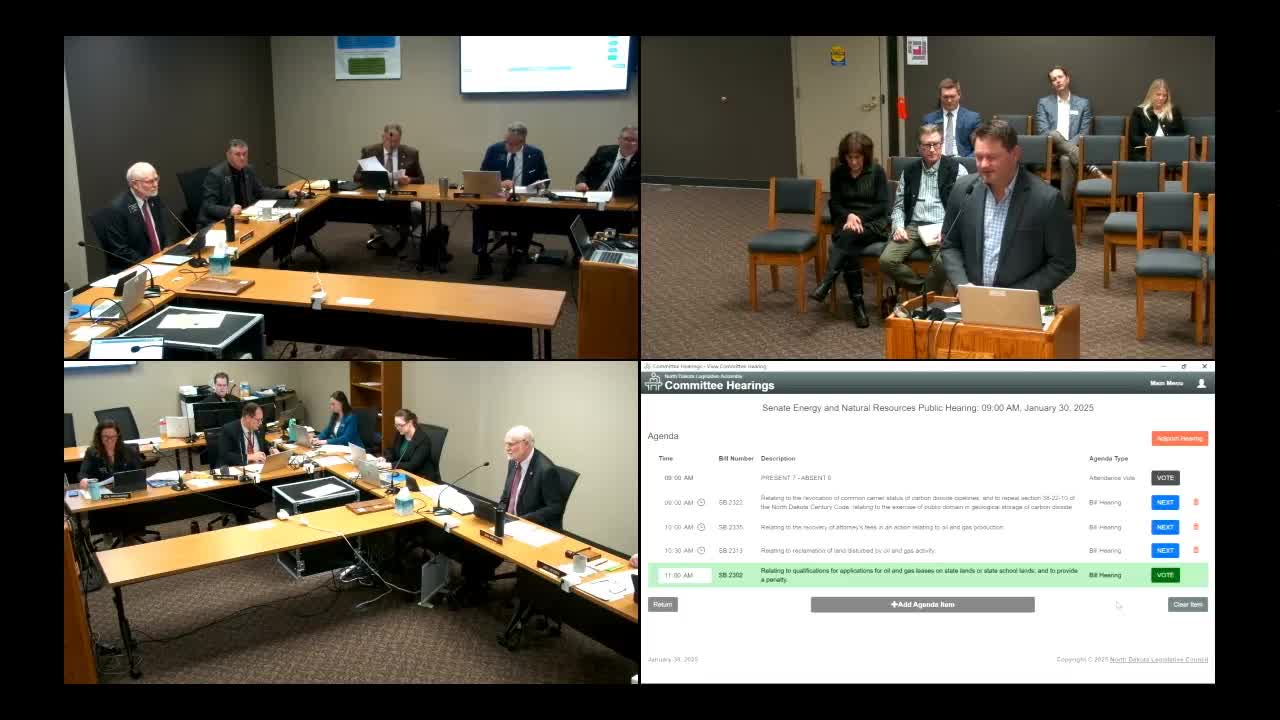
The committee considered Senate Bill 2313, introduced by Sen. Jeff Magrum, which would require that operators preserve and document suitable plant growth material (SPGM) — commonly called topsoil — when constructing oil and gas facilities, and that preservation be tracked to support final reclamation.
Supporters, including Troy (Chairman, Northwest Landowners Association) and retired trust-land official Michael Haupt, urged the committee to adopt a more prescriptive, documented process. Haupt said the Department of Trust Lands used on-site meetings and a volume-based approach to calculate required SPGM, and that the presence of visible stockpiles "ensures final reclamation will happen." He urged explicit, pre-construction reservation and monitoring so landowners know how much soil is set aside for reuse.
The Department of Mineral Resources (Oil and Gas Division) opposed the bill as written, saying current administrative rules already require removal, stockpiling and stabilization of topsoil and specify limits ("in no event shall this be deemed ... more than the top 12 inches") under North Dakota Administrative Code. Assistant director Mark Boor told the committee the division processes roughly 700 permit sites annually and currently employs two reclamation staffers; he warned the bill’s pre-construction on-site meeting and monitoring requirements would require additional trained staff and could slow permitting.
Industry groups including the North Dakota Petroleum Council and Western Dakota Energy Association said the industry has improved its reclamation practices over time and urged funding or staffing solutions for the agency rather than a prescriptive statutory change. North Dakota Petroleum Council representatives also distributed examples of industry reclamation plans and said the typical permit process already shows anticipated topsoil pile locations and estimated cubic yardage in pre‑permit plats and in as-built plats after construction.
Committee members pressed both sides on technical details — how volumes would be calculated, whether digital soil-survey data could be integrated into GIS and machine-control systems for contractors, and how to reconcile estimates with as-built quantities. The Oil and Gas Division said the current regulatory framework already: requires topsoil reservation, requires an as-built report after pad construction identifying topsoil stockpile location and estimated volumes, and requires a reclamation plan and notice before final reclamation.
No vote was recorded; the committee received neutral written testimony from an NDSU soil scientist and closed the hearing on SB 2313.