Get Full Government Meeting Transcripts, Videos, & Alerts Forever!
Get email alerts on the Eminent Domain Carbon Pipelines topic
No spam. Unsubscribe anytime.
Committee hears bill to bar eminent domain for carbon, wind and solar infrastructure
Summary
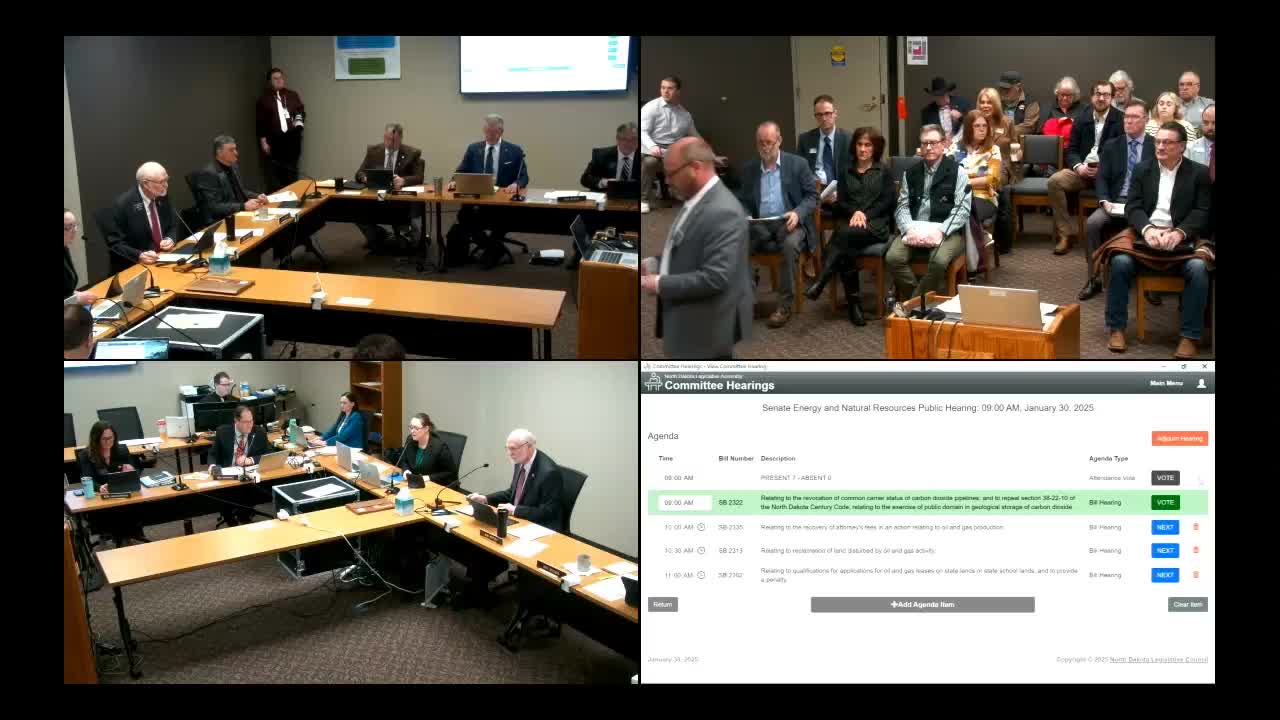
The Senate Energy and Natural Resources Committee heard testimony on Senate Bill 2322, which would prohibit the use of eminent domain to build infrastructure tied to carbon capture, carbon transport and several renewable energy projects; supporters said the bill protects landowners, while industry groups warned it would halt investment.
Senate Energy and Natural Resources held a hearing on Senate Bill 2322, introduced by Sen. Jeff Magrum, which would prevent entities from exercising eminent domain to build infrastructure associated with carbon capture, carbon dioxide transport and geological storage, wind and solar energy, hydrogen energy and projects that claim federal tax credits such as the 45Q credit.
The bill’s sponsor, Senator Jeff Magrum, told the committee the measure is intended to protect private property rights. "The goal of 2322 is to prevent the use of eminent domain for green new deal projects in North Dakota," Magrum said, adding that landowners should not have to "fear negotiations with industry representatives." Magrum cited filings by companies that claim common-carrier status under state law and a recent South Dakota Supreme Court decision that he said limits the companies’ ability to use eminent domain there.
Supporters said common-carrier claims and the threat of condemnation have pressured landowners into easements and sown community conflict. Troy (Chairman, Northwest Landowners Association) said landowners "should not be forced to host private development on their property," and Dakota Resource Council organizer Zachary Cassidy testified he has spoken with multiple landowners who “feel and regret” easements signed under pressure. Cassidy said the tool of eminent domain has "turned neighbor against neighbor," and urged the committee to remove statutory authority that allows carbon projects to claim condemnation power.
Industry and agricultural representatives opposed the bill, saying it would stall existing projects and discourage future investment. Jeff Zuger, CEO of Harvest Stone Low Carbon Partners, told the committee he opposes SB 2322 and that carbon capture and storage is "the single most important and biggest tool that we have to lower the carbon intensity of the products that we produce at our facilities today." He said his company operates an active capture-and-storage facility in North Dakota and relies on predictable state rules and federal incentives to finance projects.
Charlie Adams, manager of agriculture and stakeholder relations for Summit Carbon Solutions, said the bill "carves out CO2 from state statute as not eligible as a common carrier and strips CO2 projects from the use of eminent domain if the project has been the recipient of specific federal tax incentives," and warned the change would disqualify current projects in development and stop investment.
Other opponents included the North Dakota Petroleum Council, Lignite Energy Council and the Greater North Dakota Chamber, which argued the bill would jeopardize economic activity, hamper plans for enhanced oil recovery (EOR) and undermine a regulatory and market framework the state has developed for carbon-management infrastructure.
The hearing included repeated references to legal tests for common-carrier status and to filings with the North Dakota Public Service Commission that some witnesses said have been used to claim condemnation power. Sponsor Magrum pointed to the August 22, 2024 South Dakota Supreme Court decision finding that Summit Carbon Solutions had not shown it was a common carrier under that state’s record; he offered that as precedent supporting removal of eminent-domain authority for pipelines moving CO2.
The committee received both substantial pro- and anti‑testimony and left the record open to additional written submissions. No committee vote occurred during the hearing.
Ending: The committee closed the hearing on SB 2322 and moved to subsequent bills; senators were directed to the committee app for further written testimony on both sides.