Get Full Government Meeting Transcripts, Videos, & Alerts Forever!
Get email alerts on the Carbon Pipelines Common Carrier topic
No spam. Unsubscribe anytime.
Hearing on bill to remove CO2 from common‑carrier law draws wide, divided testimony
Summary
House Bill 1292, which would remove carbon dioxide from North Dakota's statutory common‑carrier definition and block eminent‑domain use for CO2 pipelines, prompted sharply divided testimony on property rights, safety and economic development.
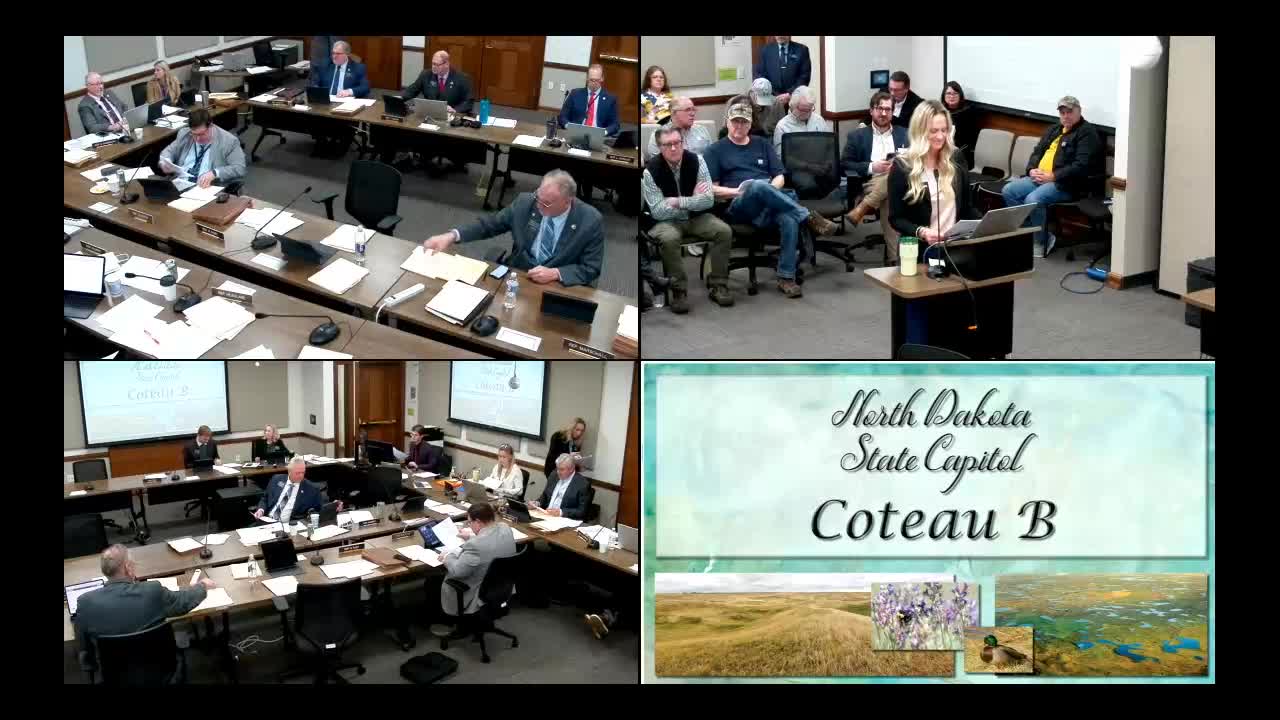
The House Energy and Natural Resources Committee held a contentious hearing on House Bill 1292, which would remove carbon dioxide from the statutory definition of a "common carrier" and thereby limit pipeline access to eminent domain.
Representative Laurie Van Winkle told the committee HB 1292 would remove CO2 from Chapter 49 definitions that grant common‑carrier status and associated eminent‑domain powers. "The carbon dioxide pipeline will not operate as a common carrier," Van Winkle said, arguing the statute was inserted to give deployers eminent‑domain authority.
Speakers in favor included landowners, farmers and grassroots volunteers who said early interactions with developers had included threats or pressure about eminent domain. Curtis Junt, a volunteer lobbyist from the affected area, said CO2 is denser than air and poses different safety challenges from natural gas. "This is no different... it is going to flow on the ground... it moves through several phases," Junt said, and he urged protections for landowners.
Proponents also pointed to an August 2024 South Dakota Supreme Court decision — cited repeatedly in testimony — that found evidence insufficient to treat a developer as a common carrier in that state. Several support witnesses said the court decision bolstered their view that the state should not allow eminent domain for CO2 pipelines.
Opponents included oil, coal and ethanol industry groups, the Greater North Dakota Chamber and Summit Carbon Solutions. Ron Ness of the North Dakota Petroleum Council said the bill would affect more than one project and could prevent infrastructure needed for enhanced oil recovery and other CO2 uses. "This bill, this policy that was put in place in 1993... is much broader than one pipeline," Ness said.
Summit Carbon Solutions' representative, Dave Nearing, said the company has secured authorizations from the Public Service Commission and the Industrial Commission and described the planned project as private investment into transport and permanent geologic storage. He urged the committee to prevent policy changes that could impair investment. "CO2 pipelines are the conduits to the markets of the future," Nearing said.
Industry witnesses emphasized that project pipelines support ethanol decarbonization, employment, tax revenues and potential uses such as enhanced oil recovery. Summit and ethanol producers said the projects had secured high percentages of voluntary agreements but that completing a project sometimes requires tools to assemble contiguous pore‑space ownership.
The hearing ran through both extensive public comment and multiple organizational positions; no committee vote was recorded at the hearing.