Lifetime Citizen Portal Access — AI Briefings, Alerts & Unlimited Follows
Bill to raise economic-analysis threshold for drainage projects draws split testimony
Loading...
Summary
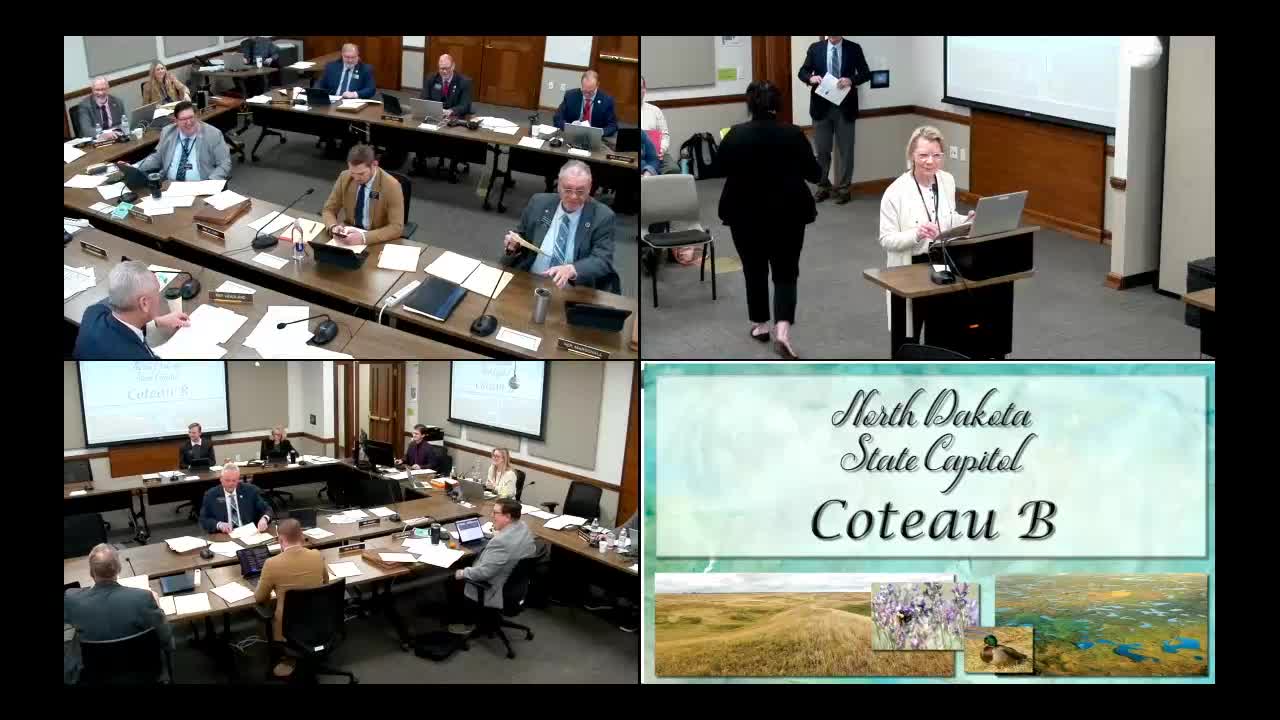
Representative Cynthia Schreiber Beck and water interests urged the House Energy and Natural Resources Committee to approve House Bill 1218, which would change the threshold at which the Department of Water Resources requires an economic analysis (EA) for water conveyance and flood control projects to $5,000,000.
Representative Cynthia Schreiber Beck and water interests urged the House Energy and Natural Resources Committee to approve House Bill 1218, which would change the threshold at which the Department of Water Resources requires an economic analysis (EA) for water conveyance and flood control projects. The bill would limit mandatory EA reviews to projects with total costs above $5,000,000.
Why it matters: Proponents representing water users, water resource districts and agricultural groups said the current lower threshold and DEQ/State Water Commission policy requiring EAs for projects at or above $200,000 has increased project costs and delays, making many locally important drainage and conveyance improvements unaffordable for producers and small districts. Kurt Lisney of the North Dakota Water Users Association said the EA process, as implemented, has reduced state cost-share levels and shifted burdens to local producers. "Requiring the economic analysis only for large-scale projects will ensure state dollars result in a meaningful return on investment," Lisney said.
Supporters' case: Dennis Reap (North Dakota Water Resource Districts Association), Justin Johnson (Richland County Water Resource District), Luke Chimeneski (Richland-Sargent Joint Water Resource District), and several farm groups (North Dakota Grain Growers, Corn Growers, Soybean Growers) testified HB1218 would reduce time and cost burdens on projects typically in the $1–$2 million range and allow more projects to proceed. Reap said conducting an EA can cost tens of thousands of dollars and represent a significant share of design/permitting costs for smaller projects.
Agency and commission opposition: Duane Poole, natural resource economist for the Department of Water Resources, strongly opposed HB1218. He recounted the 2017 legislative directive asking the state engineer to develop an EA process and said the State Water Commission later set a lower $200,000 threshold by policy to give commissioners more information when allocating state tax dollars. "In a time where competition among projects for finite state resources is only growing, it's important... to ensure state investments are made as thoughtfully as possible," Poole said. He said reducing the threshold to $5,000,000 would eliminate the option to require analyses for most projects and deprive commissioners of objective quantitative information.
State Water Commission view: Commissioner Michael Anderson described EA as a tool to calculate return on investment and said staff and commissioners have used EA results to adjust project scopes or cost-share percentages. He said the commission sometimes increases cost-share percentages after discussion with sponsors and that EA information has improved project outcomes. Anderson testified commissioners had authority to set the lower threshold and did so after public process.
Scale and numbers: The Department of Water Resources reported 50 projects have required EAs since the statutory requirement was implemented; had HB1218's proposed $5,000,000 threshold been in effect, only three of those projects would have needed an EA. Agency witnesses said the EA uses indexed historical claims and county-level data to estimate avoided damages rather than modeling crop yields, arguing that the method provides objective, defensible estimates for benefit calculations.
What was not decided: No committee vote was recorded. Lawmakers and stakeholders debated trade-offs between timely project delivery and state fiscal stewardship. Supporters urged a "due pass" to advance HB1218; agency witnesses asked the committee to retain the lower threshold so commissioners can use EA as needed.
Ending: The hearing closed after testimony for both sides; committee members asked clarifying questions about prior policy decisions and how EA results have affected cost-share awards.