Get Full Government Meeting Transcripts, Videos, & Alerts Forever!
Get email alerts on the Wastewater Grants topic
No spam. Unsubscribe anytime.
House committee hears $50 million proposal to fund local wastewater projects
Summary
Lawmakers heard testimony supporting House Bill 1577, which would create a $50 million wastewater grant program administered by the Department of Environmental Quality with per-project caps and special provisions for small cities.
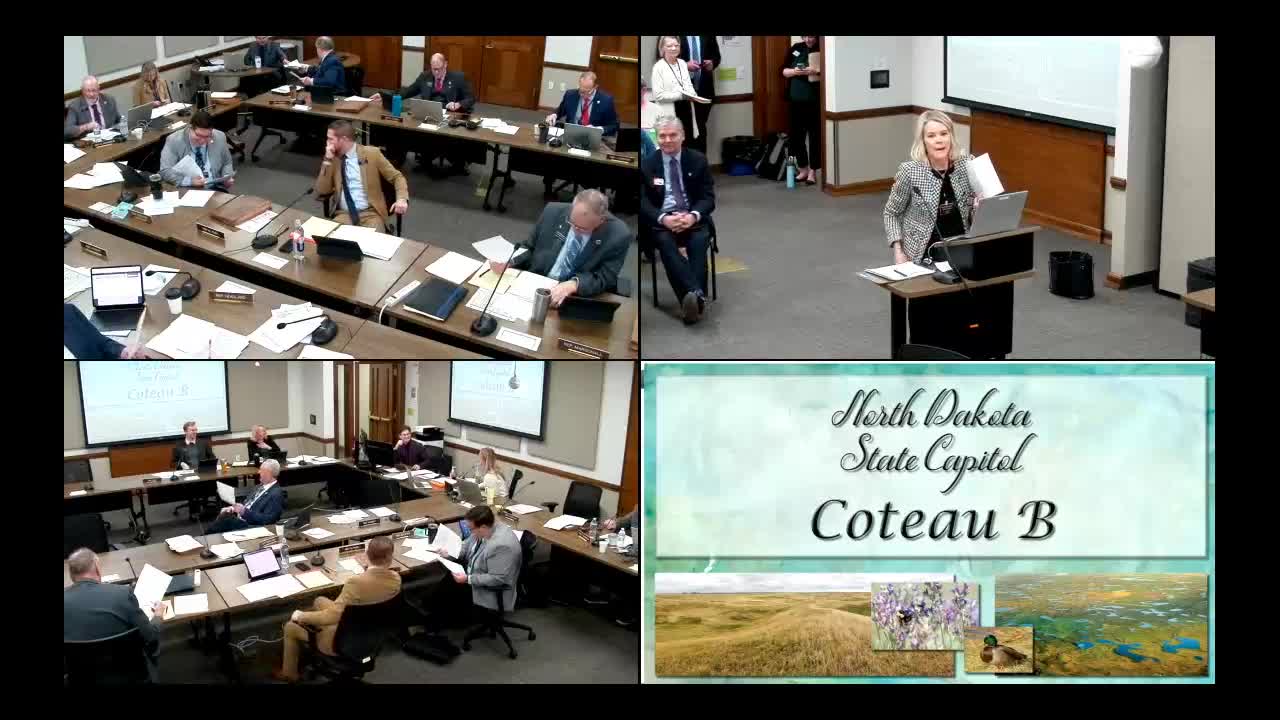
House Energy and Natural Resources Committee members heard testimony in favor of House Bill 1577, a proposal to create a $50,000,000 wastewater grant program administered by the Department of Environmental Quality (DEQ). Representative Alisa Mitskog, bill sponsor, told the committee the program would operate as a cost-share to reduce reliance on property taxes and special assessments.
The bill would authorize a $50 million appropriation to DEQ to provide grants for wastewater projects. The sponsor described the program as modeled after existing state water cost-share programs and said it would cap awards at $12,500,000 per project while reserving an equal allocation for cities with fewer than 5,000 residents. "A 60/40 match program would reduce reliance on property taxes and special assessments," Representative Alisa Mitskog said.
Why it matters: Testimony emphasized that many North Dakota communities face large wastewater needs and limited local tax bases. Matt Gardner, executive director of the North Dakota League of Cities, said the DEQ intended-use plan lists roughly 300 wastewater projects totaling about $1.7 billion in costs. "Wastewater seems to be forgotten," Gardner told the committee, noting the state has provided large cost-share investments for water projects but fewer grant options for wastewater.
Details and supporting testimony: City officials and water-sector groups described large projects and the potential resident impacts of fully local funding. Jim Neubauer, Mandan city administrator, said Mandan faces an approximate $110–$120 million wastewater treatment plant project; without state assistance, he estimated the cost could add about $75–$78 per month to a resident utility bill. Matt Volts, finance director for Horace, said a phase of the "Flush to Fargo" project carries an estimated $5–$6 million price tag and that Horace is the state's fastest-growing city by percentage.
North Dakota Rural Water's executive director Eric Volk said the $50 million would help offset burdens on local systems and suggested DEQ incorporate its existing project priority ranking and an affordability component into any grant allocation process. Volk also asked consideration of increasing the reserved amount for communities under 5,000 residents so small systems have a better chance of receiving funds.
DEQ perspective: Dave Grama, director of the Department of Environmental Quality, described the state's existing two revolving loan funds (clean water and drinking water), the below-market loans available at roughly 2% interest, and limited grant funding in recent years. Grama said DEQ evaluates approximately 145 projects per year and that, on DEQ's current priority list, more than 250 projects total about $1.5 billion in need. He confirmed DEQ performs annual inspections and said some wastewater systems date to mid-20th century and earlier, with ongoing maintenance and replacement needs.
What was not decided: The hearing recorded supportive testimony but no committee action or vote. Committee members asked for clarifications on program language, whether specific projects on DEQ's list would be eligible, and how the cap and small-city reserve would be interpreted and administered. Committee questions also touched on whether the appropriation would meaningfully address statewide needs versus being an initial step.
Looking ahead: Proponents asked for a favorable recommendation. Several city officials and water sector groups said even $50 million would be a start but would cover only a fraction of statewide needs. The committee did not take a formal vote during the hearing.
Ending: The committee hearing on House Bill 1577 closed after DEQ and stakeholder testimony; committee staff and members signaled follow-up questions and potential technical clarifications would be needed if the bill proceeds.