Get email alerts on the Building Code Update topic
No spam. Unsubscribe anytime.
Boulder County adopts 2021 model building codes with stepped energy requirements
Summary
The Boulder County Board of County Commissioners approved an update to local building codes to adopt the 2021 International Codes with local amendments, tightened residential energy requirements, a one-year delay for embodied-carbon rules, and an exemption for Article 19 Marshall Fire rebuilds.
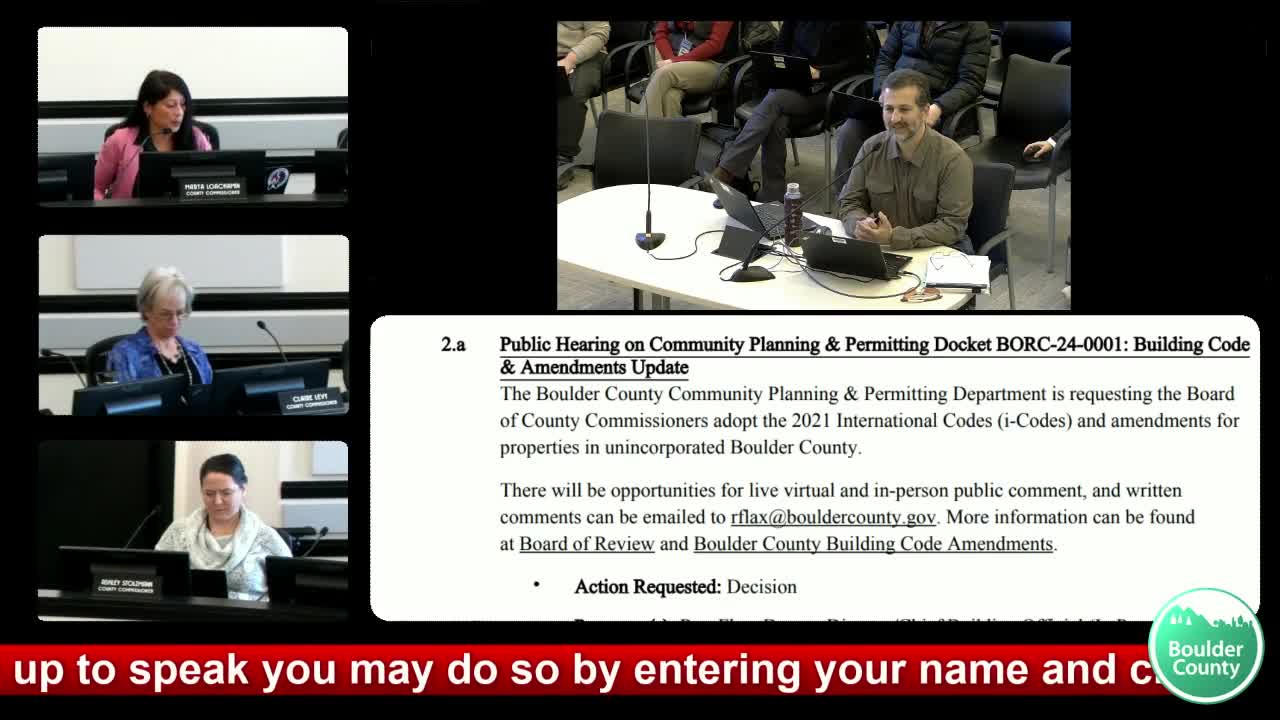
Boulder County commissioners on Jan. 23 approved a package of building-code updates that adopts the 2021 International Code Council model codes with local amendments and tightens residential energy standards, including new HERS and DOE Zero Energy Ready Home requirements and phased embodied-carbon limits for large homes.
County staff said the changes are intended to align local rules with recent model-code updates, push residential electrification, and raise energy-efficiency requirements for new and altered homes. Ron Flax, deputy director and chief building official, told the board the proposal replaces Boulder County’s existing 2015-based code and would bring the county closer to statewide and regional practices while clarifying several local interpretations.
Flax said the adoption package updates which code books and appendices the county will enforce, refines wildfire and ignition-resistant construction language, and makes targeted edits to preserve consistency with the county land-use code. On energy, he said the county will require a HERS (Home Energy Rating System) index target of 50 or lower for new homes without renewables, phase in DOE Zero Energy Ready Home requirements for homes over 1,500 square feet, and apply embodied-carbon limits for homes larger than 3,000 square feet, with those embodied-carbon provisions delayed one year to allow local concrete batch plants time to prepare.
The draft also tightens energy expectations for additions and large renovations. Flax explained that additions exceeding 1,000 square feet of conditioned floor area or renovations whose value exceeds a set threshold will trigger HERS targets or other energy-performance credits; projects above approximately $250,000 in value will face more meaningful HERS obligations. He described a broad menu of energy-credit options to allow different routes to compliance and said the county eliminated the previous prescriptive compliance pathway in favor of third-party rating programs.
Flax said the package incorporates state-required provisions such as the solar-ready language and follows the state’s electric-code adoptions, while leaving fire-code adoption to the county’s fire-protection districts where appropriate. He also noted staff will update wind and snow maps after the Structural Engineers Association of Colorado releases revised maps and will incorporate forthcoming state wildfire-code revisions when available.
The board asked several technical and implementation questions, including whether locally produced, lower-carbon concrete mixes would be available. Flax said the requirement will be implemented at local batch plants and that staff is recommending the one-year delay for embodied-carbon rules to allow the industry to adapt. Commissioners also asked how backup combustion systems would be limited to emergency use; Flax described electrical transfer-switch wiring for generators as the practical enforcement mechanism.
Eric Rogers, assistant county attorney, confirmed the county can adopt the code updates and the companion resolution together and circulate the resolution for signatures after approval.
After discussion, a commissioner moved to approve the docket (BORC-24-001) and Resolution 2025-012; another commissioner seconded, and the board voted unanimously to approve both items. The code package is proposed to take effect March 31, 2025, with the embodied-carbon provisions effective one calendar year later if the board’s proposed timeline is adopted.
The update includes an explicit exemption for homeowners rebuilding under Article 19 Marshall Fire provisions: those homeowners may continue to rebuild under the code that applied to their approved rebuild plans rather than being required to comply immediately with the new energy or embodied-carbon provisions.
The county posted code documents and explanatory materials for public review during the hearing process; staff indicated additional outreach and coordination with builders, concrete suppliers and rating programs will continue as the county moves toward administration of the new code.
AI generated
The text on this page is AI generated. Summaries, highlights, analysis, and video transcripts are all produced from the original source material.
AI can make mistakes, so if you spot one, and we will fix it for everyone.
Note: the source content is unaltered by us. Any content source we link to, be it a video, an audio recording, or a document, is presented exactly as its publisher released it. That publisher is usually a government body, sometimes an individual official or another organisation.