Get Full Government Meeting Transcripts, Videos, & Alerts Forever!
Get email alerts on the Media Public Broadcasting topic
No spam. Unsubscribe anytime.
Committee recommends 'do not pass' on bill that would bar state funds for public broadcasting
Summary
House Bill 1255, which would block use of state funds to support public broadcasting, drew extensive testimony from Prairie Public and other stakeholders; the committee recommended a do‑not‑pass report.
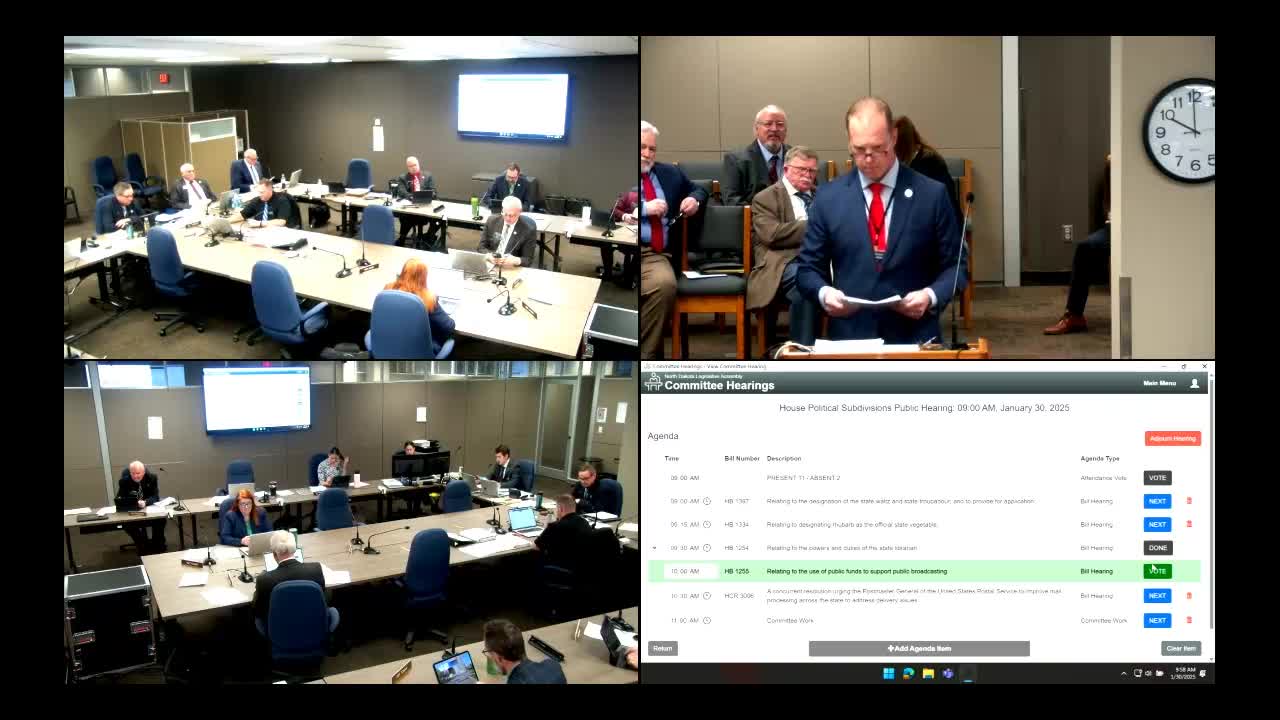
The House Political Subdivisions Committee voted to recommend a do‑not‑pass on House Bill 1255, a proposal to prohibit use of state funds to support public broadcasting in North Dakota.
Representative Joran Johnson, sponsor, framed the bill as a taxpayer‑choice measure and questioned the necessity of state support for Prairie Public in a media environment with numerous digital alternatives. "North Dakota taxpayers should have the choice whether to fund media rather than it being a compulsory tax," Johnson said, citing past appropriations to Prairie Public and asserting the organization could survive without state support through membership, grants and other revenue streams.
John Harris, president and CEO of Prairie Public Broadcasting, testified in opposition and urged the committee to vote "do not pass." Harris described Prairie Public’s mission around education, public safety and citizenship, explained the network’s mix of state, federal and private funding, and warned that losing state support would jeopardize local services and qualifications for other funds. "Passage of House Bill 1255 would jeopardize some of our resources to homes, schools, and workplaces throughout the state," Harris said.
Other opponents included North Dakota United, local healthcare and education representatives, United Printing, the North Dakota Newspaper Association and trade groups. Witnesses described Prairie Public’s educational programming, local news and documentary production, infrastructure costs for statewide transmitters and the role public broadcasting plays in rural communities with limited internet access. Testimony also documented Prairie Public’s revenue mix, including membership, charitable gaming, endowments and state and federal dollars; the organization said state and federal funding helps it qualify for other support.
Committee members questioned the bill’s drafting and the practical effect on federal funds and grants. Representative Vosley and others said state support leverages outside funds and noted Prairie Public provides local services that may not be easily replaced. Members raised equity concerns for low‑income residents and rural households that rely on free over‑the‑air service.
The committee voted 8 yeas, 4 nays, 1 absent, not voting in favor of a do‑not‑pass recommendation; Representative Ward volunteered to carry the bill on the floor.