
Board adopts US‑287 Vision Zero safety and mobility study, clearing path for median barriers and multimodal projects
Get AI-powered insights, summaries, and transcripts
Subscribe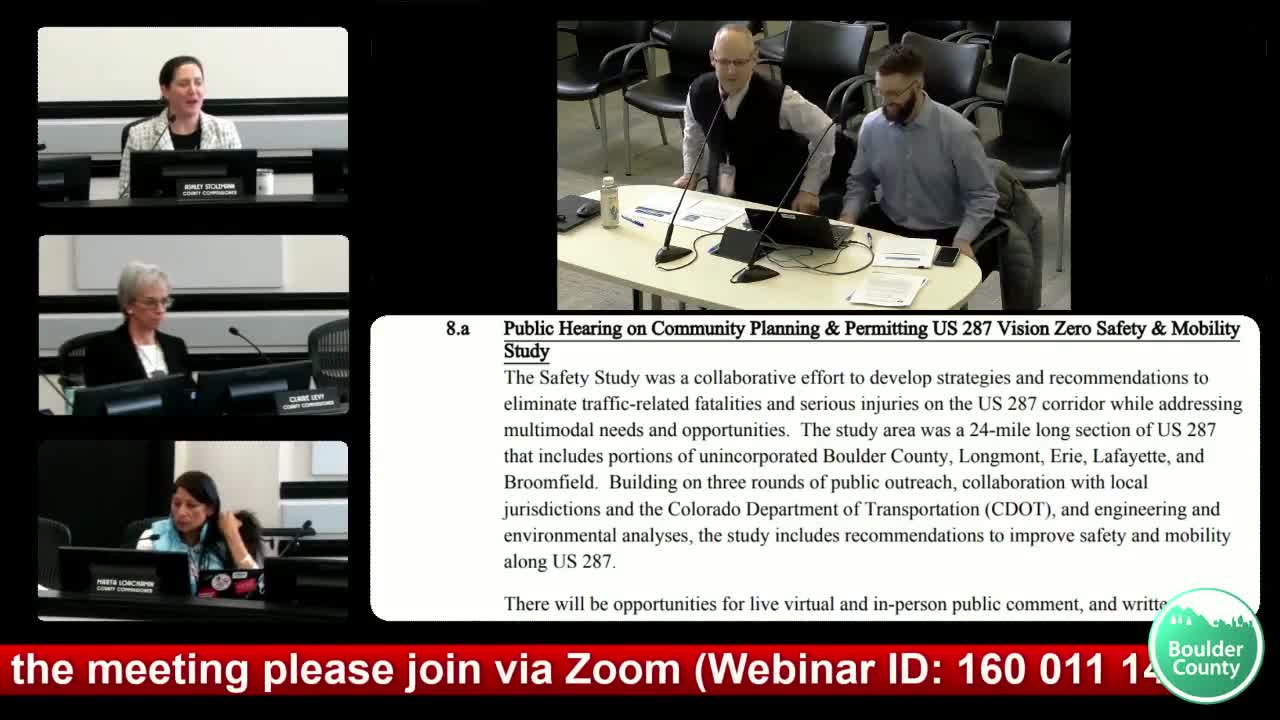
Summary
Boulder County commissioners voted to adopt the US‑287 Vision Zero safety and mobility study, endorsing a package of recommendations including center median barriers, intersection signal and timing improvements, pedestrian/bicycle facility concepts and coordination with CDOT and local municipalities to move projects into design and construction.
Boulder County commissioners unanimously adopted the US‑287 Vision Zero Safety and Mobility Study on Jan. 7, endorsing a corridorwide package of engineering, operational and multimodal improvements intended to reduce serious injuries and fatalities on the highway between Broomfield and the Larimer County line.
County transportation staff and partner agencies designed the study to identify immediate countermeasures and longer‑term projects. Staff emphasized that adoption is a milestone enabling coordinated design, funding and implementation with the Colorado Department of Transportation and the corridor cities and towns.
"People are dying on US 287, and it is our primary motivation to ask for adoption and as soon as possible to begin implementation of the safety countermeasures," Landon Hilliard, senior transportation planner, said during the presentation. The study documented roughly 1,083 crashes a year on the corridor with a disproportionate number of severe and fatal crashes in recent years and identified a set of recurring crash types such as left‑turn and crossing (median crossover) collisions, red‑light crashes, and pedestrian and bicyclist collisions concentrated in downtown Longmont.
Among the findings, staff recommended a 12‑mile center median barrier in two rural segments (about 4 miles between Longmont and Berthoud and about 8 miles between Longmont and Lafayette), to be implemented with gaps at public intersections. The study evaluated cable, guardrail and cast‑in‑place concrete median types and recommended cast‑in‑place concrete based on life‑cycle costs, maintenance and worker safety. Staff noted that private left‑turn access along barrier segments would generally be converted to right‑in/right‑out; local emergency services will be consulted on access and preemption strategies.
The report also recommends intersection improvements (signal upgrades, improved signal timing and visibility), access management at problematic crossovers, installation of rumble strips, automated speed enforcement where permitted, and a separated multi‑use path alongside the corridor—12‑foot, bidirectional, plowable paths where feasible—to improve bicycle and pedestrian safety and to connect transit stops. A planning concept identifies the west side of US‑287 as preferred for Longmont→Lafayette segments and the east side for Lafayette→Broomfield segments, subject to right‑of‑way, environmental and utility constraints.
Alex Hydrite, regional multimodal planning manager, said the study used a three‑tier public engagement approach (technical advisory group, elected‑official coalition and public outreach) and prepared conceptual designs and planning‑level environmental screens for a dozen priority locations. That analysis supported prioritized recommendations and cost estimates intended to help secure state and federal funding. CDOT has design funding for median barriers and secured a USDOT grant to construct the median barrier in Boulder County; design kicked off in September 2024, staff said.
Several municipality representatives and first responders testified in support during the hearing. Longmont’s mayor Joan Peck, Erie trustees and staff, and Lafayette and CDOT representatives offered recorded endorsements; Longmont officials noted that multiple high‑injury sections fall inside city limits and that the study informs their Vision Zero work. Crash survivors and safety advocates also urged immediate action and pointed to precedent where targeted improvements halted local fatalities.
Commissioners discussed continued coordination with CDOT, law enforcement and emergency services and the need to involve adjacent jurisdictions such as Berthoud. Commissioner Loachman noted the importance of outreach and asked staff to ensure engagement opportunities for affected communities to review specific design choices, while Commissioner Stoltzman highlighted that the work to implement the study is already underway with design and grant awards in place.
The board voted to adopt the study as presented. Adoption does not itself authorize construction; it affirms the county’s support for the recommendations and enables staff and partners to move projects into design, environmental review and grant applications. County staff highlighted immediate next steps: support CDOT’s median barrier design and outreach, pursue automated speed enforcement opportunities, and continue planning for the separated bikeway and intersection safety improvements.
Ending: With adoption, the county formally joins the corridor partners in advancing a prioritized set of countermeasures intended to reduce deaths and severe injuries on US‑287; design and implementation will proceed through the normal project‑development and permitting processes in partnership with CDOT and affected municipalities.