Get Full Government Meeting Transcripts, Videos, & Alerts Forever!
Get email alerts on the Deficiency Appropriation topic
No spam. Unsubscribe anytime.
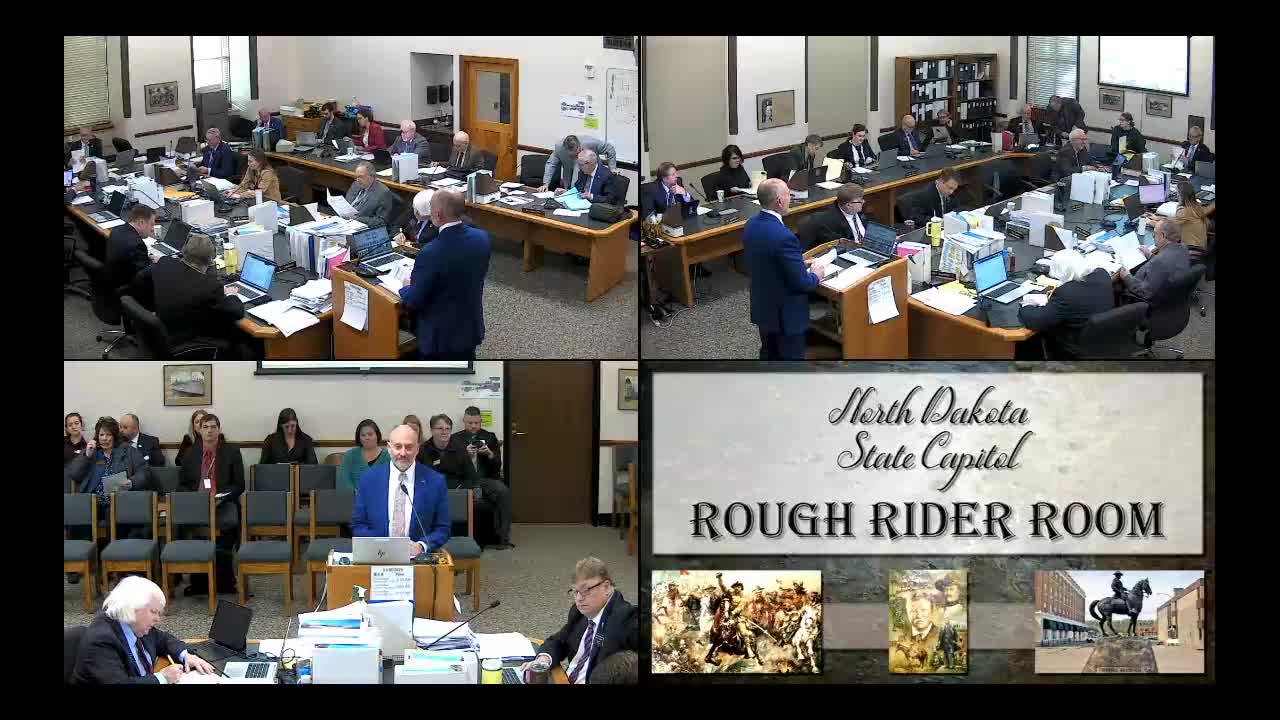
Appropriations Committee hears deficiency bill; action deferred pending follow-up
Summary
Members discussed the biennial deficiency appropriation bill (House Bill 1024), reviewing requests across several agencies including the Adjutant General, Attorney General, Department of Public Instruction and Corrections; the committee deferred final action pending follow-up information.
Joe Morissette introduced House Bill 1024 as the biennial deficiency appropriation package, describing it as the regular vehicle used to make agencies whole for costs incurred during the current biennium.
Morissette said the bill includes a $19.4 million request for the Office of the Adjutant General — covering a proposed principal repayment for Dakota Access Pipeline (DAPL) protest response costs, roughly $1.8 million for interest, and about $4.3 million in other response costs. He also described a $3.05 million request for the Attorney General’s litigation pool and witness fees, $30 million in additional federal fund authority for the Department of Public Instruction to cover increased federal program spending, $80,000 for the Department of Veterans Affairs to cover a salary shortfall, an $11.5 million general-fund request for the Department of Corrections related to excess incarceration costs, and a special-fund request for the Department of Water Resources tied to prior legislation and the water infrastructure revolving loan fund.
“Attached to my testimony is a … version of the bill with basically everything that we know at this point,” Morissette said, noting estimates are evolving and additional changes may appear before session end.
Department witnesses explained components. Lance Anderson, warden with the Department of Corrections, told the committee that DOCR has experienced population growth that required county and contracted placements and said the department projects an $11.5 million deficiency by the end of the biennium. Anderson cited statutory authority for county payment of DOCR-sentenced individuals and provided daily-cost calculations his office used to estimate the county and transitional-facility shortfall; he also said medical costs were higher in contracted settings.
Attorney General staff said the office estimates litigation spending will run near $8 million for the biennium (the governor’s budget currently lists $5 million for the AG’s litigation pool) and requested an additional $3 million to supplement existing appropriations. The AG’s finance director said the office pays many mandatory defense costs arising from enacted laws and that discretionary choices (for example, joining multistate suits) also drive demand for the litigation pool.
Committee members asked for follow-up specifics before taking action. Questions included whether paying principal on the DAPL-related debt would affect pending litigation outcomes and whether the Department of Corrections’ turnbacks and ARPA treatments were fully resolved. The committee opted not to act on HB 1024 that day and asked staff and agencies to provide additional information at a later meeting.