
County approves Albert residence with limits on grading, imposes wildfire and lighting conditions
Get AI-powered insights, summaries, and transcripts
Subscribe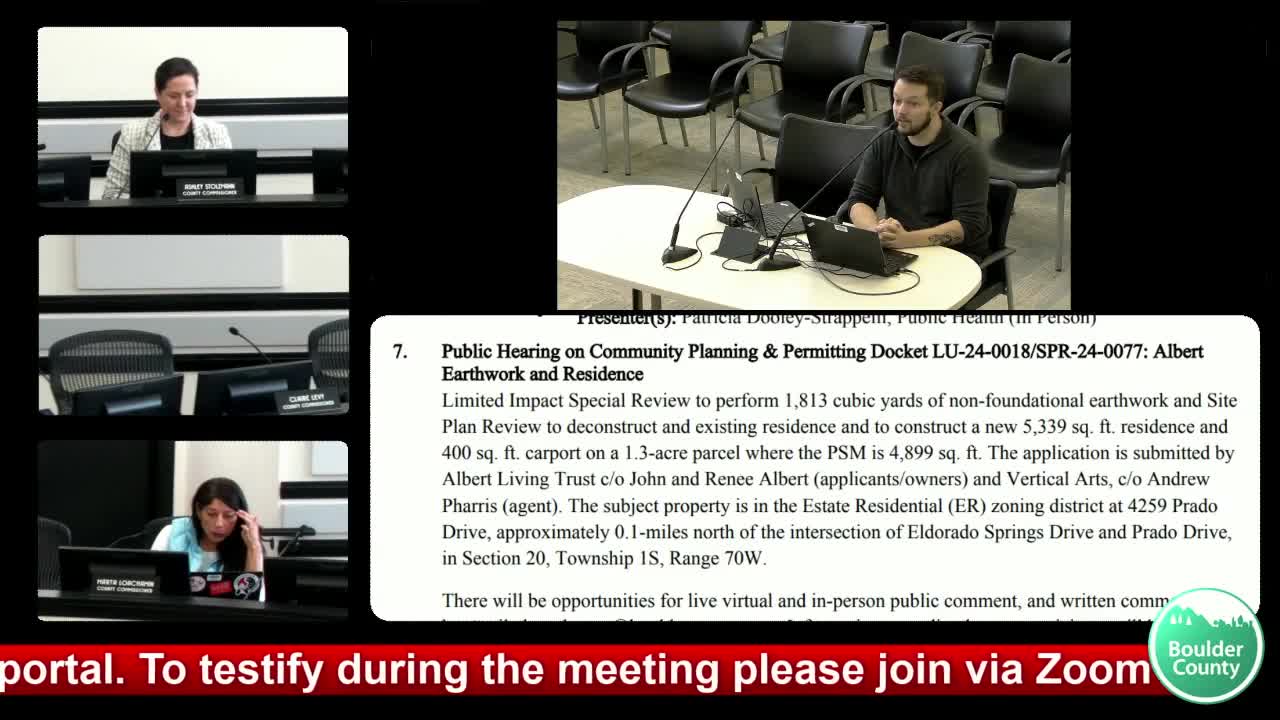
Summary
Boulder County commissioners on Jan. 7 conditionally approved an application by the Albert Living Trust to build a 4,890-square-foot residence with a 400-square-foot carport at 4259 Prado Drive, subject to limits on grading and other conditions intended to protect riparian habitat, reduce wildfire risk and limit light impacts on nearby open space.
Boulder County commissioners on Jan. 7 conditionally approved an application by the Albert Living Trust to build a 4,890-square-foot residence with a 400-square-foot carport at 4259 Prado Drive, subject to limits on grading and other conditions intended to protect riparian habitat, reduce wildfire risk and limit light impacts on nearby open space.
The approval follows a contested public hearing in which county planning staff recommended restrictions after identifying substantial proposed earthwork — initially about 1,813 cubic yards — and potential impacts to riparian areas, floodplain edges and wildlife habitat. Planning staff recommended restricting development to previously disturbed areas south of a platted easement and adding conditions addressing wildfire mitigation, drainage, invasive weeds and nighttime lighting.
Wesley Jeffries, community planning and permitting staff, told the board the site is “encumbered by the floodway, the 100‑year floodplain, and the 500‑year floodplain,” and that staff was “recommending a condition of approval restricting development to previously disturbed areas specifically south of the platted easement.” Jeffries also said the site ranks high for biodiversity and contains riparian and wetland mapping layers that informed the staff recommendation. Planning staff flagged concerns about the volume of grading and the project’s effect on historic drainage patterns and recommended conditions to mitigate those effects.
Applicant representatives said they had revised the plans during the review. Architect Andrew Farris told commissioners that a recent grading revision reduced earthwork by 25%, from 1,813 cubic yards to 1,373 cubic yards, and that much of the apparent fill is actually redistribution after demolition: “Boulder County counts cubic yards of grading 1 for cut and 1 for fill … we’re actually removing 300 cubic yards, give or take, of earth, not bringing in 1,373 cubic yards of earth.” John Albert, owner, said demolition and disposal were permitted and inspected and that the team followed required recycling and asbestos removal procedures.
Neighbors and nearby residents raised concerns during public comment about altered drainage and the potential for increased flood risk to adjacent yards, the project’s height and massing, and effects on views and wildlife habitat. Michael O’Neil, a resident across Prado Drive, urged the board to consider floodplain impacts, saying the area is “very flat” and expressing concern that grading could divert water toward neighboring yards. Other commenters said the proposed house would be larger than the prior residence and nearer the creek.
Commissioners discussed wildfire mitigation, glazing facing the open space to the north, drainage details and the tradeoffs between construction materials and defensible space. Planning staff noted that wildfire mitigation recommended in their referral includes either increased ignition‑resistant materials for exposed elements such as the carport or removal/relocation of features that impede defensible space. Staff also recommended reduced glazing or low‑light‑transmission glass on the northwest facade to reduce “lantern effect” on nocturnal wildlife and open‑space recreation.
The board adopted staff’s recommendation with one added element: the applicant must either reduce the total residential floor area to a maximum of 4,510 square feet or revise the site plan so the residence is set at least 15 feet from the eastern property line (the effect is to move development away from the riparian edge). The approval also included the standard suite of conditions in the staff packet covering drainage mitigation, a weed control plan, floodplain permitting and coordination with the county wildfire mitigation team on materials and defensible‑space measures.
Commissioner Loachman moved approval of the staff‑recommended, conditionally approved docket (LU24‑0018 / SPR24‑0077) with the additional either/or requirement on floor area or east setback; Commissioner Stoltzman seconded. The motion passed; two commissioners voted in favor and one was recorded as absent for that portion of the meeting.
The decision does not waive required building, floodplain or wastewater permits; the applicant must meet building code requirements (staff noted in review that crawl‑space access and on‑site wastewater test pits will require specific permitting and observation reports) and obtain any floodplain development permits if work occurs in regulated areas. Neighbors who raised issues about possible unpermitted earthwork were told planning staff would follow up with the county’s code compliance team to determine whether prior demolition or test pits required enforcement or additional permitting.
The approval preserves a number of referral conditions: reduced glazing and lighting facing the northwest open space, a weed‑control plan, wildfire mitigation measures to be reviewed by county wildfire staff, drainage/engineering measures to prevent off‑site impacts and limits on grading to avoid the floodway. The board’s action requires the applicant to submit a revised site plan conforming to the adopted conditions before permits can issue.
The county will monitor required follow‑up actions through the standard permitting and inspection processes. Neighbors and parties of record may seek clarifications from planning staff about the scope and timing of the mitigation measures and the specific engineering reports required.
Ending: The conditional approval allows the applicant to proceed to permit review and requires additional design work and coordination with county departments on drainage, floodplain, wildfire mitigation and lighting before construction may begin.