Get Full Government Meeting Transcripts, Videos, & Alerts Forever!
Get email alerts on the Public Safety Pensions topic
No spam. Unsubscribe anytime.
Committee Hears Bills to Move Corrections, EMS and Dispatchers into Public Safety Retirement Plan
Summary
Two related bills would expand the North Dakota PERS public safety retirement plan to include state corrections staff and—by local opt‑in—EMS personnel and dispatchers; committee members heard extensive testimony from corrections and EMS officials, PERS staff and associations.
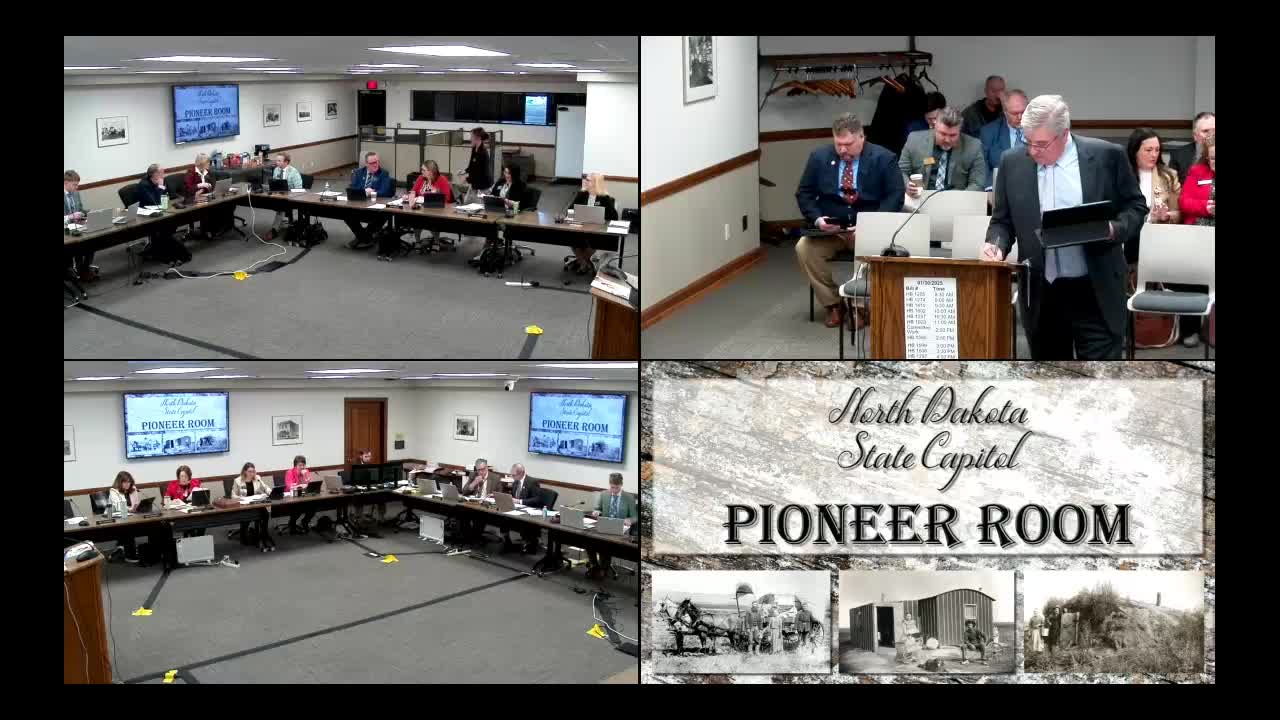
Representative Todd Porter said his two companion bills — House Bill 1274 and House Bill 1419 — are meant to level the playing field for public‑safety occupations by allowing state correctional officers, 911 dispatchers and certain emergency medical services personnel to participate in the North Dakota Public Employees Retirement System (PERS) public safety retirement plan.
Porter told the House Government and Veterans Affairs Committee that political subdivisions can already elect to place local law enforcement, fire and corrections employees into the public safety plan; the bills aim to make state employees eligible in the same way and to allow political subdivisions that choose to do so to move EMS personnel and dispatchers into the plan. “This bill aims to level that playing field,” Porter said.
Supporters included Colby Braun, director of the Department of Corrections and Rehabilitation, who described corrections officers’ elevated rates of post‑traumatic stress, depression and reduced life expectancy, and said the item is in the governor’s budget. EMS leaders including Bill Kalanick (North Dakota EMS Association), Corey Johnson (Williston assistant fire chief and paramedic), Kyle Michaels (Billings County EMS director) and others told the committee that EMS workers and dispatchers face sustained physical and mental stress that justifies inclusion in public safety benefits and that the change would aid recruitment and retention.
Derek Holbein and Derek Obine (PERS) and PERS’ actuary provided neutral technical testimony. The actuary estimated roughly 440–460 affected employees could move between plans depending on which items are adopted; PERS estimated the public safety plan is about 67–71% funded and noted differing actuarial results for the two bills. PERS also explained federal tax consequences: dispatchers generally do not meet the IRS definition of a qualified public safety officer for early‑retirement tax exceptions, so some dispatchers who retire early could face a 10% federal penalty on distributions unless other conditions are met. PERS recommended employers notify their offices of any change in membership so tax reporting is handled correctly.
Committee members asked about estimated costs, the size of the group potentially affected and whether the public safety plan’s funded status would be materially affected; PERS answered that estimates vary and that the bills have different mechanics (1274 would move state correctional officers into public safety; 1419 provides opt‑in authority for political subdivisions regarding EMS and dispatchers). No committee votes were recorded on the bills during the hearing.
Ending: Committee closed both hearings after testimony and asked PERS and stakeholders to provide additional detail on counts, fiscal impact and any necessary statutory drafting. Representatives and stakeholders noted the policy tradeoffs between leveling benefits and any employer or fiscal impacts.