Get Full Government Meeting Transcripts, Videos, & Alerts Forever!
Get email alerts on the Ag Research And Extension topic
No spam. Unsubscribe anytime.
NDSU research, extension staff brief House and Senate agriculture panels on ag tech, field work and local programs
Summary
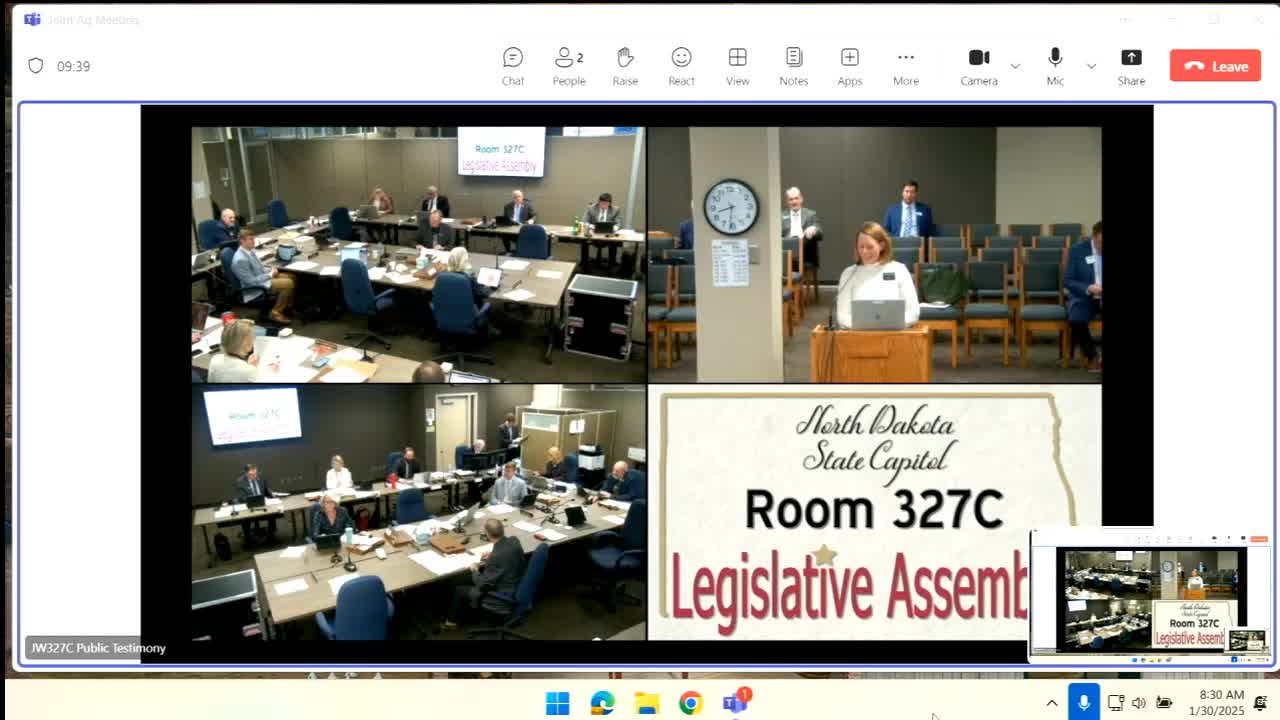
Sarah Hall Lovas, chair of the State Board of Agricultural Research and Extension, and Greg Lardy, director of the North Dakota Agricultural Experiment Station and NDSU Extension, told a joint House and Senate agriculture hearing that state investments in agricultural research and extension are producing measurable economic and on‑farm results.
Sarah Hall Lovas, chair of the State Board of Agricultural Research and Extension (SBARE), and Greg Lardy, director of the North Dakota Agricultural Experiment Station and NDSU Extension, told a joint meeting of the House and Senate agriculture committees that state investment in ag research and extension is showing measurable returns.
Lovas said the legislature’s funding has produced “significant and positive impacts for North Dakota agriculture” and emphasized SBARE’s role in budgeting and policy for the experiment station and extension programs.
The message to lawmakers was practical: NDSU researchers and extension specialists described specific projects now in the field — from genomic-assisted crop breeding to robotic and drone sensing to microbial products aimed at replacing nitrogen fertilizer — and explained how those projects are transferred to producers through county extension offices.
Why it matters: lawmakers heard that agriculture contributes billions to the state economy and that research and extension are linked to productivity, environmental outcomes and the next generation of producers. Committee members pressed presenters on costs, effectiveness in non‑flat terrain and oversight of new precision tools.
Key details from presenters
- Greg Lardy described the North Dakota Agricultural Experiment Station as “a research and development arm for the state's agricultural sector,” and said researchers are using artificial intelligence, data analytics and genomic information to speed crop‑breeding and variety development.
- Researchers described an AI‑driven weed‑identification system integrated with sprayers that in field studies cut herbicide use by roughly half. A field scientist said the system is still in testing and “not quite ready for the step of commercialization at this point.”
- Drone‑based scouting and prescription maps were described as reducing herbicide application by 50% or more in field trials, and extension specialists said their role is to evaluate whether those systems provide a cost benefit to farmers in time‑sensitive operations.
- NDSU researchers described active work on microbial products that can fix atmospheric nitrogen or suppress plant disease; a microbiologist said the first commercial‑scale products could appear within a few years.
- On livestock technologies, presenters described virtual‑fence collars that use GPS and audio cues and that kept animals inside grazing allotments “greater than 90% of the time” in trials, reducing labor and enabling flexible grazing management.
- Extension emphasized statewide reach: NDSU Extension programs operate in all 53 counties, train thousands on pesticide safety (7,200 cited in testimony), and involve more than 40,000 youth through 4‑H.
Research–extension network and field stations
Lardy and committee members reviewed the network of Research Extension Centers (RECs) across the state and the functions of the agronomy seed farm at Castleton (growing foundation seed from breeder seed produced by NDSU breeders). Presenters noted collaboration with national and international nurseries to accelerate variety development.
Lawmakers’ questions and concerns
Committee members asked about costs and business models for drone spraying, whether virtual fencing works in uneven western terrain and how local extension offices support adoption. On virtual fencing, Lardy said the technology has been tested at multiple locations statewide and “would certainly have applications on some of the, more traditional native grazing pastures” in western North Dakota.
Presenters and extension staff urged continued legislative support, saying investments yield high returns in producer income, environmental outcomes and workforce development.
Ending
Presenters closed by inviting committee members to visit RECs and field days in July; committee chairs thanked the SBARE and NDSU teams and recessed the joint session. The overview provided lawmakers with current examples of how state‑funded research is moving into practice and produced a series of follow‑up questions for staff and researchers.