Get Full Government Meeting Transcripts, Videos, & Alerts Forever!
Get email alerts on the Pensions Teachers topic
No spam. Unsubscribe anytime.
Lawmakers Hear Proposal to Give One‑Time Supplemental Payments to Retired Teachers
Summary
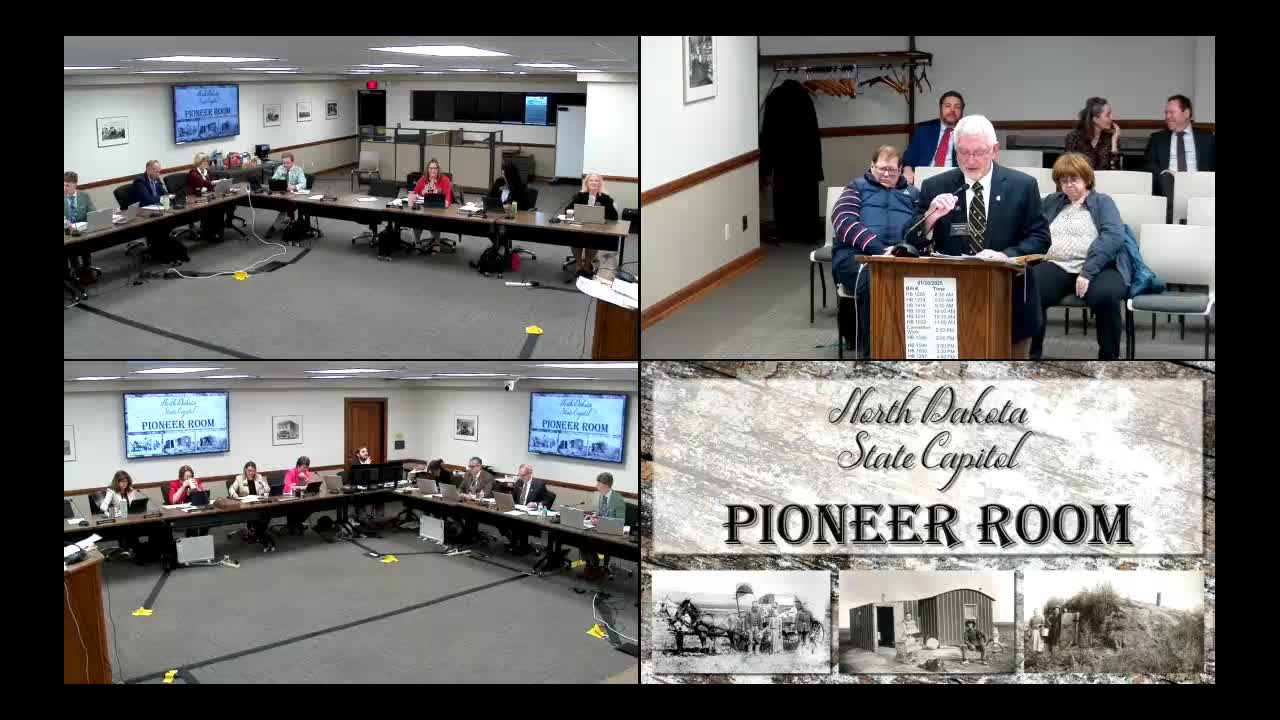
Representative Mike Schatz introduced House Bill 1285 to the Government and Veterans Affairs Committee, proposing a one‑time supplemental payment for retired teachers funded from the general fund and targeting members receiving benefits before Jan. 1, 2025.
Representative Mike Schatz, sponsor of House Bill 1285, told the House Government and Veterans Affairs Committee the bill would give retired teachers a supplemental, cost‑of‑living payment because “teachers have not had an increase since 2008.”
The proposal would direct a one‑time transfer from the general fund to the Teachers Fund for Retirement (TFFR) and authorize supplemental payments in December 2025 to members receiving benefits before Jan. 1, 2025. Schatz said he intends the increase to target lower‑income retirees and described the bill as a step toward fairness compared with annual increases the legislature has periodically granted state employees.
Why it matters: retirees who rely primarily on TFFR benefits testified that decades without regular cost‑of‑living adjustments have left some beneficiaries with small monthly checks. Patrick Pence, a retired teacher and Bismarck‑area advocate, said the measure is about “fairness” and urged the committee to move the bill forward.
Chad Roberts, deputy executive director of the Retirement Investment Office (RIO), testified for the RIO in a neutral capacity. He said the Teachers Fund for Retirement now covers about 25,000 members with roughly 9,000 receiving benefits, and that the fund is about 71% funded following prior legislative changes. Roberts said the TFFR board has historically prioritized achieving full funding before authorizing COLAs or supplemental payments and that prior supplemental legislation (most recently in 2009) included explicit distribution formulas that would likely need to be replicated or clarified if the legislature moves forward now.
Roberts told legislators the version of the bill the sponsor proposed left unspecified how the supplemental should be allocated among members; he and the fund’s actuary had begun to draft potential distribution scenarios and recommended adding clear, formulaic language. He said his office views the bill as funding that comes from the general fund (a transfer in and a transfer out), which would avoid an actuarial impact on TFFR if structured as a one‑time transfer, but that specifying who is entitled and when payments are made is necessary.
Representative Rohrer asked whether the sponsor’s amendment would make the payment retroactive; Schatz said the amendment aims to identify who is eligible and that his intent is to provide an annual half‑of‑the‑state‑employee COLA (for example, splitting a 3% raise into two halves) but acknowledged he was uncertain about all legal details. Roberts said his reading of the draft indicates it is a one‑time supplemental payment rather than an ongoing COLA.
Ending: Committee members and witnesses closed the hearing and reserved questions about precise actuarial formulas and statutory authority for follow‑up work. No committee vote on HB1285 was recorded during the hearing.