Get Full Government Meeting Transcripts, Videos, & Alerts Forever!
Get email alerts on the State Legislation topic
No spam. Unsubscribe anytime.
Arapahoe County staff recommends mixed positions on multiple state bills; board directs amendments on county enforcement bill
Summary
Arapahoe County officials reviewed several bills under consideration by the Colorado Legislature during the Board of County Commissioners’ Jan. 28 study session, asking staff to pursue a mix of positions — support, monitor or seek amendments — depending on an item’s potential local impacts.
Arapahoe County officials reviewed several bills under consideration by the Colorado Legislature during the Board of County Commissioners’ Jan. 28 study session, asking staff to pursue a mix of positions — support, monitor or seek amendments — depending on an item’s potential local impacts.
The most immediate endorsement was for a form-classification bill brought by state Sen. Sandra Judah that would add Middle Eastern, North African or South Asian selection options to local-government race/ethnicity fields. Cody O’Brien of the commissioners’ office summarized staff’s recommendation and Commissioner Jessica Campbell said the change would “inform us, especially when you think about Voting Rights Act and different, populate minority population thresholds.” Commissioners registered support for the recommendation; staff recorded four commissioners signaling a favorable recommendation to guide staff outreach on the bill.
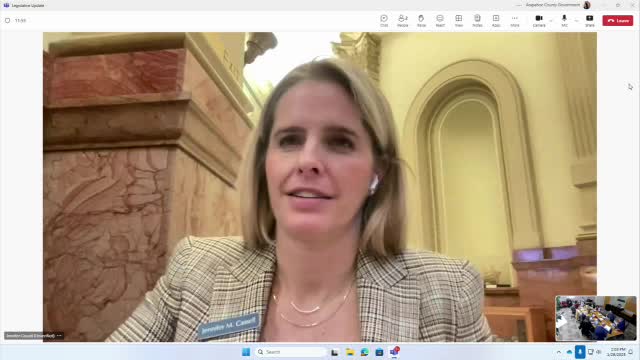
Staff next recommended monitoring a proposal to give the Colorado Department of Public Safety more flexibility in distributing state-maintained stockpiles of essential materials to local public-health agencies. Jennifer Castle of the lobbying team and public-health director Jennifer Ludwig reported the bill would let the Department of Public Safety redistribute stockpiles at times other than declared emergencies and allow distribution to entities beyond public health. CDPHE’s consultative role would be reduced under the draft, so staff recommended monitoring to align with other public-health stakeholders.
On a bill updating the interstate compact for placement of children, staff recommended support in principle but signaled it would defer extensive lobbying resources to partner associations. Dan McKelkey described the bill as clarifying that an older compact stays in effect until 35 states adopt the 2024 update; staff recommended a “monitor leaning toward support” posture so county resources for active lobbying could be prioritized elsewhere.
Commissioners discussed where to place limited lobbying capacity and asked staff to distinguish “support” (which often prompts requests from outside groups) from lower-effort signals such as “monitor” or “support-lite.” Jennifer Castle warned that publicly posting a formal county “support” on the Secretary of State site often prompts outside requests for testimony and sign-ons.
A bill that would grant counties and municipalities authority to bring civil and criminal enforcement actions to enforce certain state laws drew significant attention. County attorneys and lobbying staff have discussed amendments with the bill sponsor; Ron Karl and staff recommended more precise language about local authority and the distinction between county attorneys’ roles and district attorneys’. The board voted, without formal roll-call, to adopt an amend posture and instructed staff to continue drafting and negotiating specific changes; four commissioners indicated agreement on that approach.
Staff also updated commissioners on several other active items: a large judicial reorganization bill that carries an approximately $16 million fiscal note and roughly 110 FTE in the fiscal estimate; a telecommunications “shot clock” bill (currently a 60‑day shot clock in draft, with proposed extension amendments under discussion); and a transportation “mode choice” bill that would require MPOs and local governments above 25,000 population to conduct mode-choice planning tied to greenhouse‑gas goals. For the mode‑choice bill, staff said revisions are expected to preserve local involvement while reducing duplicative work and that regional MPOs (like DRCOG) could perform required analyses for their member jurisdictions.
On the state budget, public-health leadership alerted the board that the governor’s draft includes a proposed 5% reduction to the state line item that funds local public-health agencies. Public-health staff urged county engagement; commissioners agreed staff should coordinate with public-health associations and partner groups and be prepared to defend local public-health funding.
What’s next: staff will return with specific amendment language on the county-enforcement bill, follow up with CDPHE on stockpile language, and coordinate positions and memos for regional associations’ votes at CCI and CCAT.