Get Full Government Meeting Transcripts, Videos, & Alerts Forever!
Get email alerts on the Criminal Justice topic
No spam. Unsubscribe anytime.
Arapahoe County officials warn Aurora transfer of domestic-violence cases would more than double county caseload
Summary
County prosecutors, public defenders, probation and courts told commissioners that Aurora’s decision to stop prosecuting domestic-violence cases in municipal court will add roughly 900 misdemeanor cases a year to the 18th Judicial District, creating shortfalls in prosecutors, judges and support staff unless state or county funding is secured.
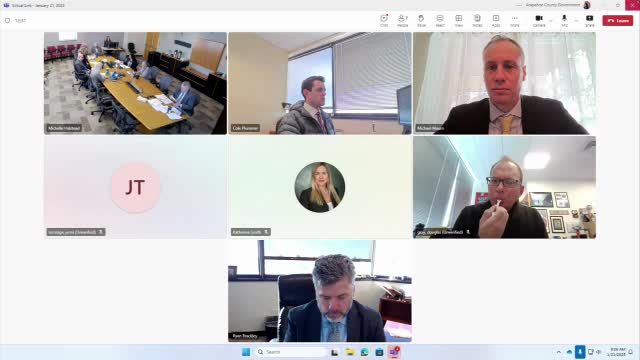
Arapahoe County officials told county commissioners at a study session that Aurora’s move to transfer municipal domestic-violence (DV) cases to state courts will sharply increase workloads across the local criminal-justice system and require additional staff and courtroom resources.
The county’s management analyst, Sarah Overby, said the district now handles about 859 misdemeanor domestic-violence cases per year and that Aurora’s filings would “layer on top” of the county’s caseload. “If you look at table 1 in the white paper…they have between 1,100 and 1,200 domestic-violence cases each year. The majority of those are going to Arapahoe County,” Overby said.
Why it matters: Aurora City Council adopted a resolution in September directing that the city’s municipal court stop prosecuting domestic-violence cases; advocacy and intergovernmental pressure moved the transition date to July 1, 2025. County elected officials and criminal-justice partners have convened to estimate the operational impact and to identify funding needs and next steps for the 18th Judicial District.
What county officials reported
Prosecutors: Mike Morrow, senior chief deputy district attorney, said the DA’s office had already taken steps to reduce felony caseload pressure but that the incoming predominantly misdemeanor DV cases would not be addressed by a previously funded felony prosecutor position. “The position…was to ameliorate the absurdly high caseloads of our felony domestic-violence prosecutors. They’re way too high,” Morrow said. He told commissioners the county’s misdemeanor prosecutors are “barely keeping our heads above water.”
Public defender and court needs: David Kaplan of the public defender’s office said municipal processing is much simpler than state-court practice; a time-tracking study showed municipal domestic-violence cases consumed a large share of agency workloads despite being a small share of filings. Kaplan said the public defender office has requested nine additional lawyers over two years (covering both the 17th and 18th Judicial Districts) and related support staff to handle state-court work.
Courts and judges: Jenny Turner, court executive for the 18th Judicial District, said a judge bill pending at the legislature includes a requested county-court judgeship intended to help handle added DV dockets. Turner warned that bond-docket volume — mandatory arrests must be heard within 48 hours under state law — will increase and that county court space and weekend staffing are already constrained.
Probation and pretrial: Doug Grange (Chief Information Officer, 18th Judicial District) and the county probation representative reported large resource needs. Probation said an additional unit (about eight probation officers and a supervisor) would be required and that current domestic-violence officers carry workloads of roughly 180 cases, well above the 121-hour standard full load. County community-resources staff estimated a pretrial supervision need of four FTE (risk-assessment and supervision) rather than an earlier six-FTE estimate.
Staff and equipment needs cited
- Current county annual misdemeanor DV caseload: about 859 cases (Overby). - Aurora municipal DV filings expected to add roughly 900 cases yearly (county estimate). - Short-term staffing snapshot discussed by partners: at minimum, county prosecutors estimated the need for 4 additional attorneys, 2 victim advocates, 1 investigator and 1 process server to staff an added courtroom; DA staff also flagged a need for an additional supervisor. - Public defender request: 9 lawyers over two years plus support staff (Kaplan). - Probation: one full unit (8 officers + 1 supervisor) to carry additional probation caseloads (probation staff). - County pretrial/community resources: adjusted request to 4 FTE for risk assessment and supervision; without those FTE some cases will not receive supervision and would be more likely to result in incarceration (Kathy Smith/Brad, Community Resources). - Budget estimate presented by partners: roughly $7.1 million as a starting subtotal for courts, probation and public defendant needs in the state funding request; county-level asks would be considered through the Q1 budget process if state funds do not materialize.
Concerns and constraints
Multiple partners flagged hiring constraints (bar exam timing, limited pipeline of new attorneys), space limitations (small courtrooms such as division 307 and elevator/access problems at the county courthouse), and the technical complexity of state-court discovery and victim-service requirements that make misdemeanor DV matters more resource-intensive in state court than at the municipal level.
Next steps and direction to staff
County staff recommended coordinated advocacy with local criminal-justice partners to press the legislature for judicial and staff funding, continued convening with Aurora-appointed city contacts (the county is seeking a meeting with Aurora’s city appointees), and preparing county-level budget asks in Q1 if state funding is partial or unavailable. Commissioners directed staff to continue the convening, advance the white paper analysis, add community-based victim-service partners to the stakeholder list, and return with more detailed budget scenarios and timelines.
Ending note: County officials said the timing of hires and physical courtroom build-out matters: even with funded positions the county anticipates hiring, bar licensing and training mean new attorneys will not be fully functional immediately and that a phased timeline — and Aurora cooperation on a transition date — will be essential to avoid service gaps.