Get Full Government Meeting Transcripts, Videos, & Alerts Forever!
Get email alerts on the Hate Crime Free Speech topic
No spam. Unsubscribe anytime.
Committee rejects bill that would bar political subdivisions from adopting hate‑crime ordinances or other speech limits
Summary
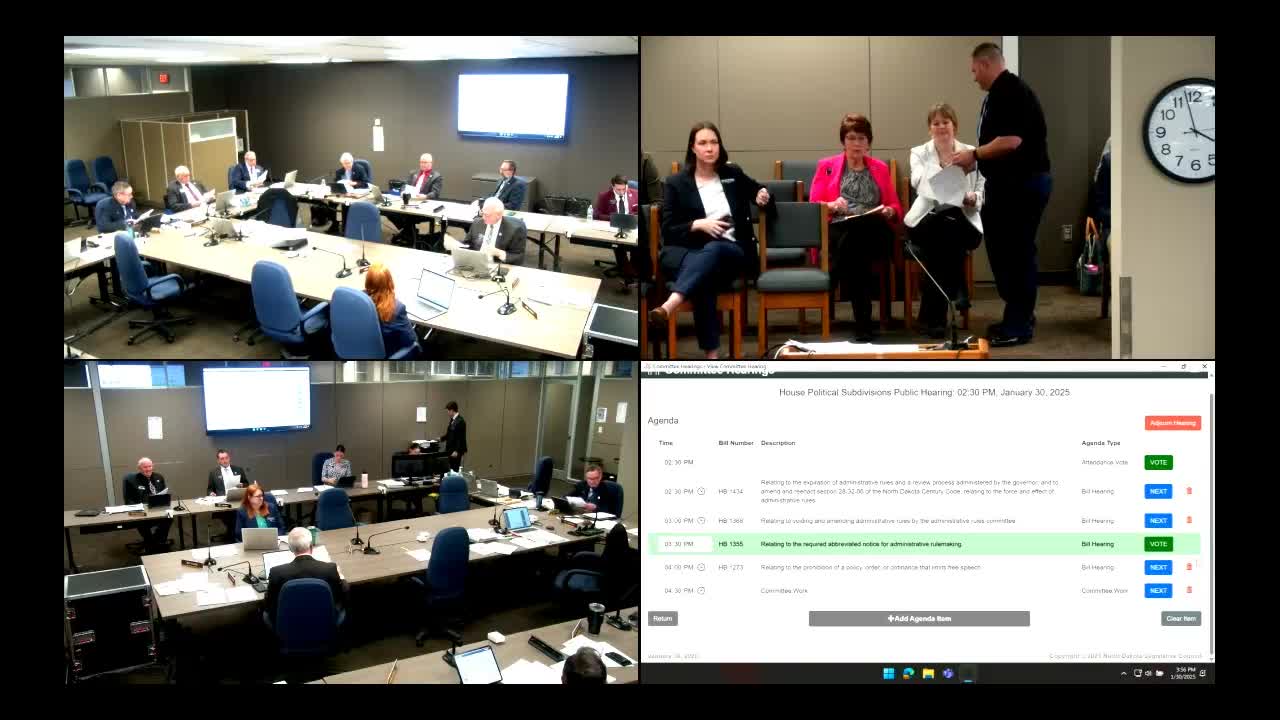
The Political Subdivisions Committee voted to recommend 'do not pass' on House Bill 1273, which would have prohibited the state and political subdivisions from adopting policies that limit or prohibit speech, including hate‑crime ordinances.
Representative Matt Heilman introduced House Bill 1273, a short statute that would bar the state or any political subdivision from adopting a policy, order or ordinance that "limits or prohibits the speech of an individual," language the bill specifically noted could include hate crime ordinances.
Heilman framed the measure as a First Amendment protection. "My intent is to protect the First Amendment and people's speech," he said, and he argued that harassment and other criminal statutes already exist at the state and federal levels.
The committee heard multiple opponents who argued the bill is broader than necessary and would undercut local policy options, workplace rules and protections for vulnerable groups. Sergiano Witsky of the Bismarck Human Relations Committee urged lawmakers to "strike out the words, including hate crime ordinances," saying such ordinances signal that cities prioritize the safety and dignity of residents and citing local incidents and FBI reporting on bias crimes. Carter Gill of the North Dakota Student Association said rescinding hate crime ordinances or similar policies could be read as permission for biased conduct and would harm vulnerable student populations.
Molly Harrington of the Office of Management and Budget testified the bill would "have a negative impact on workplace culture, legal compliance, and organizational effectiveness," and she said existing employer policies that prohibit harassment and discrimination could be invalidated by the bill’s broad language. The North Dakota League of Cities opposed the bill as written, saying it is broader than the First Amendment and could prevent municipalities from adopting time, place and manner rules (for example, limiting the subject matter or time allotted at public comment) and from enforcing content‑neutral sign or conduct regulations. The League also noted that the Fargo ordinance was locally adopted after residents requested it; municipal officials rely on such ordinances to respond to constituent concerns.
Committee members debated legal and policy tradeoffs. Some members said they supported protecting speech but questioned whether the bill's language was overbroad. Others warned that the measure could create an HR problem for public employers and would remove local discretion to adopt enhanced penalties for bias‑motivated crimes. Representative Matt Tholman suggested limiting the measure to speech‑only ordinances rather than ordinances tied to criminal motive, and the sponsor said he would be open to narrowing the bill.
After discussion the committee considered a motion to recommend "do not pass" on House Bill 1273; the motion carried on a roll call vote recorded as 11 yeas, 0 nays, 2 absent (not voting). The committee placed the bill on the consent calendar for floor consideration with a do‑not‑pass recommendation.
Ending: The committee voted a do‑not‑pass recommendation on HB1273 after receiving multiple written and oral objections that it would preempt local policy choices and undermine workplace harassment and discrimination rules.