Get Full Government Meeting Transcripts, Videos, & Alerts Forever!
Get email alerts on the Administrative Rules Review topic
No spam. Unsubscribe anytime.
State agencies urge changes as committee hears bill to time-limit administrative rules
Summary
Lawmakers heard House Bill 1434, which would set expirations and a review process for administrative rules; multiple state agencies and the governor's office testified they lack staff, resources or federal flexibility to implement the bill as written.
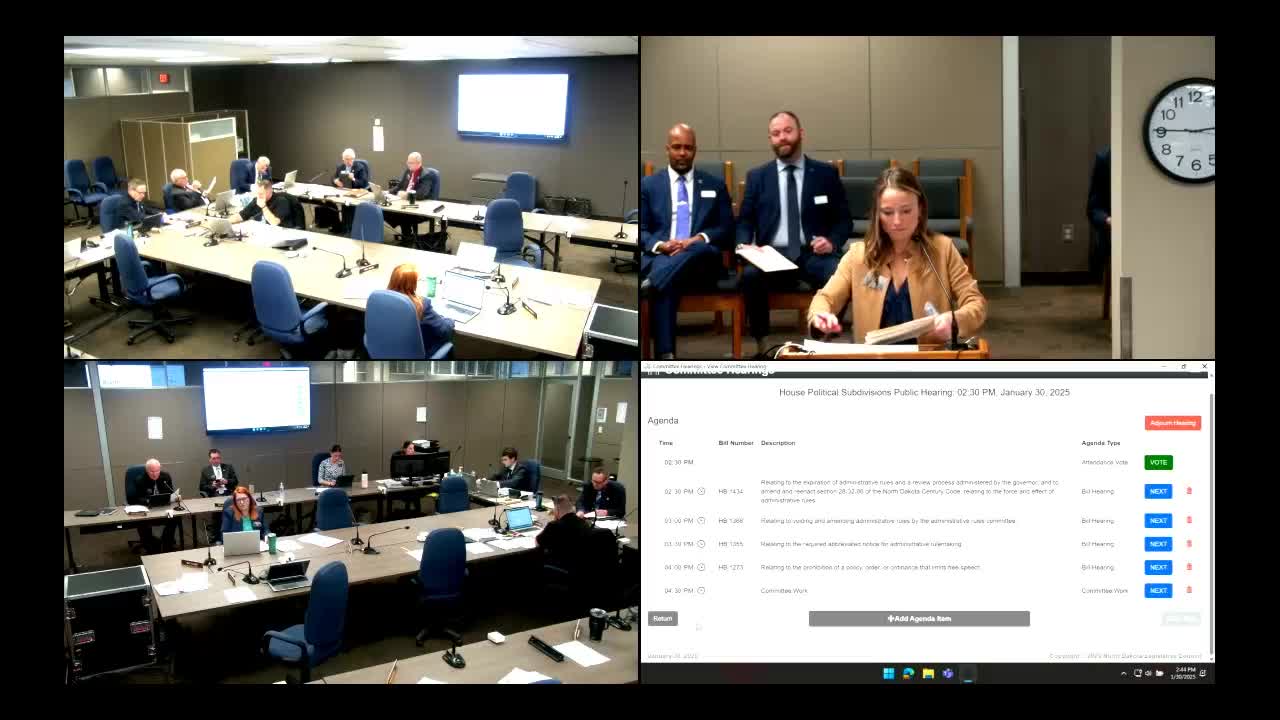
Chairman Longyear convened the House Political Subdivisions Committee to hear House Bill 1434, a bill that would impose expirations on administrative rules and direct a review process tied to the governor's office.
Representative Emily O’Brien, who introduced the measure, said the bill is intended "to improve independent regulatory reviews" and to reduce burdens she described as "layers of red tape" that fall on businesses, workers and citizens. The bill would generally set a 10‑year expiration for a rule after its effective date and require the governor to notify agencies one year before a rule's expiration; the governor could exempt a rule or grant an extension, and agencies would submit reports to facilitate review.
Proponents framed the proposal as a way to remove dated or unused rules, move consistently used rules into statute where appropriate, and reduce internal agency policies that add bureaucracy. O’Brien told the committee she planned to work with the bill’s prime sponsor and with Legislative Counsel to refine process details and address concerns raised by agencies.
Multiple state officials testified in opposition or raised concerns about the bill’s workload and risks. Dustin Oso, boards and commissions manager in the Governor’s Office, said the governor’s office currently has 17 authorized FTEs and "everyone in the governor's office currently has full time duties and responsibilities"; he said his office does not now track administrative rules and that adding the bill’s duties would require additional staffing and funding. Oso said the office currently manages appointment processes for roughly 150 boards and that there are more than 100 state agencies; adding rule review and expiration tracking for that many entities would be a "relatively heavy lift" requiring additional FTEs and budget.
Jonathan Emmer, director of Reclamation and Abandoned Mine Lands at the Public Service Commission, urged an exemption for PSC reclamation rules tied to federal requirements. Emmer noted that North Dakota's coal mining and reclamation primacy under the federal Surface Mining Control and Reclamation Act requires state laws and rules to remain as stringent as federal standards and that proposed rule changes must be reviewed and approved by the federal Office of Surface Mining, Reclamation and Enforcement (OSMRE). He said North Dakota has submitted 37 program amendments to OSMRE since 1982 and that federal review times have ranged from months to years; he warned that allowing state rules to lapse as written could place North Dakota’s primacy — and regulatory oversight of lignite mining — at risk.
Mark Borer, assistant director for the Oil and Gas Division, described operational challenges and costs. He said the Oil and Gas Division administers hundreds of rule sections (he cited 271 sections) and the Geological Survey administers hundreds more (he cited 374 sections); rulemaking is a multi‑step process that can take months and entails staff time and publication costs. Borer gave examples of long inactive regulatory provisions in mineral development (potash, uranium) and said letting rules expire and then recreating them later could "stifle" intermittent industries.
Logan Carpenter, general counsel for the North Dakota Ethics Commission, said the commission is included in the bill as written and "must oppose this bill" in its current form; Carpenter said the commission is working with Representative O’Brien on an amendment to remove the commission or otherwise address the commission’s concerns.
Representative O’Brien and several committee members acknowledged the concerns and discussed alternatives, including housing the review authority outside the governor's office, using Legislative Counsel, or creating a legislative efficiency committee (House Bill 1442 was cited as a possible sister bill). Several lawmakers suggested shortening the 10‑year review interval or providing more targeted exemptions for entities that operate under federal program primacy.
The hearing closed with no final action recorded on House Bill 1434 in the committee transcript. The bill drew significant operational questions about staffing, federal program dependencies (notably SMCRA/30 CFR for mining), and whether the governor's office is the appropriate place to house the review function.
Ending: Committee members asked the sponsor to work with Legislative Counsel, the governor’s office and affected agencies to refine exemptions, staffing needs and the governance of any review process before the measure is brought back for committee action.