Get Full Government Meeting Transcripts, Videos, & Alerts Forever!
Get email alerts on the Courthouse Reuse Housing topic
No spam. Unsubscribe anytime.
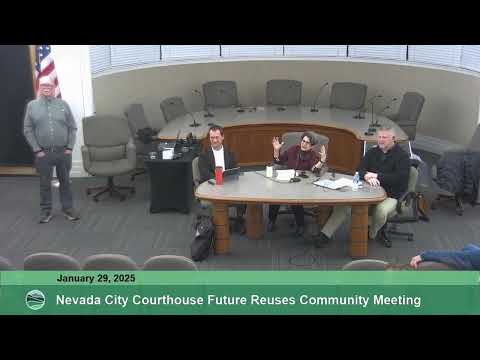
Consultants recommend annex for housing, historic courthouse be stabilized after Nevada County community meeting
Summary
Consultants leading a Nevada County–funded study told a community meeting that the most feasible near‑term option is housing on the annex parcel and stabilizing the historic courthouse while the county negotiates with the state; community speakers urged preservation, parking solutions and local uses.
Consultants leading a Nevada County–funded highest‑and‑best‑use study recommended at a Nevada City community meeting that the parcel occupied by the courthouse annex be pursued for housing while the historic courthouse be stabilized and retained for future community use.
The study team — including architects from Nelson and urban economist Dina Belzer of Strategic Economics — told residents the analysis tested five physical and financial scenarios and that, "on the private side, housing is the highest and best use," based on local market conditions, construction costs and parking constraints, Dina Belzer said.
The study covers two buildings on the site (the courthouse and the annex). Consultants presented a recommended strategy to divide the site: pursue housing development on the annex parcel (potentially market‑rate or affordable and developable by private or nonprofit developers) and preserve or stabilize the courthouse so a future community or institutional reuse can be pursued. "Anything you hear tonight, there is no project here," Mayor Gary Peterson told the meeting; "These are not things that are going to be built. This is not a master plan that's going to be built." He and county staff said the study is meant to inform negotiations with the state and future procurement steps.
Why this matters: the Judicial Council of California owns roughly 51 percent of the site and Nevada County owns about 49 percent, the consultants said; the Judicial Council intends to divest once it relocates, and that transfer likely will occur several years from now. The county and city said the study is intended to give the county negotiating leverage and a path to pursue grants or partnerships to address the expensive work needed to preserve the courthouse.
Key findings and constraints
- Market and feasibility: The consultants tested numerous uses — housing, office, hospitality, institutional, retail, arts and recreation — and concluded private investors are most likely to support housing. The team concluded there was no current institutional buyer or operator with capacity to take on the entire courthouse and annex.
- Physical constraints: The site is steep and underlain by bedrock in places, which raises excavation and underground‑parking costs. Consultants said the courthouse footprint is inefficient for typical housing unit layouts, which makes reusing the courthouse for housing costly. Greg Lehman (architect) and others showed test fits and said parking and steep grades materially limit buildable area.
- Financial model: Consultants presented pro forma tests showing construction costs (modeled at conservative and higher cost scenarios) and revenue assumptions. They assumed a local market parking rate of about one space per bedroom. Officials and the consultants emphasized that high interest rates, inflation and construction‑material volatility have reduced development activity and that many projects nationally are on hold.
- Recommended approach: Divide the site — pursue housing on the annex parcel (either by adaptive reuse or new construction) and stabilize and retain the courthouse for future community, cultural or institutional reuse. Dina Belzer said the courthouse "is so expensive to reuse that it's better to think about how can we reuse this building, really?" The report recommends the county begin negotiating with the state now and pursue stabilization funding, grant opportunities and a community engagement process to identify feasible reuse options.
Community feedback and concerns
Residents and interest groups at the meeting voiced strong preservation sentiment for the courthouse tower and facades, with several speakers urging full preservation and adaptive reuse for community uses (museums, arts, youth programs, market/food uses). Neighborhood representatives asked that any new development on the annex not "march" into adjacent historic neighborhoods or introduce tall structures above Washington Street.
Parking and unit counts drew frequent questions. Consultants said a reuse of the annex could yield roughly 30‑40 housing units; full redevelopment of the entire site could yield more (consultants cited sketches ranging into the high‑30s for the annex alone and up to roughly 70 units across the whole site in higher‑density options), but parking and site slope limit practical unit counts. One consultant reiterated that the county retained the existing surface jury/parking lot for vehicle parking rather than proposing a new structured garage because subsurface work into bedrock and building a structure made pro formas less viable.
Process, ownership and legal constraints
Consultants and county staff described the federal/state/local and procurement context: publicly owned surplus land must be offered first to public agencies and then to qualified nonprofit affordable housing developers under state rules discussed in the meeting (referred to by speakers as the Surplus Lands Act and the California Subdivision/Land Act and processed through the Department of Housing and Community Development). Consultants said this sequence limits the county's unilateral control over sale or transfer, though the courthouse building could be a candidate for an exemption from the Surplus Lands Act if reuse is infeasible — a path the county could pursue to increase flexibility for historic reuse.
Timeline and next steps
Consultants said the Judicial Council is not moving out immediately and that the county has about five years before vacancy, making it timely to use the study to pursue grants, stabilization plans and negotiation strategies. The report will be finalized, presented to the city council as an informational item, and then to the county for consideration; no formal county decision or funding commitment was made at the meeting.
Formal actions
No motions, votes or formal approvals were taken at the community meeting. The consultants and county staff said the study is an informational recommendation to guide future negotiations and procurement steps.
Ending
Speakers asked the county to move cautiously and to secure funding and partners before making irreversible changes. Mayor Gary Peterson closed by thanking participants for their engagement, saying the study was intended to help the county and city "determine what is the best path forward" and to give the community time to weigh options as negotiations with the state proceed.