Get Full Government Meeting Transcripts, Videos, & Alerts Forever!
Get email alerts on the School Traffic Calming topic
No spam. Unsubscribe anytime.
City staff and commissioners outline school traffic‑calming toolkit, delay acknowledged
Summary
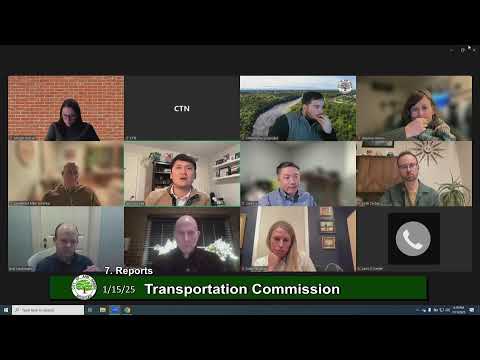
City transportation staff and members of the Transportation Commission spent the Jan. 15 meeting discussing coordination with Ann Arbor Public Schools on signage, capital projects and a school traffic‑calming toolkit that City Council directed staff to produce.
City transportation staff and members of the Transportation Commission spent the bulk of the Jan. 15 meeting discussing coordination with Ann Arbor Public Schools on signage, capital projects and a new school traffic‑calming toolkit that City Council directed staff to produce.
The discussion centered on three topics: ongoing coordination with school staff and Safe Routes to School groups on near‑term signage and operational fixes; coordination on school capital projects that overlap city right of way (for example, Nixon Road and Clague Middle School); and the delayed school traffic‑calming toolkit (Council resolution R‑23330) that staff had been instructed to deliver by Dec. 31, 2024.
Why this matters: Commissioners framed the conversation around safety for students arriving on foot, by bike and by bus, and the city’s limited control over decisions on school property. Commissioners and staff also discussed how funding structures and project timelines affect whether safety measures come as near‑term signage fixes or longer capital changes tied to resurfacing or reconstruction projects.
Cyrus Nihidi, one of the city’s transportation engineers, told the commission that city staff regularly meet with Ann Arbor Public Schools staff, school principals and Safe Routes to School groups to identify field issues and assign responsibility for fixes. “Sometimes this can come out of a Safe Routes to School meeting in the field,” Nihidi said. “Sometimes it is as simple as a request from a school to say, we’d like to establish no parking for this stretch.”
Nihidi described several recent, site‑specific interventions the city and schools have coordinated. On Nixon Road near Clague Middle School, city staff added left‑turn restrictions from a school driveway and installed pedestrian gateways at a nearby crosswalk after observing queuing that had spilled into the public right of way. He said Nixon Road will undergo reconstruction over the next one to two years, overlapping with school property work at Clague and the Logan School relocation, which requires close coordination between the city and school designers.
Nihidi also described a planned realignment at the Scarlett‑Mitchell area (Fernwood and Lorraine) that will convert a three‑leg offset into a four‑way intersection and retain a raised intersection and traffic calming on Fernwood. He said that is an example of the “high‑end” coordination when both city and school construction affect public right of way.
On the school traffic‑calming toolkit, Nihidi referenced City Council resolution R‑23330 and said staff missed the council’s Dec. 31, 2024 target. “The relevant result clause is here on the screen and says, city council directs the city administrator and staff to develop school traffic calming toolkit by December 31, 2024,” he said. “So we are behind. We are working through that and we've done a fair amount of work internally and with the schools.”
Commissioners pressed staff on tactics to reduce single‑vehicle drop‑off trips and whether changes to school bus eligibility (the “bus radius”) could shift travel behavior. Commissioner Dharma, drawing on long experience with Safe Routes to School, urged more nuanced engagement with parents and school administrators to address barriers to bus use. Commissioner Eric said he expects the Nixon Road capital project will “be a huge benefit for a lot of the people that use the corridor, both with cars and outside of cars.”
Staff outlined two related strategies for delivering the toolkit and its outcomes: (1) incorporate priority school safety elements into city capital projects where work is already scheduled (resurfacing, reconstruction or utility work), and (2) proactively prepare walking maps and candidate improvement lists for all schools rather than relying only on individual schools or parent groups to request them. Nihidi said staff piloted the mapping approach for two schools and believes staff can produce similar draft maps citywide within a year so schools have a staff‑prepared starting point for review.
Commissioners asked about limits to using capital funding for school safety. Nihidi said there is no dedicated new funding tied to the council resolution; most opportunities will depend on the scope and timing of existing capital projects (for example, resurfacing projects typically focus on pavement and may not include deep horizontal changes such as bump‑outs). He also noted operational limits: adding traffic calming can be constrained by project scope and by whether a given capital program (for example, capital preventive maintenance) allows the necessary work.
Multiple commissioners urged staff to use the mapping exercise to flag locations where bus service should be considered and to provide guidance to schools about “where it is or is not safe” for children to walk across major streets. Commissioner Pete recommended staff solicit clarification from the school district on how bond funding is used versus operational dollars for bus service, noting that bonds can build infrastructure but do not generally cover ongoing bus operations.
Next steps and direction: Staff said they will bring the toolkit and the mapping approach to the traffic calming subcommittee first, then return to the Transportation Commission and, later, to City Council. The commission did not take a formal vote on any policy or funding change; members directed staff to continue the work, produce maps for schools, and coordinate the toolkit development with the traffic calming subcommittee.
Quotes in context: All direct quotations in this story are from the transcription of the commission meeting; quotes used here are attributed to speakers who addressed the school coordination and toolkit topics during the Jan. 15 meeting.
Ending: Staff committed to return with a more detailed timeline and draft materials to the traffic‑calming subcommittee before bringing a fuller proposal back to the commission. Commissioners said they expect the toolkit to be a tool to help ensure schools without active parent groups receive the same level of attention as those with organized Safe Routes to School programs.