Get Full Government Meeting Transcripts, Videos, & Alerts Forever!
Get email alerts on the Charter Governance topic
No spam. Unsubscribe anytime.
Lansing council president urges 9 wards, pay oversight and ban on sole-source contracts during charter review
Summary
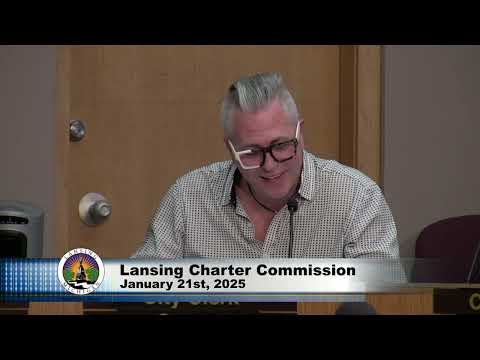
City Council President Ryan Cost and Councilmember Adam Hussain told the Lansing Charter Commission on Jan. 21 they favor replacing at-large seats with nine wards, adding council staff and auditors, and giving council more oversight of department-head pay and large contracts.
City Council President Ryan Cost and Councilmember Adam Hussain urged the Lansing Charter Commission on Jan. 21 to rewrite parts of the city charter to increase neighborhood representation, add legislative staff and auditors, and give the council more oversight over department-head pay and certain contracts.
Cost told the commission that he wants the charter rewritten to eliminate at-large council seats and expand wards to nine, saying smaller wards would make elected members more accountable to neighbors. “If you break up those 4 at large and you make them take away the 4 at large, add 5 more wards, you split that city up, that money, that influence,” Cost said, arguing smaller wards reduce the role of campaign spending in elections.
Why it matters: Charter language determines how Lansing elects council members, who confirms department heads and how much local transparency residents can expect. Cost and Hussain said changes could reduce concentration of influence and improve constituent service.
Details of proposals and examples cited
- Ward map and size: Both presenters backed nine single-member wards in place of at-large seats, saying smaller wards (roughly under 10,000 residents each in their estimate) would increase direct accountability and diversify representation.
- Council staffing: Cost urged creating a permanent legislative analyst position for council and backing minimum full-time equivalent (FTE) staffing so council work continues if staff leave. He and Hussain said council currently struggles when staff posts go unfilled.
- Internal audit: Both recommended strengthening the internal-auditor function. Cost said the city should plan for at least a second or third internal auditor; Hussain proposed “not less than three” qualified internal-audit staff to ensure annual coverage and compliance reviews, including Board of Water & Light oversight.
- Department-head pay and confirmations: Cost proposed that council have at least an up-or-down confirmation role for department heads and authority to review substantial annual pay raises for political appointees. He argued council should be able to review or vote on raises for transparency and accountability.
- City attorney and outside counsel: Both speakers said the current arrangement — in which the mayor hires and can remove the city attorney — creates a perception problem. Cost suggested council should have the power, by a qualified supermajority, to remove a city attorney for cause and be able to seek outside counsel without administrative obstruction.
- Contracts and procurement: Cost proposed changing charter procurement language from “lowest responsible bidder” to “best overall bid” and banning or severely restricting sole-source contracts. He also urged that any city contract above $50,000 come to council for review.
- Compensation structure: Cost and Hussain proposed a base pay plus per-diem model to tie pay to attendance. They cited examples: county base pay at about $10,800 and a commonly used per-meeting rate (Cost referenced $75 per meeting capped at $6,000 in county practice). Cost also mentioned current council pay roughly $28,000 and noted the city’s newly hired deputy mayor salary at about $180,000 as evidence funds exist for staffing.
Quotes from council leadership
“We should be able to talk about this openly. We should be proud of the work that's done within our departments,” Cost said, urging confirmation and pay-review processes. “I would ban sole sources,” he added.
Hussain said the council needs “an odd number” of members to avoid repeated 4–4 deadlocks and supported the per-diem approach to increase attendance and accountability. “We had a very real, knock down, drag out brawl in 2017 over leadership, and it was embarrassing,” Hussain said, arguing that staggered elections and an odd-numbered council reduce disruption.
Public comment and background
Two members of the public spoke before the presentations. Nicholas Zandy urged an elected city attorney and elimination of at-large seats, and Randy Leckheis (listed as a 4th Ward resident) asked the commission to fold the Board of Water & Light’s internal-audit function into the city auditor or require stronger independent oversight.
What’s next
Commissioners said they will weigh the council leaders’ recommendations while continuing line-by-line review of charter articles at upcoming meetings. Several commissioners asked for more detail on costs, staffing language and legal limits tied to state law.
Ending: Cost and Hussain told the commission they would be available for follow-up questions and to share sample language and examples from other Michigan charters.