Get Full Government Meeting Transcripts, Videos, & Alerts Forever!
Get email alerts on the Zoning Places Of Assembly topic
No spam. Unsubscribe anytime.
Council advances first reading on new "places of assembly" rules and licensing, sets uniform closing hours
Summary
Pontiac moved forward on Jan. 21 with updated zoning and a new municipal licensing ordinance for "places of assembly," approving first reading measures that set uniform hours (7 a.m. to 2 a.m.), outline insurance and local-contact requirements, and establish revocation rules for repeat nuisance violations.
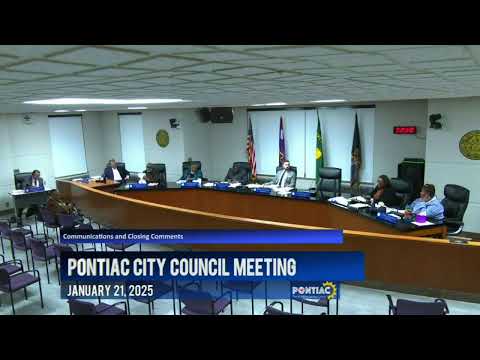
The Pontiac City Council took first-reading action on a pair of measures on Jan. 21: a zoning-text amendment that updates where "places of assembly" may locate and a companion municipal ordinance establishing a new annual license and operating rules for those venues. Council amended the proposals during debate to set consistent closing hours of 2 a.m. across all districts where places of assembly are permitted, and it added a companion municipal licensing framework that would impose a three-strike revocation process for documented nuisance violations.
What the changes do: The zoning amendment clarifies permitted and special-exception districts for venues defined as "places of assembly" (use thresholds and district-by-district permissions were updated; larger venues remain restricted to more intensive commercial or industrial districts unless the planning commission grants a special-exception). The municipal ordinance creates an annual place-of-assembly license with required insurance (general liability for at least $2 million aggregate and $1 million per occurrence), contact information for a local on-call representative and a process to revoke licenses after repeated, court-substantiated nuisance violations.
Hours and enforcement: Council members debated and ultimately set consistent hours (7 a.m. to 2 a.m.) for places of assembly citywide, eliminating the prior downtown vs. non-downtown discrepancy. The municipal ordinance covers licensing, penalties and compliance processes while exempting certain uses from the new license (religious institutions, schools, private clubs, restaurants and other specified uses). The ordinance also allows the city to impose fees and penalties and to require insurance and designated on-site or on-call responsible parties.
Why councils moved: Members said the update addresses a proliferation of unpermitted or poorly regulated event spaces and aims to balance neighborhood impacts (noise, after-hours activity) with the economic benefits of reuse and activated commercial corridors.
Next steps: The zoning and municipal ordinance were advanced on first reading as amended and will return for subsequent readings. Staff agreed to clarify ambiguous language about lighting and window-facing string lights (in a separate LED-light zoning amendment) and refine definitions to ensure the ordinance does not inadvertently capture exempt uses.