Get Full Government Meeting Transcripts, Videos, & Alerts Forever!
Get email alerts on the Reentry Services topic
No spam. Unsubscribe anytime.
Reentry providers say cuts have deepened housing and services gaps as demand rises
Summary
The D.C. Reentry Action Network and returning‑citizen providers told the committee that OVSJG funding for reentry services has fallen since 2022 even as demand grows; witnesses asked the council to restore cuts and prioritize housing, employment and mental‑health supports for people leaving incarceration.
Leaders of the D.C. Reentry Action Network (RAN) and reentry service providers told the Committee on the Judiciary and Public Safety that funding for returning‑citizen programs has declined while demand has grown, leaving organizations unable to meet needs for housing, employment, and mental‑health services.
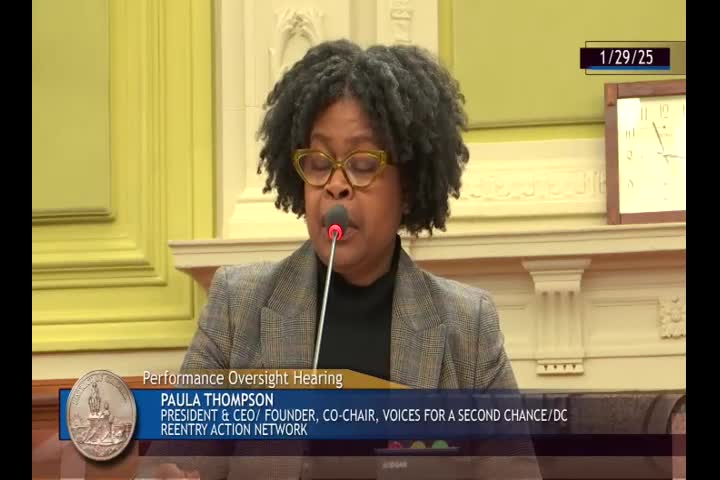
At the Jan. 29 hearing, Paula Thompson, president and CEO of Voices for a Second Chance and co‑chair of RAN, told the committee that since 2022 OVSJG funding for reentry services had been cut roughly 26 percent — a reduction parties described as more than $6.3 million — and that administrative spending increased over the same period. Thompson said OVSJG served 7,200 returning citizens through supported reentry programs in 2024, up from 794 in 2020, and argued per‑capita support has fallen.
Providers cited housing instability as a principal constraint: reentry programs expanded housing assistance in 2022–2023 as ARPA funds flowed but saw housing services decline in 2024 as that one‑time funding ended. Witnesses said that without housing and wraparound supports, returning residents face steep barriers to employment and are at higher risk of recidivism.
Reentry leaders asked the committee and the mayor’s office to restore and expand local funding for reentry services and to consider braided funding strategies that preserve ongoing staffing and flexible client assistance. They told the committee that reentry organizations, many led by people of color, carry high caseloads and cannot absorb further cuts without reducing service availability.
OVSJG Director Jennifer Porter acknowledged the shrinking ARPA share and said the office tries to allocate stable local and federal grants and to support grantees with technical assistance to build capacity. The director and reentry witnesses agreed further collaboration is needed on housing, transportation and employment supports.
Ending: RAN and partner organizations urged the council to restore reentry funding and to prioritize housing, employment, and mental‑health supports for returning citizens as demand increases.