Get Full Government Meeting Transcripts, Videos, & Alerts Forever!
Get email alerts on the Substance Use Treatment topic
No spam. Unsubscribe anytime.
Planning commission approves rehabilitation clinic at 673 Martin Luther King Jr. Blvd., adds facade and buffer conditions
Summary
The commission approved a special-exception permit and preliminary site plan for a substance use rehabilitation clinic at 673 MLK Jr. Blvd., requiring a Type A buffer where the site meets residences and improvements to the front façade; vote was 5-1 on the special-exception permit and site plan approved by voice.
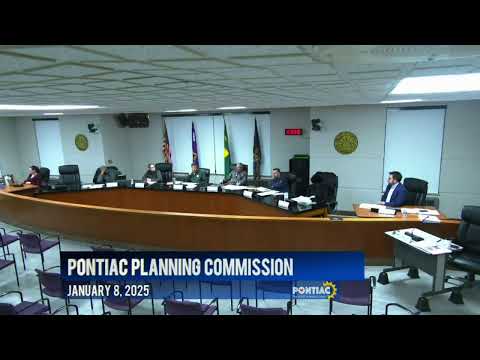
The Pontiac Planning Commission voted Jan. 8 to approve a special-exception permit and preliminary site plan that will allow an opioid medication‑assisted treatment and recovery clinic to operate at 673 Martin Luther King Jr. Boulevard.
Staff described the application as a reuse of an existing medical clinic building for outpatient substance use disorder treatment that includes medication‑assisted treatment (MAT), counseling, case management, peer support, urine drug screening and telehealth services. Corey Christiansen, senior planner, told the commission the proposal meets the city’s land‑use standards for a community service facility in the C‑1 district but that staff recommended three conditions to address buffering and streetfront appearance.
The applicant team — which said it has state licensing and federal registrations — described a program model combining clinical services with peer recovery support and community outreach. An applicant identified as Fahad said the organization has worked in post‑acute care for 17 years and that the site will provide telehealth devices, case navigation and connections to employment and housing resources. Peer recovery coach Maria Carroll said the clinic will offer bilingual outreach and work with local churches, shelters and community partners.
Public comment included both support and concern. Several speakers urged caution about location and neighborhood impacts; others, including social‑services leaders, supported the clinic as a locally available recovery resource. Robert Bass, a neighborhood leader, said community engagement and measurable accountability were essential. Several commissioners asked about security, hours and parking; staff said parking capacity and access had been staffed reviewed and found sufficient for the proposed use.
The commission approved the special‑exception permit, 5‑1, with conditions that require an awning and at least one full window on the Martin Luther King frontage, screening for the utility meter and that the site provide a Type A landscape buffer where the property abuts residential land. The commission specified 25% transparency (a compromise between existing building transparency and the 40% standard for new construction) for the front façade and allowed the utility screening to use fixed protective bollards if the measure complies with city right‑of‑way rules. Vote on the motion recorded in the meeting minutes: Commissioner McGinnis — yes; Commissioner Shepherd — no; Commissioners Sinclair, Duvall, Henley and Northcross — yes; motion passed.
The commission also approved the associated preliminary site plan with four staff conditions: revise plans to add required missing informational items; provide at least one bicycle parking space; extend a vegetative Type A buffer across the rear property line where adjacent to residences; and honor the special‑exception permit conditions. The site‑plan approval was taken by voice vote after the special‑exception motion was amended to specify 25% transparency and screening bollards where allowable.
What this means: The approvals allow the applicant to move toward final site‑plan review and building/operational licensing. City staff and the applicant said additional details — including final photometrics, final landscaping plans and operational hours — will be resolved in the final site‑plan and licensing steps. The applicant said the clinic will coordinate with Oakland County health partners and community organizations for referrals and wraparound services.
Authorities referenced in discussion included federal SAMHSA guidance, DEA registration for controlled substances, Joint Commission accreditation and state licensing for addiction treatment. The commission’s conditions add municipal requirements for buffering and façade improvements before the clinic opens.