Get Full Government Meeting Transcripts, Videos, & Alerts Forever!
Get email alerts on the Domestic Violence Housing topic
No spam. Unsubscribe anytime.
Domestic‑violence housing providers warn federal freeze would close services; call for local baseline funding
Summary
Domestic‑violence service providers told the council that a recent federal order briefly threatening grant payments — later paused by a federal judge — underscored the need for stable city funding to keep shelters and survivor programs operating.
Domestic‑violence service providers told the Committee on the Judiciary and Public Safety that gaps in stable local funding would force lifesaving shelters and survivor programs to reduce services or close if federal grants were paused.
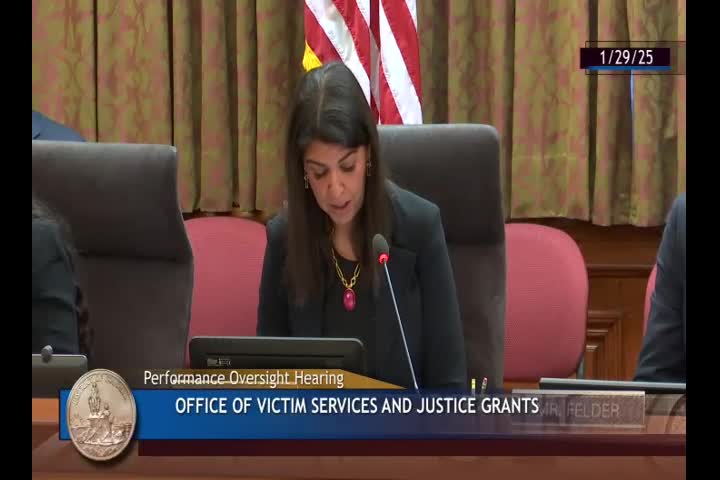
At the Jan. 29 oversight hearing on the Office of Victim Services and Justice Grants (OVSJG), witnesses from the District Alliance for Safe Housing (DASH), DC Safe, the D.C. Coalition Against Domestic Violence (DCCADV) and other members of the Victim Assistance Network (VAN) described how OVSJG‑funded housing programs support survivors at immediate and longer‑term stages of recovery.
DASH described two OVSJG‑supported housing programs: Cornerstone (emergency housing) and the Empowerment Project (a scattered‑site transitional housing program). DASH said its programs prevented housing instability for 305 people in FY24, and it reported that OVSJG funds supported more than 44,000 safe‑nights and 194 adults and children across DASH housing projects. DASH described a survivor case it called “Monique” who moved from emergency shelter to a permanent unit with DASH relocation and stabilization support.
DC Safe said it operates a 24‑7 crisis intervention line and is the only around‑the‑clock domestic‑violence crisis responder in the district; the organization told the committee it served more than 12,000 survivors in 2024 and that OVSJG awarded it roughly $4.5 million — about half of DC Safe’s annual budget — in FY24. Several witnesses emphasized that housing, relocation assistance and case management are key to survivors’ safety and ability to rebuild lives.
Witnesses raised alarm about a Presidential memorandum instructing a temporary freeze on some federal grants; Chair Brooke Pinto and witnesses said a federal judge issued a temporary stay that paused enforcement but left grantees deeply unsettled. DCCADV and other providers urged the council and the mayor’s office to plan for contingencies and provide local assurances so programs could continue during federal uncertainty.
Members of the Victim Assistance Network testified that their FY26 budget request asks for $82,130,000 for victim services, including a $59,410,000 recurring baseline and $22,720,000 for new or expanded programs. Providers asked for more transparency in OVSJG’s budget allocations so grantees and the council can understand how the office plans to allocate funds year to year, particularly if federal dollars become restricted.
Witnesses described programmatic details and costs: DC Safe said the agency had 54 staff and that hotel relocation costs for a single adult average roughly $2,000 per month because of local rents; DASH and others asked the council to consider the true operating cost of shelters when setting baseline funding. Several witnesses also emphasized the confidentiality needs of domestic‑violence services and asked for continued support for trauma‑informed, culturally competent programs.
OVSJG Director Jennifer Porter described FY24 awards and reaffirmed the agency’s role in making multi‑year federal awards and administering local victim‑service grants; she also highlighted OVSJG’s efforts to improve grant management, monitoring and training for grantees.
Ending: Domestic‑violence providers asked the council for baseline, recurrent funding and contingency plans to protect services from federal funding shocks; they requested clearer OVSJG budget reporting and collaboration with city leadership to shore up housing and crisis services for survivors.