Lifetime Citizen Portal Access — AI Briefings, Alerts & Unlimited Follows
Access to Justice grantees tell council legal aid demand remains high, call for sustained funding
Loading...
Summary
Nonprofit legal providers told the Committee on the Judiciary and Public Safety that demand for civil legal services has remained high since the pandemic and that Access to Justice Initiative funding is essential to prevent evictions, preserve housing and help residents retain benefits.
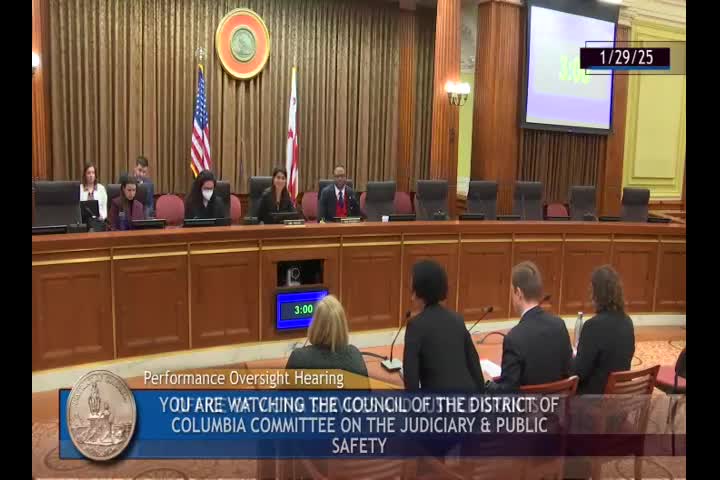
Access to Justice Initiative grantees told the Committee on the Judiciary and Public Safety on Jan. 29 that civil legal services demand in Washington, D.C., has not subsided since the pandemic and that continued funding through the Office of Victim Services and Justice Grants (OVSJG) is needed to keep low‑income residents housed and connected to benefits.
Speakers from the D.C. Access to Justice Commission, DC Bar Foundation, Legal Aid, Legal Counsel for the Elderly and others described programs funded through the initiative that aim to prevent evictions, assist tenants and homeowners, provide family‑law representation and support probate and benefits work for seniors and caregivers.
Witnesses said early FY24 data and recent program reports show increased caseloads and positive client outcomes. The DC Bar Foundation said its Civil Legal Counsel Projects partners closed 2,241 cases from January through June 2024, a 30 percent increase from the same period in 2023, and that represented tenants retained possession in roughly 76–81 percent of landlord‑tenant matters and 89–92 percent of voucher‑termination cases when represented. The foundation and other witnesses also described the planned DC Resource Bridge, a coordinated intake and referral system expected to fully launch in FY25.
Legal Aid DC and the Landlord Tenant Legal Assistance Network (LT LAN) described a single intake hotline and courthouse staffing that collectively routed thousands of low‑income residents for services; LT LAN organizations handled nearly 3,500 residents last year, the witnesses said. Legal Counsel for the Elderly reported that an $123,000 Access to Justice investment in a probate project yielded roughly $2.4 million in benefits for older residents, citing that as evidence of program leverage.
Speakers also emphasized language access. Ayuda's Community Legal Interpreter Bank (CLIP) and the Victim Service Interpreter Bank (VISIB) provide in‑person and telephonic interpreters and translated documents for courts, clinics and victim service providers; CLIP reported nearly 500 in‑person interpretings and more than 7,000 on‑demand telephonic interpretation events in FY24, while VISIB reported 302 in‑person events and 2,126 telephonic instances in FY24.
Committee members pressed witnesses and OVSJG staff about whether service types have shifted; legal providers agreed housing remains the largest funding focus (about 52–55 percent of funding in the ATJ and CLCPP budgets, witnesses said), while family law, probate and public‑benefit assistance also show growing demand. Providers told the committee that digital barriers and the end of emergency rental assistance programs have increased reliance on legal services.
Witnesses requested predictable baseline funding and coordination so providers can staff intake, court representation, social‑work support and outreach. They described partnerships that send tenant‑empowerment specialists into communities to canvass and get people to court, and emphasized that legal representation both preserves housing and conserves government resources by reducing emergency care and other downstream costs.
The committee heard detailed, personal examples — from foreclosure prevention to probate help and assistance recovering from identity theft — that witnesses said illustrate how the initiative stabilizes families and keeps people housed.
OVSJG Director Jennifer Porter acknowledged the role of ATJ grantees and said the office intends to maintain that portfolio as a priority; she described OVSJG’s peer‑review process, technical assistance and efforts to make grant applications more accessible through trainings and grief‑reduction of administrative hurdles.
The hearing record contains written reports and data cited by witnesses; committee members asked OVSJG and grantees to supply additional performance metrics and to continue work on the coordinated intake platform.
Ending: Witnesses urged the council to sustain and stabilize Access to Justice funding so civil legal providers can meet growing, persistent demand — particularly for eviction defense, family law and probate assistance — and to expand language‑access supports for non‑English speakers and deaf residents.